The LTV to CAC ratio compares how much gross profit a customer brings in over the whole relationship with what you spent to win that customer. Most guides throw a 3:1 benchmark at you and then mix up formulas, so this one uses a single example business from start to finish. You will see three ways to calculate it, how payback period changes the picture, and what to fix when the number comes in low.
Table of Contents
What the LTV to CAC Ratio Tells You
Two numbers sit behind every growth decision. Customer lifetime value (LTV) is what an average customer is worth to you over the full time they keep buying. Customer acquisition cost (CAC) is what it costs, on average, to win one new customer.
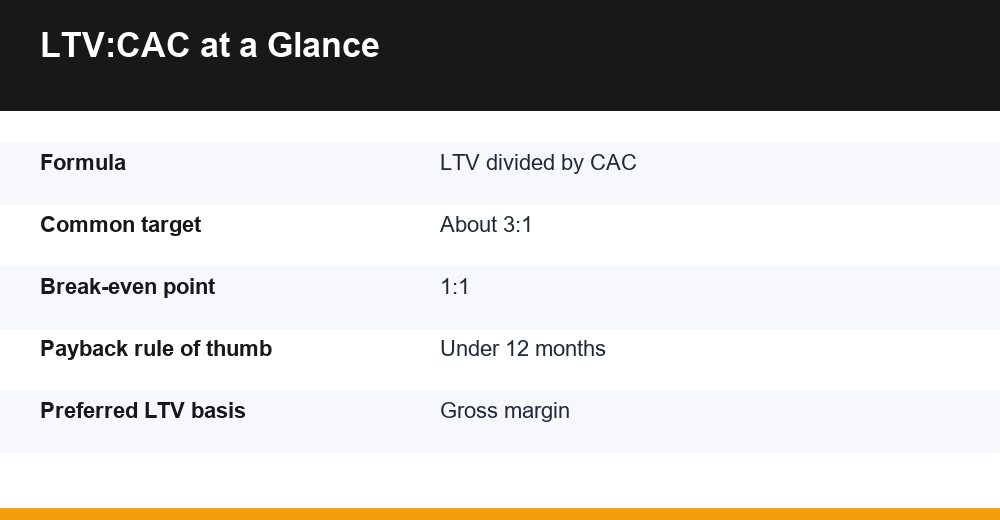
Divide the first by the second and you get the ratio. A result of 3:1 means each dollar spent on acquisition comes back as roughly three dollars of lifetime value. A result of 0.8:1 means you are buying customers at a loss.
The metric matters because it answers a question revenue alone cannot: is growth creating value, or just burning cash faster? A company can double sales while destroying money if every new customer costs more than they will ever return.
- Founders use it to decide how hard to push marketing spend.
- Investors use it as a quick screen for unit economics.
- Marketing teams use it to compare channels, since each channel has its own CAC.
It is a unit-economics metric, not a profit-and-loss statement. It ignores rent, salaries outside sales and marketing, and other overhead. That limitation is exactly why the usual benchmark sits well above 1:1.
How Do You Calculate LTV and CAC?
Start with CAC, because it is the half people most often underestimate. The basic method is the same everywhere: add up all acquisition costs for a period, then divide by the number of new customers gained in that same period.
Count indirect costs such as staff time and software, not only ad spend. A CAC built only from ad invoices flatters the result. These figures also belong in the financial projections section of a lender-ready plan; the SBA’s guide on how to write your business plan covers what that section should contain.
What belongs in CAC
- Paid advertising and sponsored placements
- Salaries, commissions and contractor fees for sales and marketing
- Marketing and sales software (CRM, email, analytics)
- Content production, events, trade shows and agency retainers
- Free trials or onboarding costs you incur before a customer pays
What belongs in LTV
LTV needs three inputs: average revenue per customer per period, the gross margin on that revenue, and how long customers stay. For subscriptions, lifespan is usually estimated as 1 divided by the churn rate. If 4% of customers cancel each month, the average customer stays about 25 months.
For businesses without subscriptions, replace churn with purchase behavior: average order value, how many times a customer buys per year, and how many years they keep coming back. Your own order history is the best source for these figures.
3 Easy Formulas With One Worked Example
To keep the math honest, every formula below uses the same example: a small B2B service charging $100 per month, with a 75% gross margin, 4% monthly churn and a CAC of $600.
Formula 1: Revenue-based LTV
LTV = average monthly revenue per customer / monthly churn rate. Here that is $100 / 0.04 = $2,500. Divided by a $600 CAC, the ratio is about 4.2:1. It is the quickest version and the most optimistic one.
Formula 2: Gross-margin LTV
LTV = (average monthly revenue x gross margin) / monthly churn rate. That gives ($100 x 0.75) / 0.04 = $1,875. Against the same $600 CAC, the ratio drops to about 3.1:1. Same business, very different story.
Formula 3: Purchase-based LTV for non-subscription businesses
LTV = average order value x purchases per year x customer lifespan in years x gross margin. If our example customer placed a $100 order 12 times a year for about 2.08 years at a 75% margin, LTV = $100 x 12 x 2.08 x 0.75 = roughly $1,875, the same as Formula 2. This version suits retailers, agencies and service firms that bill per job.
| Formula | LTV | CAC | Ratio | Best for |
|---|---|---|---|---|
| 1. Revenue-based | $2,500 | $600 | ~4.2:1 | Quick sanity check only |
| 2. Gross-margin | $1,875 | $600 | ~3.1:1 | Subscriptions, SaaS, memberships |
| 3. Purchase-based | ~$1,875 | $600 | ~3.1:1 | Retail, e-commerce, project work |
Notice that Formulas 2 and 3 agree once the inputs describe the same behavior. The real gap is between revenue and margin, which is where most published advice quietly diverges.
Should LTV Use Revenue or Gross Margin?
Use gross margin. CAC is paid in real cash, so the value it is compared against should also be cash you actually keep after delivering the product. Revenue includes money that immediately goes back out as hosting, materials, payment fees, support staff or shipping.
The difference grows as margins shrink. A software company with 85% gross margin sees only a modest gap between the two methods. A product business with 35% margin sees its LTV cut by nearly two thirds.
| Gross margin | Revenue LTV | Margin LTV | Ratio at $600 CAC |
|---|---|---|---|
| 85% | $2,500 | $2,125 | ~3.5:1 |
| 75% | $2,500 | $1,875 | ~3.1:1 |
| 50% | $2,500 | $1,250 | ~2.1:1 |
| 35% | $2,500 | $875 | ~1.5:1 |
All rows assume $100 per month and 4% monthly churn. A revenue-based calculation would show 4.2:1 in every case, which hides the fact that the low-margin business is barely covering its acquisition spend.
If you see a benchmark, check which definition sits behind it. Comparing your revenue-based figure with someone else’s margin-based target is the most common way founders convince themselves they are healthier than they are.
A conservative extra check
Simple churn formulas assume customers can stay indefinitely. Some operators cap lifetime at 24 or 36 months to avoid counting value that may never arrive. With a 24-month cap, our example’s margin LTV falls to roughly $1,170, and the ratio to about 2:1. Treat that as a stress test, not your headline number.
What Is a Good LTV to CAC Ratio?
The widely repeated target is about 3:1, a rule of thumb popularized by SaaS investors that has spread to other industries. It leaves room to cover overhead and still earn a profit. It is a starting point, not a law.
| Ratio | What it usually signals | Typical response |
|---|---|---|
| Below 1:1 | Each new customer loses money | Pause or cut spend, fix economics |
| 1:1 to 2:1 | Thin; overhead likely not covered | Lower CAC, raise margin or retention |
| About 3:1 | Commonly cited healthy zone | Scale carefully, watch payback |
| 4:1 to 5:1 | Strong unit economics | Test more spend on best channels |
| Well above 5:1 | Possibly under-investing in growth | Consider faster acquisition |
Context changes the target. A business with long contracts and predictable renewals can live with a lower ratio. A business with volatile demand, thin cash reserves or a long sales cycle should aim higher.
A very high ratio is not automatically good news. If competitors are taking market share while you hold a 7:1 ratio, you may be leaving growth on the table by spending too little.
What a Ratio of 1:1 Really Means
An LTV to CAC ratio of 1 means a customer is worth exactly what you paid to acquire them. What that implies depends on the formula you used.
- Gross-margin LTV at 1:1: you recover acquisition cost and nothing more. Rent, admin salaries, product development and every other overhead remain unfunded, so the business loses money overall.
- Revenue-based LTV at 1:1: the situation is worse. After delivery costs, you never earn back what you spent to win the customer.
- Either way: growth makes losses bigger, not smaller.
In our example, a 1:1 margin-based ratio would mean CAC had climbed to $1,875. At that level, the company would wait the full average customer lifetime of about 25 months just to break even on each acquisition.
A 1:1 reading is not always a death sentence for a brand-new channel or product launch, where early CAC is high and data is thin. It is a signal to stop scaling that channel until the numbers improve.
CAC Payback Period: The Cash Check
The ratio tells you whether a customer is profitable eventually. CAC payback period tells you how long your cash is tied up before that happens. A 5:1 ratio with a 36-month payback can still starve a small business of cash.
Payback in months = CAC / (monthly revenue per customer x gross margin). For our example: $600 / ($100 x 0.75) = 8 months. Using revenue instead would suggest 6 months, which again overstates the position.
| CAC | Monthly gross profit | Payback | Margin LTV:CAC |
|---|---|---|---|
| $400 | $75 | ~5.3 months | ~4.7:1 |
| $600 | $75 | 8 months | ~3.1:1 |
| $900 | $75 | 12 months | ~2.1:1 |
| $1,200 | $75 | 16 months | ~1.6:1 |
A frequently cited guideline is payback under 12 months. Bootstrapped firms often need it far shorter, because every new customer is financed from the bank balance rather than investor money. If payback is long, map it against your cash flow management plan before increasing spend.
Upfront annual billing changes the math dramatically. A customer who prepays 12 months at $1,200 returns the $600 CAC on day one, even though the LTV and the ratio are unchanged.
How Can a Small Business Improve Its Ratio?
There are only three levers: lower CAC, raise revenue or margin per customer, and keep customers longer. Small businesses usually get the fastest results from retention, because it improves LTV without new spend.
Lower acquisition cost
- Cut or pause channels whose own ratio is below 1:1, even if blended numbers look fine.
- Build referral programs; referred customers often cost less to win.
- Invest in channels that compound, such as search content, partnerships and email lists. Our guide on how to get customers covers low-cost options.
- Improve conversion on your site and sales calls so the same spend produces more customers.
Raise value per customer
- Review pricing. Many small firms underprice, and a modest increase may cost few customers. See how to price a product for a structured approach.
- Add higher tiers, bundles or add-ons for customers who need more.
- Reduce delivery costs to lift gross margin, which feeds straight into margin-based LTV.
Keep customers longer
- Fix onboarding, the stage where many cancellations start.
- Talk to customers who leave and act on repeat reasons.
- Offer annual plans with a fair discount to reduce churn and speed up payback.
In our example, cutting monthly churn from 4% to 3% lifts margin LTV from $1,875 to $2,500, and the ratio from about 3.1:1 to about 4.2:1, without touching CAC.
Common Calculation Mistakes
Most bad readings come from inconsistent inputs rather than bad arithmetic. Check these before you share the number with a lender, partner or investor.
- Revenue LTV against full CAC: mixing a generous numerator with a strict denominator, or the reverse.
- Ad-only CAC: leaving out salaries, tools and agency fees.
- Counting organic customers: dividing paid spend by all new customers, including word-of-mouth signups, which shrinks CAC artificially.
- Blended averages only: one great channel can hide two losing ones; calculate per channel too.
- Too little history: a churn rate from three months of data on a few dozen customers is a guess. Label early figures as approximate.
- Ignoring payback: a healthy ratio with a long payback can still cause a cash crunch.
Recalculate quarterly. Prices, churn and ad costs move, and a figure from last year can be badly out of date.
Frequently Asked Questions
How do you calculate the LTV to CAC ratio?
Calculate customer lifetime value, ideally as average monthly revenue times gross margin divided by monthly churn, then divide it by customer acquisition cost. CAC is total sales and marketing spend for a period divided by new customers won in that period. A $1,875 LTV and $600 CAC give a ratio of about 3.1:1.
What is a good LTV to CAC ratio?
Around 3:1 is the commonly cited healthy target, meaning each acquisition dollar returns about three dollars of lifetime gross profit. Below 1:1 loses money on every customer. Ratios far above 5:1 can mean you are under-investing in growth. Always judge the ratio alongside CAC payback period and gross margin.
Should LTV use revenue or gross margin?
Gross margin is the more accurate choice. CAC is paid in cash, so it should be compared with the profit a customer generates after delivery costs, not total revenue. Revenue-based LTV can make a low-margin business look healthy, so confirm which definition any benchmark uses before comparing your results.
What does an LTV to CAC ratio of 1 mean?
It means a customer is worth exactly what you spent to acquire them. With margin-based LTV you only break even on acquisition, leaving overhead unfunded, so the business loses money overall. With revenue-based LTV the position is worse. In either case, scaling spend at 1:1 increases losses.