Small business cash flow management is the practice of knowing when money will enter and leave your bank account, and acting early enough to keep the balance above zero. Most guides on the topic are written to sell accounting software. This one is tool-agnostic: a worked profit-versus-cash example, a 13-week forecast you can build in any spreadsheet, and a payment-terms playbook that gets invoices paid sooner.
Table of Contents
What Is Small Business Cash Flow Management?
Cash flow is the movement of actual money: deposits from customers, loan proceeds and owner contributions coming in; payroll, rent, supplier bills, taxes and loan repayments going out. Small business cash flow management is the discipline of tracking those movements, predicting them a few months ahead and changing your behavior before a shortfall arrives.
It is different from bookkeeping. Bookkeeping records what already happened. Cash management looks forward and asks one blunt question: will there be enough money in the account on the day each bill is due?
The stakes are real. In recent editions of the Federal Reserve Banks’ Small Business Credit Survey, roughly half of employer firms named uneven cash flows as a financial challenge, and more than half reported difficulty paying operating expenses. Those are not only failing companies; many of them are growing ones.
The three flows you need to watch
- Operating cash flow: money from selling your product or service minus the cost of running the business day to day. This is the engine.
- Investing cash flow: equipment, vehicles, software builds or property. Big, lumpy and often avoidable in a tight month.
- Financing cash flow: loans received and repaid, owner draws and owner injections. Useful as a bridge, dangerous as a habit.
If you are still in the planning stage, build these three categories into your model from day one. Our guide on how to start a small business covers the setup steps where a realistic cash plan belongs.
Can a Profitable Business Still Run Out of Cash?
Yes, and it happens constantly. Your profit and loss statement records revenue when you earn it (under accrual accounting), but your bank only records it when the customer pays. The gap between those two dates is where profitable businesses get into trouble.
A worked example: the order that nearly broke the business
Imagine a small manufacturer starting the quarter with $30,000 in the bank. In month one it lands a $50,000 order on net-60 terms. Materials cost $24,000 and must be paid upfront; extra labor costs $6,000. Fixed overhead is $4,000 a month. No other orders arrive this quarter, to keep the math clean.
| Month | Profit on paper | Cash in | Cash out | Bank balance at month end |
|---|---|---|---|---|
| Start | – | – | – | $30,000 |
| Month 1 | +$16,000 | $0 | $34,000 | -$4,000 |
| Month 2 | -$4,000 | $0 | $4,000 | -$8,000 |
| Month 3 | -$4,000 | $50,000 | $4,000 | $38,000 |
| Quarter total | +$8,000 | $50,000 | $42,000 | +$8,000 net change |
Over the quarter the business made $8,000 and ended with $8,000 more cash than it started with. Profit and cash agree in the end. But for roughly two months the account was overdrawn, and payroll, rent or the supplier could have bounced in that window.
The lesson: a large order is a cash outflow before it is a cash inflow. Before accepting one, check whether your bank balance can absorb the gap, then negotiate a deposit or progress payments to shrink it. In this example, a 30% deposit ($15,000) would have kept the account positive the whole quarter.
The Most Common Causes of Cash Flow Problems
Cash shortfalls rarely come from a single bad decision. They usually come from a few structural habits that compound. These are the ones that show up most often:
- Slow-paying customers. Generous terms, unclear invoices and no follow-up process stretch the time between doing the work and getting paid.
- Thin or wrong pricing. If each sale barely covers its direct costs, there is nothing left to fund overhead or a slow month. Revisit our guide on how to price a product if margins feel tight.
- Growing too fast. Every new order needs materials, labor or ad spend before it pays. Growth consumes cash.
- Excess inventory. Stock sitting on shelves is cash you cannot spend on payroll.
- Seasonality without a plan. Busy months hide the fact that quiet months are coming.
- Lumpy annual or quarterly bills. Insurance premiums, software renewals and estimated tax payments arrive in large chunks that are easy to forget.
- Owner draws that ignore the forecast. Taking money out on a good week, without checking what next month needs.
- Using short-term money for long-term assets. Paying for equipment from operating cash instead of financing it over its useful life.
Notice that only one of these depends heavily on the wider economy. Most cash crises start inside the business, which is good news: they can be fixed with process.
How to Build a Simple 13-Week Cash Flow Forecast
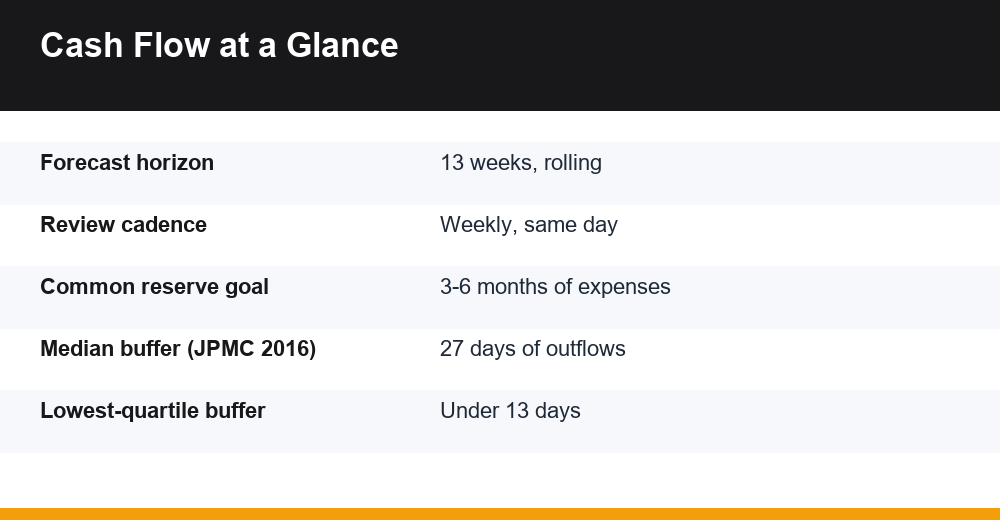
A 13-week forecast covers one quarter, week by week. It is short enough to be accurate and long enough to give you time to react. Turnaround advisers and lenders favor it because it focuses on the number that is hardest to massage: the closing bank balance.
Step-by-step walkthrough
- Set the opening balance. Use the real bank balance today, not the figure in your accounting software. Include all operating accounts.
- List expected receipts by week. Go through open invoices and assign each to the week you realistically expect payment, based on that customer’s history, not the due date. Add forecast cash sales separately.
- List fixed outflows on their actual dates. Payroll, rent, loan payments, subscriptions, insurance. These are the easiest lines to get right.
- Add variable outflows. Supplier bills, materials, freight, marketing. Use your payables ledger and purchase orders.
- Add the lumpy items. Estimated taxes, annual renewals, equipment purchases, owner draws.
- Calculate net flow and closing balance for each week. Each week’s closing balance becomes the next week’s opening balance.
- Set a minimum cash threshold, such as two weeks of fixed costs, and highlight any week that drops below it.
- Roll it forward every week. Replace the oldest week with actuals, add a new week 13 and note why reality differed from the plan.
What the first four weeks might look like
| Line | Week 1 | Week 2 | Week 3 | Week 4 |
|---|---|---|---|---|
| Opening cash | $18,000 | $20,000 | $16,000 | $20,800 |
| Customer receipts | $9,000 | $6,500 | $11,000 | $5,500 |
| Payroll | $0 | $8,000 | $0 | $8,000 |
| Rent | $3,000 | $0 | $0 | $0 |
| Suppliers | $4,000 | $2,500 | $5,000 | $1,500 |
| Loan / estimated tax | $0 | $0 | $1,200 | $4,000 |
| Net cash flow | +$2,000 | -$4,000 | +$4,800 | -$8,000 |
| Closing cash | $20,000 | $16,000 | $20,800 | $12,800 |
| Below $15,000 threshold? | No | No | No | Yes – act now |
In this example the forecast flags week 4 three weeks early. That is enough time to chase two overdue invoices, push a non-urgent supplier payment by a week or cover the estimated tax payment from a tax set-aside built earlier.
If you want a structured template, SCORE publishes the SBA Financial Management Workbook, a free primer that walks through cash flow projections alongside budgets and financial statements.
Common forecasting mistakes
- Booking receipts on the invoice due date instead of the date customers actually pay.
- Forgetting that some months contain three pay dates when payroll runs biweekly.
- Leaving out owner draws, which makes the forecast look healthier than reality.
- Building it once and never updating it. A stale forecast is worse than none, because it creates false confidence.
The Payment-Terms Playbook: Getting Invoices Paid Faster
The fastest way to improve cash flow is usually to collect money you have already earned. Customers tend to pay the invoices that are easiest and most expected first, so your job is to make yours both.
Set terms before the work starts
| Tactic | How it works | Best for |
|---|---|---|
| Upfront deposit | 25-50% due before work or ordering begins | Custom work, events, projects with material costs |
| Milestone billing | Invoice at agreed stages (design, build, delivery) | Projects longer than a month |
| Retainers | Fixed monthly fee billed in advance | Ongoing services, agencies, advisers |
| Shorter terms | Net-15 or due on receipt instead of net-30/60 | New clients, small invoices |
| Early-payment discount | Small discount for paying within 10 days | Customers with cash to spare; calculate the cost first |
| Late fees | Interest or fixed fee stated in the contract | Repeat late payers, where local law permits |
| Card or auto-pay on file | Charge a stored payment method on the due date | Subscriptions and recurring work |
An early-payment discount sounds cheap but is often expensive. Classic “2/10 net 30” terms give up 2% to be paid 20 days sooner, which works out to an annualized cost of roughly 37%. Use it only when you need cash urgently and have no cheaper option.
Send invoices that are easy to pay
- Invoice the same day the work is delivered, not at month end.
- Include a purchase order number if the client uses them; a missing PO is a common reason invoices stall in accounts payable.
- Show the due date as a calendar date, not just “net 30”.
- Offer at least two payment methods, including bank transfer and card.
- Address the invoice to the person who pays it, and copy the person who approved the work.
A late-invoice follow-up schedule
- 3 days before due: friendly reminder with the invoice attached.
- Due date: short note confirming payment is due today, with the payment link.
- 7 days late: polite but direct email asking for an expected payment date.
- 14 days late: phone call to the payer, not just the project contact.
- 30 days late: pause further work and apply contractual late fees.
- 60+ days late: formal demand letter, then a decision on collections or small claims.
Firm collection does not have to damage relationships. Clients who feel well served tend to pay well too, which is why customer retention strategies and receivables discipline belong in the same conversation.
Controlling Outflows Without Starving the Business
Cutting costs is the obvious lever, but blind cuts can damage the parts of the business that generate cash. A better approach is to control the timing of outflows first and the size second.
Timing levers
- Pay suppliers on the due date, not the day the bill arrives. Paying early only makes sense if there is a discount worth taking.
- Ask key suppliers for longer terms once you have a payment track record.
- Switch large annual subscriptions to monthly billing if the premium is small.
- Align pay dates and rent with your strongest receipt weeks where possible.
- Smooth quarterly estimated taxes by setting aside a percentage of every deposit into a separate account.
Size levers
- Review every recurring charge quarterly and cancel what nobody used.
- Order inventory closer to demand, and clear slow-moving stock even at a lower margin.
- Lease or finance equipment instead of buying it outright with operating cash.
- Renegotiate or rebid contracts for insurance, telecoms and logistics annually.
Before cutting anything, ask whether it directly produces revenue or retains customers. Trim overhead that does neither; protect spending that does.
How Much Cash Reserve Should a Small Business Keep?
A commonly cited target is three to six months of operating expenses. It is a sensible long-term goal, but reality is far thinner for most firms. The JPMorgan Chase Institute’s widely cited 2016 study of roughly 600,000 small businesses found the median firm held enough cash to cover only 27 days of typical outflows, and a quarter held fewer than 13 days.
Rather than chase a single number, build the reserve in tiers:
| Tier | Target | Purpose |
|---|---|---|
| 1. Survival floor | 2-4 weeks of fixed costs | Covers payroll and rent if a big customer pays late |
| 2. Operating buffer | 1-3 months of total expenses | Absorbs seasonal dips and slow quarters |
| 3. Resilience reserve | 3-6 months of total expenses | Survives losing a major client or a downturn |
| Tax set-aside | Kept separately | Estimated and sales taxes, never counted as reserve |
Seasonal businesses, firms with one or two dominant customers and businesses with long project cycles should aim higher. Subscription businesses with predictable billing can often run leaner.
A practical method: transfer a fixed percentage of every customer receipt (for example 5%) into a separate savings account until the next tier is reached. Automating it removes the temptation to skip a month.
A line of credit is a useful backup, but it is not a reserve. Banks can reduce or freeze lines exactly when conditions worsen, so arrange one while the business is healthy and treat it as a last resort.
9 Small Business Cash Flow Management Tactics for This Quarter
If you do nothing else, work through this list over the next 90 days. Together these tactics form a complete small business cash flow management routine that does not depend on any particular software.
- Build the 13-week forecast and review it on the same day every week.
- Set a minimum cash threshold and agree in advance what you will do when a week dips below it.
- Require deposits on any new project with upfront costs.
- Move long jobs to milestone billing so cash arrives as costs are incurred.
- Invoice the day work is delivered and run the follow-up schedule without exception.
- Pay bills on their due dates, not when they arrive.
- Audit recurring costs and cancel unused subscriptions.
- Separate tax money into its own account the moment it is collected.
- Automate a reserve transfer from every deposit until you reach the next tier.
Weekly 30-minute cash review
- Update the bank balance and replace last week’s forecast with actuals.
- List invoices that are overdue or due this week and assign who chases each one.
- Check upcoming lumpy payments in the next 13 weeks.
- Decide on owner draws only after looking at week 13, not today’s balance.
Good small business cash flow management is less about clever finance and more about rhythm. A weekly habit, clear payment terms and a reserve built a little at a time will do more than any dashboard. Free help is available too: SBA resource partners such as SCORE mentors and Small Business Development Centers offer no-cost or low-cost guidance on budgeting and cash planning.
Frequently Asked Questions
Can a business be profitable but still run out of cash?
Yes. Profit counts revenue when it is earned, while cash counts it when the customer actually pays. If you buy materials and pay staff today but your client pays in 60 days, your books can show a profit while your bank account is overdrawn. Large orders, long payment terms and fast growth widen this gap the most.
How do you create a simple cash flow forecast?
Start with today’s real bank balance. List expected customer payments by week, based on when each customer usually pays. Add fixed outflows like payroll and rent on their actual dates, then variable and lumpy costs such as suppliers and taxes. Calculate each week’s closing balance and roll the forecast forward weekly for 13 weeks.
How much cash reserve should a small business keep?
A common long-term target is three to six months of operating expenses, but many firms hold far less. Build it in stages: first two to four weeks of fixed costs, then one to three months of total expenses, then the full target. Keep tax money in a separate account so it is never mistaken for reserve.
How can I get customers to pay invoices faster?
Agree on terms before work starts, ask for deposits on projects with upfront costs and use milestone billing for longer jobs. Invoice the same day you deliver, show a clear due date and offer bank transfer and card payment. Then follow a set reminder schedule, from a friendly note before the due date to a phone call at 14 days late.