
Knowing how to price a product is one of the most important decisions you will make, because the number on your label affects your profit, how customers perceive your brand, and how quickly you can grow. Set it too low and you earn less than you could; set it too high without a clear reason and buyers look elsewhere. This guide turns pricing into a repeatable system you can apply to any product or service.
Table of Contents
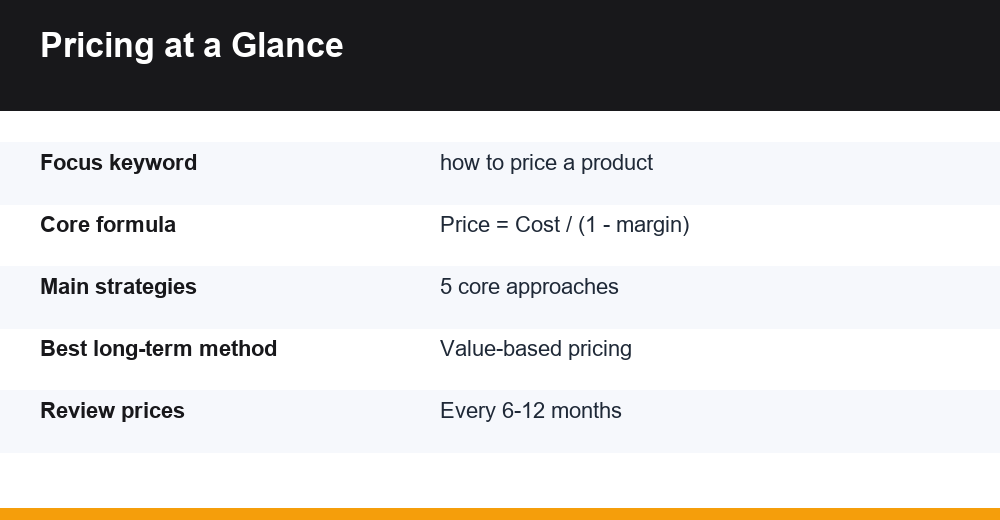
Why Pricing Deserves Careful Attention
Raising your price increases revenue without adding a single unit of production cost. Cutting expenses protects your margin, and chasing more volume means more work for each sale, but a well-judged price increase sends most of the extra money straight to profit. If demand holds, a modest increase can do more for your finances than months of cost-cutting. That is why pricing deserves the same care you give the product itself.
Even so, many owners settle on a number in a few minutes – a rough markup, a glance at a rival’s website – and never revisit it. Underpricing is a common and costly mistake. It limits your profit, reduces the budget you need for marketing and hiring, and trains customers to expect a bargain. Overpricing without a clear reason is just as risky, because buyers sense the mismatch and leave.
Whether you are testing one of many small business ideas or refining an established catalog, your price says as much about your brand as your logo does. A higher figure can signal quality and confidence, while a very low figure can suggest lower quality. Because the number sends a clear signal, set it deliberately.
Before you pick a strategy, it helps to see exactly what your price communicates to the market:
- The perceived quality of your product and where it sits against the alternatives
- Which customers you attract, and which you turn away
- How much room you have to fund ads, hiring, and product work
- Whether a discount reads as a genuine offer or a sign of weakness
Start With Your Costs and Break-Even
You cannot judge any price until you know the floor beneath it. That floor is your total cost per unit – everything it takes to produce, package, and deliver a single sale. If you leave out a cost here, every profit figure you record is only partly accurate, which is how a business can stay busy all year and still end it short of cash.
Split your costs into two groups. Variable costs move with each unit sold: raw materials, packaging, shipping, and payment processing fees. Fixed costs stay level whether you sell ten units or ten thousand: rent, software, salaries, and insurance. To find a realistic unit cost, add the variable cost of one unit to a fair share of your monthly fixed costs, based on how many units you expect to sell.
Your break-even point is the sales level where revenue finally covers all of those costs. Below it you lose money for the period; above it you start to earn. Knowing that threshold tells you the minimum volume any candidate price must support, and it keeps optimistic assumptions from replacing a realistic plan.
Margin vs. markup: don’t confuse them
These two terms are often confused, and the mistake can distort your math. Markup expresses profit as a percentage of your cost. Margin expresses profit as a percentage of the selling price. They are not the same, and treating them as interchangeable leads to prices that look healthy but barely clear your costs.
- Find your unit cost: add the variable cost per unit to a fair share of fixed costs.
- Markup pricing: multiply cost by (1 + markup). A $12 unit at a 50% markup sells for $18.
- Margin pricing: divide cost by (1 – margin). For a 50% margin, that same $12 unit must sell for $24.
Notice how the same 50% produces two very different prices. Retailers, lenders, and investors usually speak in terms of margin, so use margin when you compare options; otherwise you may settle on a number that leaves very little profit.
Five Pricing Strategies and When to Use Each
Once you know your floor, pick the approach that fits your market, your brand, and your goals. Most businesses rely on one primary strategy and borrow tactics from the others. For a broader, neutral overview of the field, you can read the reference summary of pricing strategies before you decide.
Here are the five approaches you are most likely to use, along with the trade-offs that determine when each one fits.
| Strategy | How it works | Best for | Watch out for |
|---|---|---|---|
| Cost-plus | Add a fixed markup to unit cost | Simple goods, retail, manufacturing | Ignores what buyers will actually pay |
| Value-based | Price on the outcome buyers receive | Differentiated or premium offers | Needs real customer research |
| Competitive | Anchor to what rivals charge | Crowded or commodity markets | Invites price wars and thin margins |
| Penetration | Launch low to win share fast | New entrants, network products | Hard to raise later; attracts deal-seekers |
| Premium / skimming | Set high to signal quality | Strong brand, early adopters | Limits volume; invites undercutting |
Value-based pricing tends to perform best over the long run because it ties your price to the results a customer receives rather than to your internal costs. It asks more of you – customer conversations, surveys, and testing – but it gives you more pricing flexibility than cost-plus can.
You do not have to commit to a single method. A common and effective pattern is to set a cost-plus floor so you never sell at a loss, check competitors so you stay in a credible range, and then move toward value-based pricing wherever your product clearly outperforms the alternatives. The floor protects your margin, and value-based pricing raises it.
How to Price a Product Step by Step
With your costs mapped and a strategy chosen, here is how to price a product in a sequence you can repeat for every new item you launch.
- Calculate your true unit cost, including a fair share of overhead.
- Set a target margin that keeps you above break-even with room to invest.
- Convert that margin into a starting price: price = cost / (1 – margin).
- Check competitors to see where your number lands in the real market.
- Validate against value – does the price match the outcome buyers get?
- Choose a final figure, then commit to testing it rather than guessing.
A worked example
Suppose you sell hand-poured candles. Your variable costs come to $6 in wax and fragrance, $1 in packaging, and about $0.50 in payment fees. Add $4.50 for a fair share of labor and overhead, and your unit cost is $12. These figures are illustrative – use your own numbers.
You decide you want a 60% gross margin. Using price = cost / (1 – 0.60), your starting price is $12 divided by 0.40, which equals $30. That is your cost-plus starting point, before you factor in the market.
In this example, comparable candles sell for roughly $26 to $38, so $30 sits comfortably mid-market. Your reviews praise the scent and long burn time, which point to real value, so you round up to $32 rather than competing on price alone.
At $32 with a $12 cost, you keep $20 per candle, a 62.5% margin. That margin helps fund ads, free samples, and the occasional promotion without erasing your profit, and it leaves room to absorb a supplier price increase.
Psychological Pricing That Influences Buyers
Numbers carry meaning beyond their arithmetic. Small framing choices can change how expensive a price feels while barely affecting your margin, which is why the same $32 can seem inexpensive or costly depending on how you present it.
- Charm pricing: an ending of .99 or .95 makes a price read as a lower bracket.
- Anchoring: show a higher option first so the target price feels reasonable.
- Tiered options: a good-better-best menu guides buyers toward the middle choice.
- Decoy pricing: a slightly worse deal makes your preferred plan look clearer.
- Bundling: package items so combined value replaces a direct per-unit comparison.
Use these tactics to communicate value clearly, not to mislead anyone. A price that seems fair at first but leaves customers feeling misled costs you the repeat orders and referrals that keep a small business profitable. Transparency supports long-term growth, while manipulation undermines it.
Remember that price never works alone. It interacts with every stage of your sales funnel, from the first ad a visitor sees to the checkout page. Test your message and your price together, because a strong offer inside a confusing funnel still converts poorly.
Pricing Services and Digital Products
Physical goods have clear unit costs, but services, software, and digital downloads follow different rules. Your marginal cost may be close to zero, so cost-plus pricing will undervalue what you sell. Here, value-based thinking is essential rather than optional.
For a service, avoid billing purely by the hour, because it caps your income and penalizes efficiency. Package outcomes instead: a defined deliverable at a fixed fee lets clients judge value against results, and it rewards you for getting faster and better. Tiered packages – a basic, a standard, and a premium – also give buyers an easy way to select the level they need.
For digital products, base your price on the result you provide, not the file size. A template that saves a founder ten hours is worth far more than its production cost suggests. Consider tiers, licenses, or subscription access, and remember that a slightly higher price often signals higher quality to a first-time buyer.
Testing and Adjusting Your Price Over Time
Your first price is a hypothesis, not a verdict. The market will tell you whether you judged it well, so treat pricing as an ongoing experiment rather than a one-time decision. Part of knowing how to price a product is recognizing when the number needs to change.
- Run split tests: offer different prices to comparable segments and compare revenue and profit, not just clicks or sign-ups.
- Watch price sensitivity: if a modest increase barely dents your volume, you were probably charging too little.
- Raise prices deliberately: strengthen the offer first, explain the change plainly, and consider holding the old price for loyal customers for a set period.
- Review on a schedule: costs, competitors, and demand all change, so revisit your prices at least once or twice a year.
Small, well-tested increases usually work better than large, sudden ones. Move in steps, measure the effect on both conversion and total revenue, and keep only the changes you can clearly justify to yourself and your customers.
Common Pricing Mistakes to Avoid
Most pricing problems trace back to a short list of avoidable errors. Run through this checklist before you settle on any number.
- Pricing only on cost while ignoring the value you actually deliver.
- Copying a competitor without knowing their costs or strategy.
- Competing on price alone, which invites a race you cannot win.
- Forgetting hidden costs such as fees, returns, and support time.
- Setting a price once and then never revisiting it.
- Discounting so often that the regular price loses its meaning.
Treat how to price a product as a system – costs, strategy, psychology, and testing working together – and you turn a difficult guess into a repeatable process. Revisit the whole process whenever your product, your market, or your costs change, and your pricing will keep pace with your business rather than hold it back.
Frequently Asked Questions
What is the first step in how to price a product?
Start with your true unit cost – every variable and fixed expense tied to one sale. That floor tells you the minimum viable price. From there you add a target margin, a competitor check, and a value assessment to reach a confident final number.
What’s the difference between margin and markup?
Markup measures profit against your cost; margin measures profit against the selling price. A $12 item with a 50% markup sells for $18, but a 50% margin means it must sell for $24. Most retailers and investors speak in margin, so use margin to stay consistent.
Should I set my prices lower than competitors?
Rarely as a default approach. Undercutting can win quick sales, but it trains buyers to expect low prices and squeezes your margin. Unless low cost is a genuine core advantage, compete on value, service, or positioning, and reserve discounts for specific, time-limited goals.
How often should I review my prices?
At least once or twice a year, and sooner if your costs, competitors, or demand change noticeably. Treat each price as a hypothesis: test small changes, watch how volume and revenue respond, and keep the increases you can clearly justify to customers.