
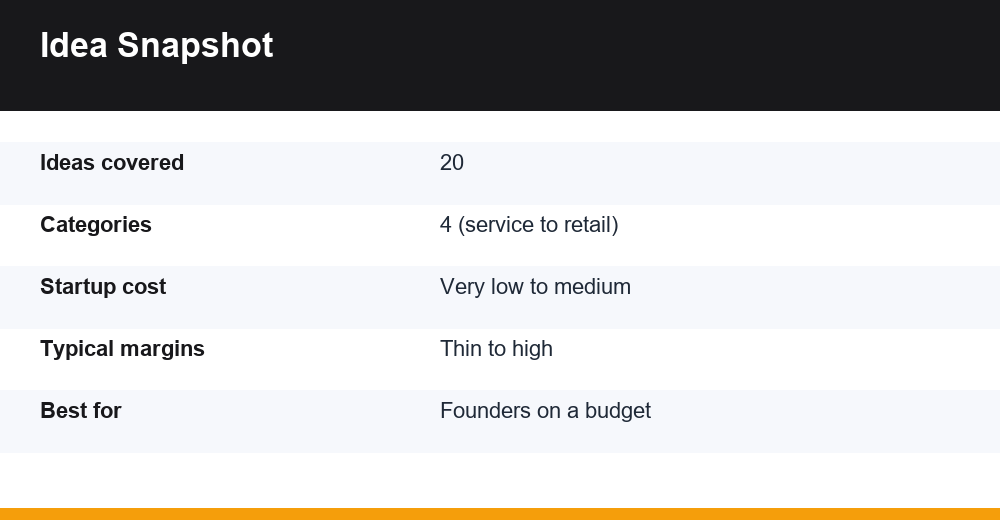
The strongest small business ideas share three things: real demand, a startup cost you can afford to lose, and margins that still hold up once you count your own time. This guide skips the hype and lays out 20 realistic options across services, online work, retail and local trades, grouped by cost and the skills they need. For each one you get an honest read on effort and profit, so you can pick something you can actually sustain past the first busy month.
Table of Contents
What Makes a Good Business Idea in 2026
Many roundups of small business ideas bury a handful of good options under dozens of padded entries, so everything looks equally promising. It rarely is. A venture worth your time solves a problem people already pay to fix, fits the money and hours you can commit, and still leaves a margin once your own labour is counted.
One thing has shifted for 2026: the cost of testing an idea keeps falling. Cheap software, remote clients and no-code tools let you launch, learn and adjust without a large upfront outlay. That lowers the risk of starting, but it also means more people can try the same thing, so a clear niche matters more than raw effort.
Setup matters too. Before you commit, learn the basics: registering, opening a separate business account and staying compliant. Our guide on how to start a small business walks through those steps so you can focus on the idea itself. Requirements vary by location, so check official sources for your area.
Before you settle on any option, hold each idea against four simple tests:
- Demand you can actually see. People already search for it, hire for it, or complain that nobody nearby offers it. Chasing demand you have only imagined is a common early mistake.
- An honest startup cost. Add up tools, software, insurance and marketing, not just the obvious kit. Overlooked costs are what quietly strain an underfunded first venture.
- Margins that survive your time. A hectic business paying less per hour than a job is really just a job with extra risk attached.
- Skills you have or can pick up quickly. The best fit uses what you already know, rather than a two-year detour to qualify.
None of the ideas below is passive or guaranteed. What they offer is a sensible balance of cost, demand and effort, which beats chasing whatever sounds most profitable this year.
Low-Cost Service Businesses You Can Start Solo
Service work is the quickest route from a skill to real income, because you sell time and expertise instead of buying inventory first. Startup costs stay low, and you can prove demand with one or two paying clients before spending more.
The honest catch is that your earnings are tied to your hours until you hire, raise prices, or turn the service into a repeatable package. Plan for that ceiling from the start.
- Bookkeeping. Small firms always need clean, current books, and monthly retainers make income more predictable. Costs are mostly software and time, so margins tend to be strong. Expect to learn a tool such as QuickBooks or Xero, and a certification can help you win trust.
- Freelance writing and content. Cheap to begin and consistently in demand, but crowded at the entry level. Choose a niche such as finance, healthcare or B2B software and your rates can climb faster. Growing past your own hours means adding editors or fixed-scope packages.
- Virtual assistant. Busy owners often pay to hand off email, scheduling and admin. Startup cost is near zero and competition is stiff, so specialise in one industry and grow through referrals rather than trying to do everything for everyone.
- Social media management. Local businesses know they need a presence and rarely have time to keep it up. Keep metrics and screenshots that show your posts drove reach or sales; results, not follower counts, are what let you raise your rates.
- Cleaning services. Unglamorous but dependable, with recurring contracts and very low overhead. As a solo cleaner your hours cap income, but margins can improve once you hire and schedule a small crew while you focus on winning new work.
- Tutoring or coaching. If you hold a subject, language or skill others want, margins tend to be strong. One-to-one sessions pay well, and small groups or recorded material can lift your effective hourly rate without adding more hours to your week.
Online and Digital Business Ideas
Digital businesses can grow past your available hours, which is their real appeal. The trade-off is time: most take longer to earn than a service business, because you build an audience or an asset before the money follows.
Treat the early months as unpaid groundwork and keep another income source running while it matures. Patience, rather than luck, tends to separate the projects that pay off from the ones that stall.
Whichever digital route you pick, an email list or a small, engaged following is the asset that makes the rest work. It costs little to start collecting sign-ups early, and it gives you a direct way to launch, test prices and sell again without paying for reach every time.
- SEO or digital marketing consulting. Demand can be strong, but clients buy outcomes. Get one business measurable gains, turn it into a case study, and use that proof to price the next engagement properly instead of competing on hourly rate.
- Web design and maintenance. One-off builds are fine, but recurring care, hosting and update plans are better, converting a single project into monthly revenue and steadier cash flow. Modern tools let you deliver faster than many clients expect.
- Print-on-demand. Products print only after a customer buys, so upfront financial risk is low. Margins are usually slim, though, and distinctive designs plus disciplined marketing decide who actually sells and who just uploads art nobody sees.
- Online courses. Once recorded, a course can sell repeatedly at a high margin. It only works if you genuinely know the subject and already have, or are willing to build, a small audience that trusts you enough to buy.
- Niche content or affiliate site. Potentially close to passive, but slow and dependent on search rankings you do not control. Treat it as a multi-year asset built alongside other income, never as a fast or guaranteed earner.
- Niche e-commerce store. A focused product line is far easier to market than a general store. Margins are modest and stock ties up cash, so start with a handful of products and reinvest as sales prove which ones work.
Local and In-Person Business Ideas
Local, hands-on work faces less online competition and builds loyalty through word of mouth. Many of these ventures reward reliability over raw talent, which makes them accessible if you simply show up and do good work consistently.
The real costs to weigh here are physical effort and travel time between jobs. Route planning and repeat clients matter as much as the service itself.
Pricing local work is simpler than it looks: cover your costs and travel, add a fair rate for your time, then check what nearby providers charge. Being the cheapest is rarely the goal. Being reliable, easy to book and consistent is what earns repeat work and the referrals that keep your schedule full.
- Pet care and dog walking. Steady, low-cost and easy to book through apps or a simple local presence. Trust and reliability matter more than anything technical, and satisfied owners often turn into repeat clients and referrals.
- Lawn care and landscaping. Dependable if seasonal, with equipment as the main upfront cost. Seasonal contracts smooth out income, and add-ons such as clean-ups, mulching or snow clearing help you earn across more of the year.
- Handyman and small home repair. Demand rarely dries up, and one reliable local pro is hard to find. Check local licensing rules before advertising certain trades, and build your reputation through reviews and word of mouth in one area.
- Mobile car detailing. You travel to the customer, which keeps overhead low and convenience high. One-off washes are fine, but recurring maintenance packages can turn a busy weekend into steadier monthly income.
- Personal training or fitness. Coach in person or online, whichever suits your market. One-to-one pays, while group classes and virtual sessions multiply what you earn from a single hour of your own time.
Retail and Product-Based Ideas
Selling physical products is satisfying but unforgiving on margins, because inventory, packaging and platform fees eat into every sale. Retail and food usually run on thin net margins, so pricing discipline matters more here than in almost any other category.
Getting the numbers right from day one is what separates a paying business from an expensive hobby. Our walkthrough on how to price a product covers costs, mark-ups and what the market will actually bear. Start lean, sell before you scale, and keep a close eye on cash.
- Handmade goods. Jewellery, candles, ceramics and similar crafts sell better when you build a recognisable brand and a clear niche instead of competing on price. A marketplace and your own store can run side by side.
- Specialty food or baking. Genuine demand exists, but food-handling, labelling and licensing rules apply and vary widely by location. Confirm exactly what your area requires from official sources before you sell a single item, because the penalties for skipping this are real.
- Resale and flipping. Thrift, vintage or refurbished goods need little upfront cash and teach you sourcing, pricing and what genuinely sells, all before you risk money on larger inventory.
Comparison: Startup Cost, Effort and Margins
The table below compares a representative spread of these small business ideas so you can weigh them side by side. The cost and margin labels are general guidance, not promises: they shift with your location, niche and execution, so treat each one as a rough pattern rather than a figure you can bank on.
| Idea | Startup cost | Skills needed | Typical net margin | Time to profit |
|---|---|---|---|---|
| Bookkeeping | Low | Numbers, software | High | Weeks |
| Freelance writing | Very low | Writing, a niche | High, time-capped | Weeks to months |
| Social media manager | Low | Content, marketing | Medium to high | Weeks to months |
| Cleaning service | Low | Systems, reliability | Medium, scales | Weeks |
| SEO consulting | Low | Marketing, analysis | High | Months |
| Online course | Low to medium | Expertise, teaching | High once built | Months |
| Niche e-commerce | Medium | Marketing, operations | Modest | Months |
| Lawn and landscaping | Medium | Labour, equipment | Medium | Weeks, seasonal |
| Handmade goods | Low to medium | Craft, branding | Thin, brand-led | Months |
| Specialty food | Medium | Cooking, compliance | Thin | Months |
Read the table as a shortlisting tool, not a scoreboard. A thin margin at high volume can out-earn a high margin you can only deliver a few hours a week, so weigh margin against how much you can realistically sell.
How to Choose Small Business Ideas That Fit You
The best of these small business ideas is the one you can actually stick with, so filter by fit before profit. Match the work to your skills, the hours you have, and how long you can go before it needs to pay. A modest idea you finish beats an ambitious one you abandon.
Then validate before you invest. Real money changing hands tells you more than any survey or business plan, so test cheaply first:
- Talk to five potential customers about the problem before you build anything.
- Take one paid job, or pre-sell a small batch, to see if money actually changes hands.
- Keep your day job until the income is steady and repeatable.
It also helps to set a simple stopping point before you begin. Decide in advance how much money and time you are willing to spend on the test, and what result would tell you to stop, continue or commit more. A clear limit keeps a slow start from quietly turning into an open-ended drain.
Finally, get the fundamentals right: register the business, separate your finances, and understand your tax obligations. These rules vary by country and state, so confirm the specifics with an official source such as the U.S. Small Business Administration or your local equivalent before you trade.
Whichever of these small business ideas you choose, treat the first year as a test you can afford to fail. Let the results, not the hype, decide where you commit more time and money.
Frequently Asked Questions
What is the cheapest small business to start?
Service businesses such as freelance writing, virtual assistance, tutoring and cleaning usually cost the least, often only a few hundred dollars for basic tools and marketing. You trade money for time, since your hours cap income until you hire help or package your services. Exact costs vary by location and niche.
Which businesses have the best profit margins?
Knowledge and service work usually lead, so bookkeeping, consulting, coaching and online courses can keep costs low and margins high. Retail and food tend to run much thinner because inventory, fees and packaging eat into every sale. Margins still depend heavily on your pricing and efficiency, so treat any figure as a rough guide.
How much money do I need to start out?
It varies widely. Many service and online businesses can start for a few hundred dollars, while local trades and retail may need thousands for equipment or stock. Start lean, validate demand with real sales, and reinvest profit rather than borrowing heavily before you know the idea works.
Do I need to register my business before starting?
Usually yes, but requirements differ by country and state, covering registration, licences and taxes. Some low-risk activities can begin as a sole proprietor while you test the idea. Confirm the rules for your location with an official government source before you take on customers or money.