A sales funnel is the path a stranger takes from never having heard of you to becoming a paying, repeat customer. Map that path deliberately and you stop guessing why deals stall — you start seeing exactly where attention turns into revenue and where it slips away. This guide covers the stages, the numbers that matter, and the practical fixes that separate a funnel that leaks from one that pays.
Table of Contents
What a Sales Funnel Really Is
The idea behind a funnel is simple, even if the reality is messy: people rarely buy the first time they meet you. The model breaks that journey into stages — wide at the top, where many people first notice you, and narrow at the bottom, where a smaller, committed group actually buys. Naming those stages turns a vague hope of getting more sales into a set of specific, fixable problems.
Three terms get tangled here. A marketing funnel concentrates on attention and interest near the top; a sales pipeline is your team’s internal view of the deals it is working. The funnel in this guide sits across both and follows the buyer, not your org chart.
The concept is old and well tested. The classic purchase funnel, first sketched more than a century ago, described how buyers move from awareness toward action. The vocabulary has shifted since, but the underlying psychology has not: attention is earned first, then trust, then the sale.
For a founder or small-business owner, the real value is diagnostic. When revenue is flat, “we need more customers” is rarely the useful answer. The funnel tells you whether the problem is too few visitors, too few of them opting in, or too many walking away at the price — three very different fixes.
It also keeps teams honest. Marketing can claim a campaign worked while sales insists the leads were useless. A shared funnel with real numbers at each stage settles that argument with evidence instead of opinion.
The Five Stages, From Stranger to Repeat Buyer
Most funnels boil down to five stages. Your customers will not march through them in a straight line — they loop back, stall, go quiet, and sometimes skip a step entirely — but naming each stage tells you exactly what to offer and what to measure in that moment.
| Stage | Buyer’s mindset | Your job | Metric to watch |
|---|---|---|---|
| Awareness | I have a problem | Get found and be useful | Traffic, reach, impressions |
| Interest | Can this help me? | Educate and capture the lead | Opt-ins, email sign-ups |
| Decision | Is this the right choice? | Prove value, answer objections | Demo or quote requests, replies |
| Action | I’m ready to buy | Make buying effortless | Conversion rate, close rate |
| Retention | Was this worth it? | Deliver and earn the next sale | Repeat rate, churn, lifetime value |
You will also hear people talk about the top, middle, and bottom of the funnel. That is just shorthand: the top covers awareness and interest, the middle is where consideration happens, and the bottom is decision and action. Each stage rewards a different kind of content — discoverable articles and videos up top, comparisons and proof in the middle, and clear pricing and guarantees at the bottom.
Notice the final row. Retention is not a victory lap; it is where a thin-margin business becomes a durable one, since selling again to a satisfied customer usually costs a fraction of winning a stranger.
None of this is rigid. A warm referral might arrive already convinced and skip straight to action, while a cautious buyer loops through the decision for weeks before committing. Treat the stages as a checklist of what a person needs at each point, not a track they are forced to run in order.
How to Build One, Step by Step
Building your first funnel does not require a rebrand or a big budget. It requires deciding, stage by stage, what actually moves a person forward — and then removing everything that does not.
- Start with the buyer, not the product. Write down the real questions and doubts someone carries at each stage. The whole funnel exists to answer them in the right order, so map the questions before you map the pages.
- Choose one clear entry point. Pick a single channel to attract the right traffic — organic search, referrals, or one social platform — instead of spreading yourself thin across all of them. Our guide to getting your first customers covers where to focus effort early on.
- Capture, do not just attract. Give visitors a concrete reason to leave an email or start a conversation, so a one-time visitor becomes a lead you are actually allowed to contact again.
- Nurture with useful follow-up. A short, honest sequence of emails or calls that teaches and reassures does the heavy lifting most businesses skip entirely.
- Strip friction from the decision. Transparent pricing, an obvious next step, and straight answers close more deals than any pressure tactic. If you are unsure what to charge, work through how to price a product before you build the checkout.
- Deliver, then ask again. Set up one simple prompt — a follow-up, a review request, a related offer — to earn the second sale you already paid to make possible.
- Measure one stage at a time. Find the single biggest drop-off, fix that, and only then move on to the next weakest point.
Treat the whole thing as a draft. Your first funnel will be wrong in places, and that is fine — the point is to make your assumptions visible so real customer behaviour can correct them.
Lead Magnets and Nurturing That Actually Convert
A funnel only works if strangers are willing to hand over a way to reach them. That is the job of a lead magnet: something genuinely useful you offer in exchange for an email or a phone call. The test is simple — would someone happily pay a small amount for it? If yes, it is strong enough to give away.
- A practical checklist or template that saves someone an hour of fiddly work
- A short email course that solves one specific, nagging problem step by step
- A free assessment, calculator, or product sample that lets people feel your value first-hand
- An honest buyer’s guide or comparison for a considered, higher-price purchase
Capturing a lead is the opening move, not the win. Nurturing is the patient follow-up that keeps you useful while someone decides — a few well-timed emails, a check-in call, a relevant case study. The aim is to help, not to hound. A prospect who trusts you buys sooner, negotiates less, and complains rarely.
Keep the sequence short and specific. Three to five messages that each answer one real objection will outperform a long, generic newsletter that lands whether or not it is wanted. And resist gating everything: if people must fill in a form just to learn what you do, most will not bother.
Metrics and Conversion Rates Worth Tracking
You cannot improve what you do not measure — but measuring the wrong things is worse than measuring nothing, because it feels like progress. Chasing vanity metrics such as raw follower counts, page views, or email open rates is comfortable and tells you almost nothing about revenue.
Track movement between stages instead. The numbers that earn their place:
- Stage conversion rate — the share of people who advance from one stage to the next
- Cost per lead and cost per acquisition, so growth stays profitable
- Average deal size and the time it takes to close
- Customer lifetime value measured against what you spend to win each customer
A quick illustration shows why stage rates matter. Say 1,000 visitors produce 100 email sign-ups and 10 sales: that is a 10% opt-in rate and a 10% lead-to-sale rate. Lift either one and you increase revenue without spending a cent more on traffic. These figures are only an example — your own baseline is what counts.
Finally, read every rate next to its neighbour, and review them on a steady rhythm. Monthly is plenty for most small businesses; checking daily just invites overreaction to noise. A climbing conversion rate means little if you are closing fewer, worse-fit buyers who churn a month later.
One habit makes all of this stick: write the numbers down somewhere you will actually see them. A rate you check once and forget teaches you nothing, but a simple month-by-month record turns a single snapshot into a trend, and a trend is what tells you whether last month’s change helped.
Common Funnel Leaks and How to Plug Them
A leaky sales funnel rarely fails at the very top. Awareness is the easiest thing to see and the easiest to blame, yet mature funnels usually lose the most volume in the middle and around the decision, where genuine interest quietly cools into silence.
The leaks worth hunting for first:
- Traffic that is never asked to do anything — no clear, single next step
- A lead magnet that attracts curious browsers instead of likely buyers
- Follow-up that stops after one email, or never actually starts
- A hidden or confusing price that quietly stalls the decision
- A checkout, booking, or contact step buried under needless friction
- No system at all for earning the second sale after the first
To find a leak, follow a handful of real prospects end to end. Where did they hesitate, reply, or vanish? Analytics show you which stage bleeds volume; talking to actual people tells you why, which is the part software cannot supply.
Plug them in order of impact, not order of comfort. A five-point improvement where most people already drop off is worth far more than doubling the traffic pouring into a funnel that cannot hold what it already has.
Getting Started Without Expensive Software
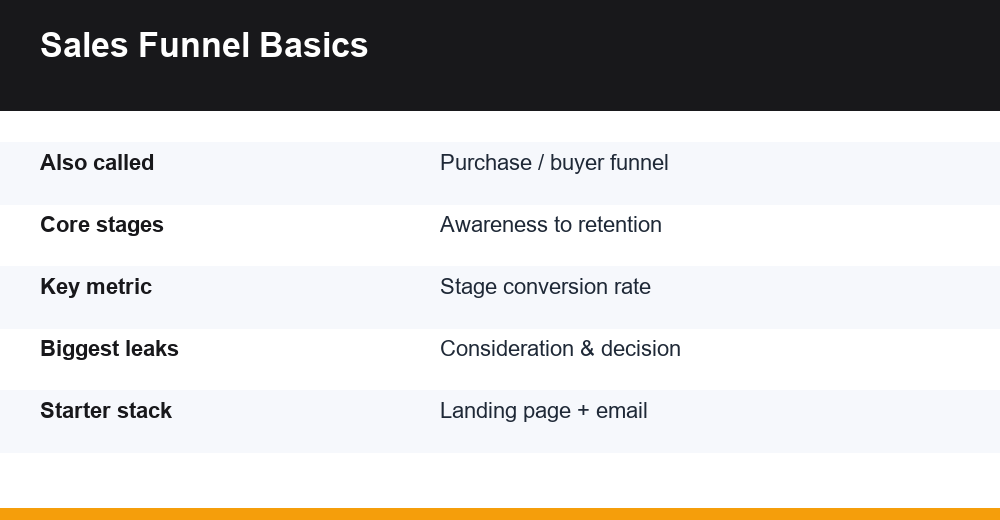
You do not need an expensive stack to begin. You can run a complete sales funnel with a single landing page, an email tool, and a spreadsheet that tracks where each lead came from and where it stalled.
A few honest tool notes, minus the hype:
- Email and automation: Mailchimp, MailerLite, and ConvertKit each handle lead capture and nurture sequences at small-business scale.
- Landing pages: Carrd and most modern website builders can publish a focused, single-purpose page without a developer.
- Tracking: a free CRM tier, such as HubSpot’s, or simply a well-kept spreadsheet is enough to see your stages clearly at first.
A realistic first funnel can be modest: a helpful article that answers a question your buyers actually ask, a checklist offered in exchange for an email, a four-message follow-up sequence, and a clear product page with honest pricing. That is a full path from stranger to customer, and you can build it in a weekend.
Whatever you pick, keep the pieces connected. A landing page that does not feed your email tool, or an email tool that never tells you which leads went on to buy, leaves you guessing all over again. The value is in seeing one lead’s whole journey, not in owning the fanciest tool for any single step.
Start manual and stay curious. Watch how real prospects behave, then automate only the steps that genuinely repeat. Good tools speed up a funnel that already works; none of them can rescue one built on guesswork.
Frequently Asked Questions
What’s the difference between a sales funnel and a sales pipeline?
A sales funnel is the buyer’s journey from first awareness to purchase, seen from the customer’s side. A pipeline is your sales team’s internal view of specific deals and the stage each one has reached. They describe the same process from opposite ends — one led by the buyer, the other tracked by the seller.
How long should a sales funnel take?
It depends entirely on price and complexity. A low-cost, low-risk purchase can move from awareness to action in minutes, while a considered B2B deal may take months and dozens of touchpoints. Match the length and intensity of your follow-up to how long your buyers genuinely need to feel confident deciding.
Do I need paid software to start a funnel?
No. A single landing page, a free email tool, and a spreadsheet are enough to launch, measure, and learn. Paid platforms save real time once your process is proven, but they cannot fix an offer, an audience, or a message that isn’t working yet. Prove the path first, then automate it.
What counts as a good conversion rate?
There is no universal benchmark worth chasing — it varies widely by industry, price point, and traffic quality. Instead of comparing yourself to someone else’s headline figure, measure your own baseline and work to improve it. A steady rise in stage-to-stage conversion is a far better sign of health than any single number.