
Product market fit is the point where a clearly defined group of customers wants what you built badly enough to keep using it, pay for it and tell others about it. Most founders talk about it in vague terms, which is why so many believe they have it long before they do. This guide turns the idea into signals you can measure, a survey you can run this week and an interview script you can use tomorrow.
Table of Contents
What product market fit actually means
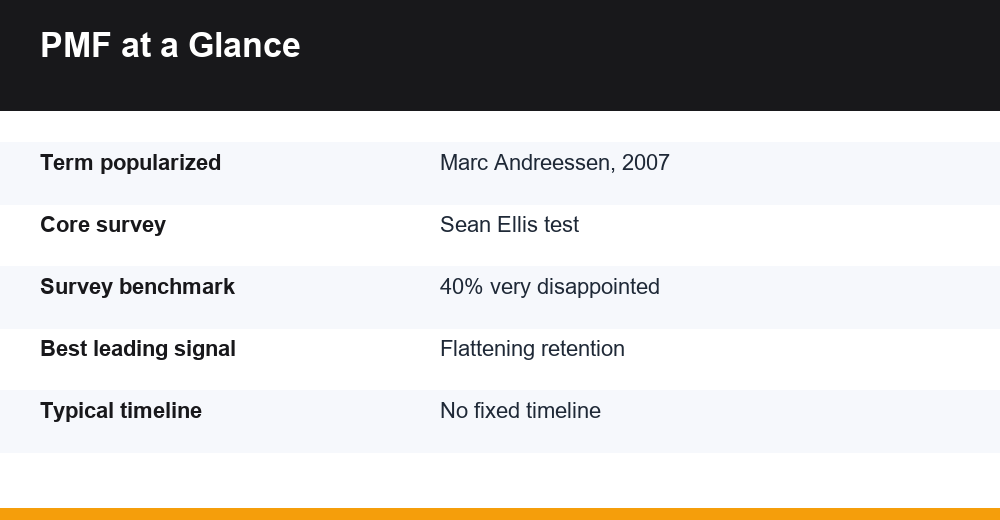
Investor Marc Andreessen popularized the phrase in a 2007 essay titled “The only thing that matters”, where he credited the underlying idea to venture capitalist Andy Rachleff. His definition was simple: being in a good market with a product that can satisfy that market.
Two words in that definition matter more than people notice. Good market means a group of buyers with a real, frequent or expensive problem and the ability to pay. Satisfy means the product solves that problem well enough that customers would struggle to go back to their old workaround.
In practice, product market fit is less a single moment and more a shift in which force is doing the work. Before fit, the founding team pushes the product into the market through cold outreach, discounts and favors. After fit, the market starts pulling: users come back without reminders, referrals show up unprompted and sales cycles shorten.
Fit is always fit with someone
A product rarely fits “the market” as a whole. It fits a segment: freelance designers, mid-sized dental clinics, parents of toddlers in apartment buildings. The narrower and more specific that segment, the easier it is to tell whether you have fit, and the easier it is to expand from a strong base later.
This is why an early minimum viable product should be aimed at one tightly defined customer rather than everyone who might conceivably buy. A broad audience blurs your data; a focused one makes the signal obvious.
How do you know if you have product market fit?
No single metric proves it. You are looking for several signals pointing the same way at the same time. The table below separates the signals that tend to move first from the ones that only confirm fit later.
| Signal | Type | What good looks like | Where to measure it |
|---|---|---|---|
| Cohort retention curve | Leading | Curve drops, then flattens above zero | Product analytics, billing data |
| Organic referrals | Leading | Growing share of signups from word of mouth | “How did you hear about us?” field |
| Sean Ellis survey | Leading | 40% or more “very disappointed” | In-app or email survey |
| Unprompted feature requests | Leading | Users ask for more depth, not a different product | Support tickets, interviews |
| Sales cycle length | Lagging | Deals close faster with less discounting | CRM |
| Unit economics | Lagging | Lifetime value clearly exceeds acquisition cost | Finance model |
| Revenue growth | Lagging | Growth continues when outbound effort pauses | Revenue reports |
Leading signals let you decide early whether to double down or change direction. Lagging signals, such as a healthy LTV to CAC ratio, tell you whether that fit can become a sustainable business. You need both, but early-stage teams should give most of their attention to the leading ones.
The qualitative tell
Founders who have reached fit often describe it the same way: the problem stops being finding customers and becomes keeping up with them. Servers strain, support queues grow and hiring becomes urgent. If your days still revolve around convincing people to try the product, treat that as information.
Leading signals: retention curves and organic referrals
Retention is the most honest measure of value because it records what customers do, not what they say. Group users by the week or month they signed up, then plot the percentage still active in each following period.
How to read a retention curve
- Curve falls to zero: people try the product and eventually all leave. You have curiosity, not fit.
- Curve flattens: after an early drop, a stable share of each cohort keeps using the product. That plateau is the clearest leading indicator of product market fit.
- Curve flattens higher in newer cohorts: your product changes are working. Compare cohorts side by side, not just the overall average.
- Curve rises after a dip (a “smile”): lapsed users return over time, often a sign of deepening habit or expanding use within a team.
Define “active” around the core action that delivers value. For an invoicing tool that is sending an invoice, not logging in. Vanity definitions of activity make a weak curve look strong.
Measuring organic referrals
Word of mouth is retention’s partner signal. Add a required “How did you hear about us?” question at signup with options that include “a friend or colleague recommended it”. Track the share of new users choosing that answer each month.
A rising share of referral signups while your paid and outbound effort stays flat is strong evidence that customers value the product enough to spend their own reputation on it. A flat or falling share means growth depends on your spending, not their enthusiasm.
The 40% rule and the Sean Ellis survey
Growth marketer Sean Ellis created a survey built around one question: How would you feel if you could no longer use this product? Respondents choose very disappointed, somewhat disappointed, not disappointed, or that they no longer use it.
The 40% rule says that if at least 40% of the right users answer “very disappointed”, the product likely has meaningful fit with that group. Ellis arrived at the threshold by comparing results across a large set of startups: those that cleared it tended to have strong traction, and those well below it usually struggled.
To calculate the score, divide the number of very disappointed responses by the total number of valid responses and multiply by 100. Treat the 40% line as a rule of thumb drawn from experience, not a statistical law.
How to run it properly
- Survey only people who have used the core product recently and at least a couple of times. Dormant signups drag the score down without telling you anything.
- Aim for a sample large enough to be meaningful; a few dozen qualified responses is a common minimum, and more is better.
- Segment the results. A 25% overall score can hide a 50% score among one customer type.
- Rerun the survey every quarter or after major product changes so you see the trend, not a snapshot.
The segmentation step is where the survey earns its keep. If accountants at small firms score far higher than everyone else, you have found the group to build for, and the rest of your roadmap gets much simpler.
What to ask in a fit survey
The disappointment question gives you the score. The follow-up questions tell you why, and those answers are where the real value sits. Keep the survey short so completion stays high.
| Question | Why you ask it |
|---|---|
| How would you feel if you could no longer use [product]? | Produces the core fit score |
| What type of people do you think would most benefit from [product]? | Reveals your best segment in customers’ own words |
| What is the main benefit you receive from [product]? | Shows what to emphasize in messaging |
| What would you likely use as an alternative if [product] were no longer available? | Identifies your real competition |
| How can we improve [product] for you? | Surfaces gaps that stop “somewhat” users becoming fans |
A useful way to act on the answers: study the “very disappointed” group to learn what they love, then look at the “somewhat disappointed” users who name that same main benefit. They already see the value; something is blocking them. Fixing that blocker is often the fastest way to raise your score.
Give little weight to feedback from the “not disappointed” group. They are telling you they are not your customer, and building for them pulls the product away from the people who care.
A step-by-step customer interview script
Surveys tell you how many; interviews tell you why. Before you have enough users for a useful survey, interviews are your main instrument. The U.S. Small Business Administration lists surveys, focus groups and in-depth interviews among the methods of direct market research, and the same discipline applies here.
Before the call
- Talk to recent, active users and to people who churned. Each group teaches you something different.
- Book 20 to 30 minutes. Record only with permission and note exact phrases.
- Do not demo, pitch or defend the product during the conversation.
The script
- Context: “Tell me about your role and what a normal week looks like.”
- The problem: “Walk me through the last time you dealt with [problem]. What happened?”
- The old way: “Before you used us, how did you handle it? What did that cost you in time or money?”
- The trigger: “What made you start looking for something different at that moment?”
- First value: “When did the product first feel useful? What were you doing?”
- Current use: “How often do you use it now, and for what exactly?”
- The loss test: “If it disappeared tomorrow, what would you do instead?”
- Referral: “Have you mentioned it to anyone? What did you say?”
- Close: “Is there anyone else facing this problem who I should talk to?”
Ask about past behavior, not hypothetical future intentions. “Would you pay for this?” invites politeness. “What did you spend on solving this last year?” invites facts.
Scoring your interviews
After each call, note three things: how painful the problem was on a 1 to 5 scale, whether the person described a concrete alternative they would return to, and whether they have already recommended you. Patterns across ten or more interviews are far more reliable than any single enthusiastic conversation.
Clear signs you do not have product market fit yet
Founders are skilled at explaining away weak signals. These warning signs deserve to be taken at face value.
- Retention keeps sliding toward zero in every cohort, even the newest ones.
- Most growth comes from paid ads or founder outreach, and it stalls the moment you pause either.
- Customers describe the product as “nice to have” or “interesting” rather than naming a problem it solved.
- Deals need heavy discounts, long free trials or personal favors to close.
- Feature requests point in many unrelated directions, a sign you are serving several half-interested groups instead of one committed one.
- Your Sean Ellis score sits well below 40% in every segment you test.
- Press coverage, launch-day spikes or investor interest are your strongest evidence of demand.
Seeing several of these at once is not a failure; it is a diagnosis. The usual responses are to narrow the target segment, sharpen the core use case, or change the problem you are solving. What rarely works is raising spending in the hope that volume fixes a value problem.
A common trap is premature scaling: hiring a sales team or raising marketing budgets before fit exists. It burns cash and buries the real signal under paid acquisition. If you are still at the earliest stage, revisit the fundamentals in our guide on how to start a startup before committing to growth spending.
How long does it take to reach fit?
There is no standard timeline, and anyone quoting a fixed number is guessing. Some teams find fit quickly because they are solving a problem they know intimately; others iterate for years and pivot more than once before the signals line up.
These factors tend to shape how long the search takes:
| Factor | Tends to speed it up | Tends to slow it down |
|---|---|---|
| Market knowledge | Founders lived the problem | Founders are outsiders to the industry |
| Sales cycle | Self-serve, quick purchase | Enterprise deals with long procurement |
| Feedback loop | Daily or weekly usage | Usage once a year |
| Segment focus | One narrow customer type | Several audiences at once |
| Regulation | Light rules | Health, finance, government |
A more useful question than “how long” is “how fast are we learning?” Teams that run short cycles of building, measuring retention and interviewing users get through more experiments per month, and that learning speed is what compresses the timeline.
Fit is not permanent
Markets move. Competitors copy, customer expectations rise and new technology changes what “good enough” means. Keep tracking retention, referrals and your survey score after you believe you have product market fit, because the same tools that told you when you found it will warn you if you start to lose it.
Frequently Asked Questions
What does product market fit actually mean?
It means a specific group of customers wants your product enough to keep using it, pay for it and recommend it. Marc Andreessen popularized the term in 2007, describing it as being in a good market with a product that can satisfy that market. In practice, growth starts being pulled by customers rather than pushed by you.
How do you know if you have fit?
Look for several signals at once: cohort retention curves that flatten above zero, a growing share of signups from word of mouth, and 40% or more of active users saying they would be very disappointed without the product. Faster sales cycles and healthy unit economics then confirm that the fit can support a real business.
What is the 40% rule for startups?
It comes from Sean Ellis’s survey, which asks users how they would feel if they could no longer use the product. If at least 40% of qualified, recently active users answer very disappointed, the product likely has meaningful fit with that group. It is a rule of thumb drawn from comparing many startups, not a statistical guarantee.
How long does it take to reach fit?
There is no fixed timeline. Some teams get there quickly because they know the problem well, while others take years and pivot along the way. Long enterprise sales cycles, infrequent usage and regulated markets usually slow the search, while a narrow segment and fast feedback loops tend to speed it up.