Few recent consumer products show as clearly as colour-prediction apps how fast something can scale, and how quickly it can lose its footing when the law moves. Short game cycles, aggressive referrals and simple payments helped them spread fast among Indian smartphone users. For founders, the useful question is not how to play, but what the model teaches about revenue design, distribution and building on regulatory sand.
Table of Contents
Why Founders Should Study Colour-Prediction Apps
Business schools love case studies where growth and risk sit side by side, and colour-prediction platforms are exactly that. They were cheap to build and easy to explain, yet the whole category in India rested on one fragile assumption: that real-money gaming would continue to be tolerated.
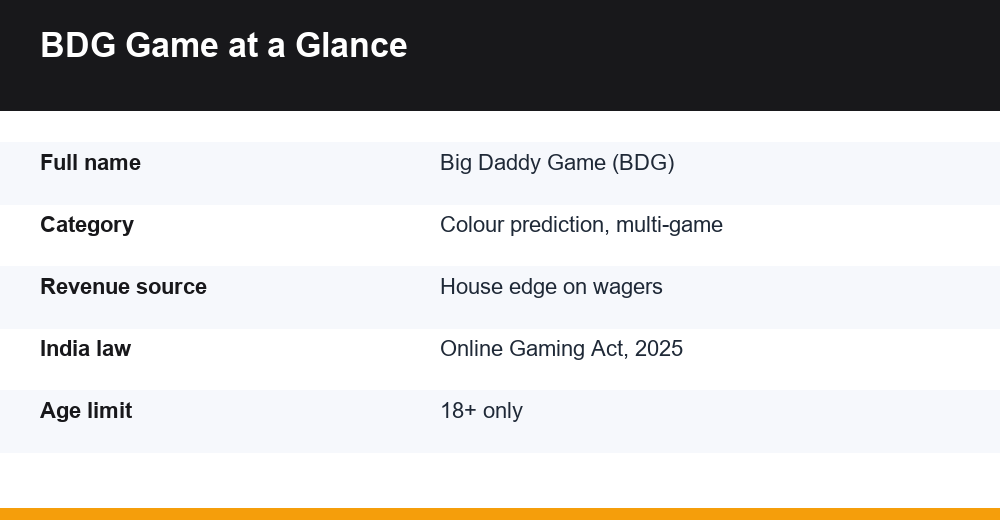
BDG Game, short for Big Daddy Game, is a typical example: a real-money colour-prediction and multi-game app aimed at players in India. Users pick a colour or number, a round closes within minutes, and the result is settled against the stake.
This article treats the platform as a business case, not a product recommendation, and nothing here encourages depositing or playing. Real money is at risk on such apps, outcomes are driven by chance with a built-in house edge, and they are strictly for adults aged 18 and over, and only where they are legal at all.
How the Model Actually Works
At its simplest, the model is a digital bookmaker wrapped in a casual-game interface. The operator sets the odds, takes bets in short rounds and keeps the statistical difference between what players stake and what is paid out over time. Strip away the bright colours and you find four building blocks that any founder will recognise:
- Monetisation: a structural margin on every round, known as the house edge.
- Engagement: rounds lasting a minute or a few minutes, which multiply the number of transactions per session.
- Acquisition: referral and agent commissions that turn existing users into a sales force.
- Payments: wallets topped up via UPI or similar rails, with withdrawals processed by the operator.
Each block is clever in isolation, but all four depend on one external permission: the legal right to take money for games of chance. And the incentives are inverted. A subscription product earns more when customers get more value; a wagering product earns more when customers lose more money over time.
Lessons 1 and 2: House Edge and Speed
Lesson 1: Know where your margin really comes from
Revenue here is not a subscription or a fee. It is the house edge: payouts are set slightly below what the true odds would justify. The player faces a negative expected value; the operator collects a predictable margin. The table below uses purely hypothetical numbers, not any real app’s odds, to show how a small edge works at scale.
| Illustrative item | Value | What it means |
|---|---|---|
| Stake per round | Rs 100 | Amount a user wagers |
| Assumed chance of winning | 45% | Hypothetical probability |
| Payout on a win | 2x (Rs 200) | Returned to the user |
| Expected return per Rs 100 | Rs 90 | 0.45 x Rs 200 |
| Expected operator margin | Rs 10 (10%) | Kept on average per round |
No strategy changes that arithmetic. “Prediction tools” and pattern-spotting cannot overcome an outcome set by the operator’s system. For founders, a margin taken quietly from customers is not a moat but a liability waiting for a regulator or a lawsuit.
Lesson 2: Speed multiplies everything, including harm
Short rounds raise transaction frequency, which raises gross revenue. They also compress decision time and encourage chasing losses. A player who stakes Rs 100 on sixty one-minute rounds has wagered Rs 6,000 in an hour, and the expected loss grows with every round. Products engineered for compulsive frequency attract the strictest scrutiny.
Lessons 3 and 4: Referrals and Payment Rails
Lesson 3: Referral engines scale reach, and liability
Colour-prediction apps grew largely through invitation codes, multi-level agent commissions and promotion in Telegram and WhatsApp groups. The user base itself became the marketing department.
That looks efficient on a spreadsheet. In practice, referral-driven acquisition spreads legal exposure to every promoter, and India’s 2025 law explicitly targets the advertising and promotion of online money games. And when commissions are tied to recruits’ deposits, promoters are rewarded for pushing friends and family to spend more.
Lesson 4: Your payment partners are your real regulators
Every real-money platform depends on someone moving money in and out. Banks and UPI-linked merchants are the narrowest point in the chain; when they withdraw, user balances can get trapped. The Act addresses this directly by barring banks and financial institutions from facilitating transactions for online money games. For founders in any regulated sector, payment rails can be switched off faster than any app store listing.
Lesson 5: The 2025 Act and Regulatory Sand
The Promotion and Regulation of Online Gaming Act, 2025 was passed by Parliament and received Presidential assent in August 2025. The Ministry of Electronics and Information Technology notified its commencement in April 2026, and the Act and the accompanying Online Gaming Rules took effect on 1 May 2026, alongside a newly constituted Online Gaming Authority of India. In brief, the Act:
- Prohibits offering, operating or facilitating online money games, whether they are framed as skill or chance.
- Prohibits advertising and promotion of such games, including by individuals and media.
- Bars banks and payment providers from processing related transactions.
- Sets criminal penalties, including imprisonment and fines, for operators, promoters and facilitators.
For real-money colour prediction, the impact is existential rather than incremental. The service sits squarely within the definition of an online money game, and no compliance tweak turns house-edge wagering into a permitted social game. This is a summary for business readers, not legal advice; anyone with exposure to the sector should read the official text of the Act and its rules and consult a qualified lawyer.
The wider principle is what strategists call regulatory sand: a business whose core revenue exists only because the law has not yet caught up. The law was signalled, debated and passed months before commencement; businesses that read the direction of travel early had time to pivot or exit, while those that treated the gap as a growth window simply accumulated exposure.
Lessons 6 and 7: Trust, Red Flags and Focus
Lesson 6: Trust signals are part of the product
There is no public evidence that justifies calling BDG Game a scam, and this article does not do so. But the category as a whole shows red flags that any customer, partner or investor should check before handing over money or reputation.
- No clearly named legal entity, registered address or regulator.
- Promises of “guaranteed” wins, prediction tricks or daily income.
- Withdrawal limits, sudden fees or requests to deposit more to unlock funds.
- Pressure from agents who earn commissions on your deposits.
Transparency is a feature, not paperwork. A named company, published terms and predictable withdrawals are what let customers extend trust. If you suspect fraud, report it on the national cybercrime portal (cybercrime.gov.in) or call the helpline 1930. If gambling is affecting your mood or finances, the government’s Tele-MANAS mental-health line is reachable on 14416.
Lesson 7: Protect founder attention from noise
The opportunity cost of these apps is real for founders too: hours spent chasing short rounds are hours not spent on customers, product or hiring. Practical time management techniques help guard those hours, and if you notice yourself reaching for an app instead of a hard task, our guide on how to stop procrastinating is a better investment than any colour prediction.
A Founder’s Checklist for Regulatory Risk
The same pattern appears in lending apps, crypto products, fantasy sports and unlicensed health services. Before you build or invest, run through these questions.
- Permission test: does the core revenue depend on a legal grey area that could be closed by one rule?
- Customer value test: would customers pay if they fully understood the economics?
- Partner test: would banks, app stores and ad platforms still serve you after scrutiny?
- Pivot test: do your assets, such as code, brand and audience, survive a ban in a lawful form?
Durable companies answer yes to most of these. Platforms built on wagering margins, opaque payouts and promoter networks rarely do, and that is the deepest lesson here: growth that ignores regulatory direction is borrowed time, not a moat.
A practical way to apply the checklist is a one-page “kill memo” written before launch. Describe the single rule change, payment decision or platform policy that would end the business, then estimate how many months of runway you would have to respond. For example, a team building a tipping feature for creators might note that a card network reclassifying tips as wagers would freeze payouts within weeks, and plan an alternative settlement route in advance.
There is a constructive side as well. Fast onboarding, tight feedback loops and community-led distribution are valuable skills when pointed at products that leave customers better off. Founders can borrow the craft while rejecting the economics.
Frequently Asked Questions
How does a colour-prediction app make money?
The operator sets payouts slightly below true probability and keeps the difference as a house edge. Growth relied on short rounds, referral commissions and payment wallets. Players face negative expected value, and real money is always at risk.
Are real-money colour-prediction apps legal in India now?
The Promotion and Regulation of Online Gaming Act, 2025 came into force on 1 May 2026 and prohibits online money games, their promotion and related payments. Real-money colour prediction falls within that ban. This is general information, not legal advice.
Can prediction tools help win colour games?
No. Results are chance-based and controlled by the operator’s system, with a built-in house edge. Tools or tips promising guaranteed wins should be treated as a red flag. Over many rounds, the expected outcome for players is a loss.
Where can I get help if I lost money or suspect fraud?
Report suspected online fraud at cybercrime.gov.in or call the national helpline 1930 as quickly as possible. If gambling is affecting your wellbeing, Tele-MANAS offers free mental-health support on 14416.