Good time management is not about squeezing more tasks into a day; it is about protecting your attention for the work that actually matters. Most people don’t need another app or a stricter schedule. They need a small set of reliable methods matched to the specific problem they keep running into.
Table of Contents
How to Pick a Technique That Fits
Every method here solves one of three problems: staying focused, deciding what to work on, or handling the flood of small tasks and requests. Trouble starts when you apply a focus tool to a priority problem, or a priority tool when the real issue is constant interruptions. The method isn’t wrong; it just wasn’t built for that job.
So before you adopt anything, name your bottleneck. If you sit down and can’t concentrate, you need focus techniques. If everything feels equally urgent, you need prioritisation. If your day dies by a thousand tiny tasks, you need workflow methods. The twelve techniques below are grouped in exactly that order, so you can jump straight to the ones that fit your day.
If you are not sure which bottleneck is yours, spend two or three ordinary days noting where the time actually goes and where the friction shows up. You will usually find that one problem dominates: either you cannot start, you cannot choose, or you cannot stop small tasks from taking over. Fix that one first. Chasing all three at once is how most attempts stall before they begin.
Techniques for Deep Focus
Focus techniques help you concentrate for longer and waste less time deciding what to do next. Reach for these when you sit down to work but can’t seem to get traction.
1. Time blocking
Time blocking means assigning specific calendar slots to specific tasks, then working only on the task that owns each slot. It removes the constant, draining question of what to do next, which is where a surprising amount of the day quietly leaks away. Plan your blocks the evening before, and leave gaps for the overruns and interruptions that always happen. Mornings then start with a plan instead of a decision.
2. Timeboxing
A close cousin of blocking, timeboxing adds a hard limit: you give a task 45 minutes, say, and stop when the time is up. It draws on Parkinson’s law, the observation that work expands to fill the time you allow it. Timeboxing shines on jobs that could otherwise sprawl forever, like polishing a proposal or tidying a report, and it is a quiet cure for perfectionism when a task is never quite finished.
3. The Pomodoro Technique
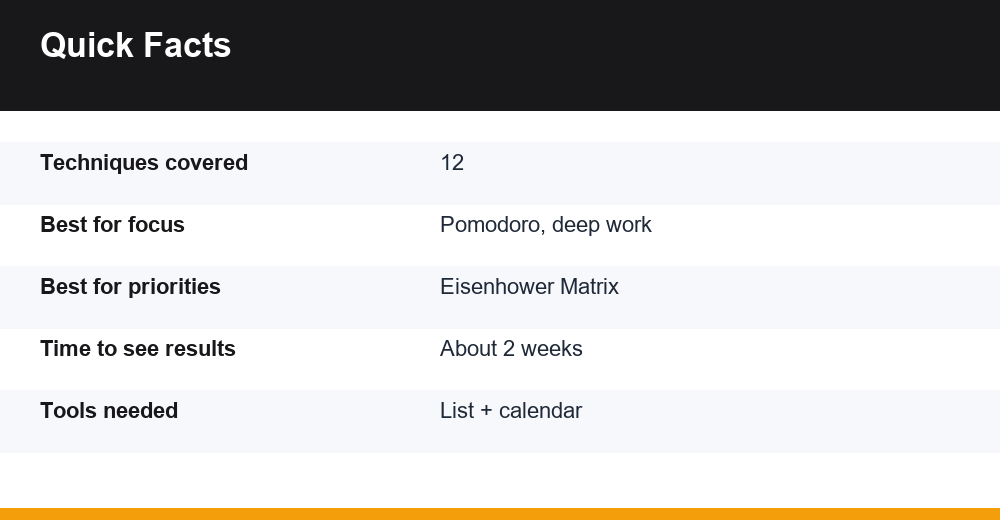
Created by Francesco Cirillo, the Pomodoro Technique breaks work into 25-minute focus sprints separated by five-minute breaks, with a longer break after four rounds. The short bursts make starting easy, since almost anything feels doable for 25 minutes, and the regular breaks stop fatigue from piling up. If short sprints keep interrupting demanding work, stretch them to 50 minutes with a 10-minute break; the ratio matters more than the exact numbers.
4. Deep work
Coined by Cal Newport, deep work is a long, distraction-free stretch on cognitively demanding tasks, the kind that genuinely move a project forward. Most people can sustain only a few genuinely focused hours a day, so treat that capacity as scarce rather than assuming you can stay sharp all afternoon. Begin with 60 to 90 minutes, silence every notification, and guard the block like a meeting you cannot reschedule.
None of these four fixes a lack of clarity about what to work on; they only help you execute once you have decided. If you find yourself focusing beautifully on the wrong things, the next group of methods is where you should start.
Techniques for Sharper Priorities
When every task feels urgent, these methods force an honest decision about what actually deserves your attention. Use them when you are working hard but the important things keep slipping to tomorrow.
5. The Eisenhower Matrix
The Eisenhower Matrix sorts every task into four boxes by urgency and importance. Do the urgent and important now, schedule the important-but-not-urgent, delegate the urgent-but-unimportant, and delete the rest. Its real value shows during weekly planning, when you can see the whole list at once and notice how much so-called urgent work is not actually important. That single realisation tends to change how you spend the entire week.
6. Eat the frog
Popularised by Brian Tracy, this rule says to tackle your hardest, most important task first thing, before email and meetings crowd it out. Finishing the ‘frog’ early builds momentum and guarantees the day’s biggest win is already banked by mid-morning, whatever chaos follows. Choose your frog the night before, so you don’t spend the first hour negotiating with yourself about whether you are really ready to start.
7. The 80/20 rule
The Pareto principle observes that roughly 80% of results come from about 20% of the effort. Applied to your work, it means finding the handful of activities that drive most of your outcomes and protecting them fiercely. A useful test: ask which tasks you would keep if you could only work two hours a day. Those are your 20%, and almost everything else is more negotiable than it feels.
Prioritising is uncomfortable because it means admitting some tasks will never get done, and that is exactly the point. A list where everything is a priority is really no list at all.
Techniques for a Smoother Workflow
The last five methods tame the small, endless tasks, messages and requests that quietly consume a working day. Reach for these when your calendar looks fine but the hours still seem to disappear.
8. The 2-minute rule
From David Allen’s Getting Things Done, the two-minute rule is simple: if a task takes less than two minutes, do it now rather than filing it for later. It keeps tiny jobs from compounding into an overwhelming backlog of loose ends. The catch is timing, so save these quick wins for a dedicated processing window, not the middle of focused work, or you will never stay in the zone long enough to do anything hard.
9. Task batching
Task batching means grouping similar work and handling it together: answer email in two set windows, make all your calls in one block, run errands in a single trip. Every switch between different kinds of work carries a hidden cost as your brain reloads context, and batching cuts that tax dramatically. It works best for repetitive, low-creativity tasks that don’t need deep thought, which is precisely the work that tends to fragment a day.
10. Getting Things Done (GTD)
Getting Things Done, David Allen’s full system, rests on one idea: your mind is for having ideas, not holding them. You capture every commitment in a trusted external list, decide the very next physical action for each, and review the whole system once a week. It has a real learning curve, so it is overkill for a simple week, but it suits people juggling dozens of small commitments across many projects.
11. Energy management
Not every hour is equal. Track when you feel sharpest, often called your biological prime time, and reserve those windows for demanding work while pushing admin and email to your low-energy stretches. Matching hard tasks to high-energy hours frequently does more for your output than any clever scheduling trick, because you are working with your body’s natural energy instead of against it. A week of honest notes usually reveals a clear pattern.
12. Learning to say no
Every yes is a claim on hours you can’t get back. Learning to say no to low-value meetings and requests is what protects the blocks you have set aside for real work; often a short written update replaces a half-hour meeting entirely. This works best when your priorities are already clear, so read our guide on how to set goals to decide what actually earns a yes.
Together these five methods handle the friction of a busy role, the pings, hand-offs and quick asks that never appear on your official to-do list but still eat the day.
The 12 Techniques at a Glance
Use this table to match a time management method to the problem you are actually trying to solve, and to the kind of work it fits best. Start with the row that describes your day most accurately. The effort column is a rough guide to how much setup each one needs before it pays off, which matters when your time is already tight.
| Technique | Best for | Effort to start | Use it when |
|---|---|---|---|
| Time blocking | Structuring the day | Low | Your day feels shapeless |
| Timeboxing | Tasks that sprawl | Low | Perfectionism slows you |
| Pomodoro | Starting and focus | Very low | You keep procrastinating |
| Deep work | Complex projects | Medium | Output needs full focus |
| Eisenhower Matrix | Prioritising | Low | Everything feels urgent |
| Eat the frog | Beating avoidance | Very low | You dodge the hard task |
| 80/20 rule | Finding leverage | Medium | Busy but not moving |
| 2-minute rule | Clearing small tasks | Very low | Little jobs pile up |
| Task batching | Reducing switching | Low | You multitask all day |
| GTD | Managing many tasks | High | Commitments overwhelm you |
| Energy management | Timing hard work | Medium | Focus swings by the hour |
| Saying no | Protecting time | Low | Your calendar gets hijacked |
Why Time Management Techniques Fail
Most time management systems collapse for predictable reasons, and rarely because the method itself is broken. Spotting these traps early is half the battle, so watch for the four below.
- Adopting too much at once. Layering five new habits on a Monday almost guarantees you will have dropped all of them by Friday. Change one thing at a time.
- Fighting your natural rhythm. A rigid 5am routine will fail if you genuinely think best at night. Build the system around your energy, not against it.
- Using the wrong tool for the job. A focus method won’t fix a priority problem, and a tidy to-do list won’t manufacture concentration you don’t have.
- Mistaking busy for effective. Ticking off ten trivial tasks can feel productive while the single task that actually matters slides to tomorrow, and the day after.
The remedy is modest ambition. Pick one technique, run it for two weeks until it feels automatic, and only then add a second.
Building Your Own System
You don’t need all twelve methods, and trying to use them at once is the fastest way to quit. People who stay consistent usually combine just two or three: one to set priorities, one to protect focus, and one to clear small tasks. That is enough to cover the three problems every busy day throws at you.
A workable stack might look like this: run the Eisenhower Matrix each Sunday to set the week’s priorities, block your calendar around your energy peaks, and do a two-minute-rule sweep twice a day for the small stuff. That is a complete, realistic time management system, and it fits on a sticky note rather than in a manual.
Start where the pain is sharpest, keep the setup light, and expect to adjust as you learn what sticks. The right software helps too, automating reminders and calendar blocks instead of adding busywork; our roundup of the best productivity tools is a sensible place to look. Whatever you pick, the aim of time management never changes: less friction, and more of your attention on the work that counts.
Whatever combination you land on, add a recurring note to review it once a month. Habits drift, workloads change, and a routine that suited a quiet quarter can buckle under a busy one. Ten minutes spent asking what is still working, what has slipped, and what needs dropping will keep the system honest far longer than willpower alone.
Frequently Asked Questions
What is the best time management technique?
There is no single best one; it depends on the problem you are solving. For focus, try the Pomodoro Technique or deep work. For priorities, use the Eisenhower Matrix or eat the frog. For a flood of small tasks, batch them or apply the two-minute rule. Match the method to your bottleneck.
How long before a new method actually works?
Give any technique at least two weeks of daily use before you judge it. New habits feel awkward at first, and that early friction is completely normal, not a sign of failure. If a method still feels forced after a month, it probably does not suit your work, so calmly swap it for another.
Can I combine several methods?
Yes, and most consistent people do. A practical mix is one method for prioritising, one for focusing, and one for small tasks. The key is to add them one at a time rather than all at once, giving each habit room to take hold before you introduce the next one.
Do I need special apps to manage my time well?
No. A paper list and a calendar can run every technique on this list. Apps help by automating reminders and cutting friction, but they do not build the habit for you. Choose the method first, then add a tool only if it genuinely removes busywork rather than creating more of it.