
Learning how to set goals is the difference between a business that drifts and one that moves with intent. Most founders and professionals fall short not for lack of ambition but because their goals stay vague, unmeasured, and disconnected from daily work. This guide gives you a practical, no-hype system you can start using today.
Table of Contents
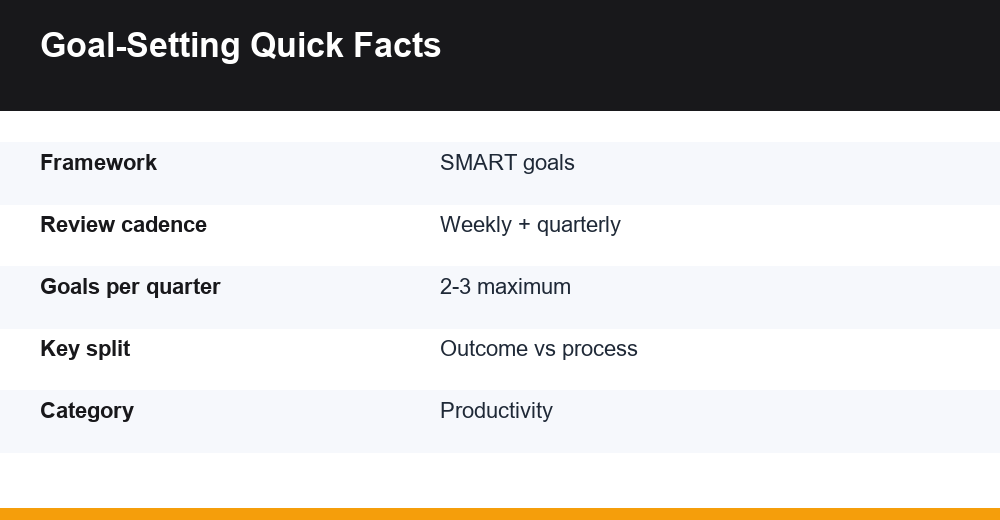
Why Most Goals Fail Before You Start
Most goals fail in the execution, not in the ambition. When a goal collapses, the cause is rarely a shortage of willpower; it is usually a shortage of structure. A target that lives only in your head has to compete with every urgent email, every problem, and every distraction, and it tends to lose that competition a little more each day.
The most common trap is fixating on the finish line while ignoring the work that gets you there. You write ‘grow revenue’ or ‘get in shape,’ feel motivated for a week, then let the daily grind crowd the goal out. The intention was real; the system was missing.
- The goal is too vague to act on, like ‘be more productive.’
- There is no deadline, so it never feels urgent.
- It is never written down, so it is never reviewed.
- It ignores real constraints such as time, cash, and energy.
- Daily habits pull the other way, which is often a procrastination problem rather than a planning one.
In a company, the same failure shows up at team scale. A goal announced in a kickoff meeting but never assigned an owner, a metric, or a review date is effectively decoration. Everyone nods, nobody moves, and by the next quarter it has been quietly forgotten.
Decades of research on goal-setting theory found that specific, challenging goals reliably outperform vague ‘do your best’ intentions. You can read a neutral overview of that work on Wikipedia’s goal-setting page. The practical lesson for busy operators is that a clear structure matters more than a burst of motivation.
How to Set Goals That Actually Get Done
Knowing how to set goals well comes down to a repeatable sequence, not a burst of inspiration. Treat it as a process you run every quarter, the same way you would run payroll or a sales pipeline. Reliability comes from the routine, not the mood.
- Name the outcome you actually want, in plain language.
- Make it SMART so it is specific and measurable.
- Split it into process goals, the weekly actions you control.
- Schedule those actions into your calendar, not a wish list.
- Track progress and review on a fixed cadence.
Write each goal down and keep it somewhere you see often. A goal you have to remember competes with everything else in your head, while a goal on the page in front of you does not. This single step sounds trivial, but it is often what separates a plan you act on from one you forget by the second week.
The order matters. People who learn how to set goals but skip the scheduling step end up with a tidy plan and no execution. A goal that never lands on your calendar rarely gets done. Time is the resource every plan spends, so commit it deliberately.
Why quarterly? Ninety days is long enough to achieve something real but short enough to stay urgent. Annual goals feel distant for eleven months and rushed for one. Quarterly cycles keep the deadline close enough to matter and give you four clear chances a year to reset and improve.
Keep the list short. Two or three meaningful goals per quarter will beat ten you abandon by February. For small teams especially, focus is a real advantage, because it is the thing larger, slower rivals struggle to copy.
The SMART Goals Framework, Explained
SMART is the most useful filter for turning a fuzzy wish into a workable target. It will not do the work for you, but it will stop you from committing to something you cannot act on. Each letter closes a specific gap that lets goals slip.
| Letter | What it means | Weak → strong |
|---|---|---|
| Specific | Exactly what, and why | ‘Get more clients’ → ‘Sign 5 retainer clients’ |
| Measurable | A number you can check | ‘Grow traffic’ → ‘Reach 10k monthly visits’ |
| Achievable | Realistic for your resources | Ambitious, but not fantasy |
| Relevant | Tied to a real priority | Moves the business, not vanity metrics |
| Time-bound | A firm deadline | ‘Someday’ → ‘By March 31’ |
The hardest letter to judge is usually Achievable. Set the bar too high and you quit the first week you fall behind; set it too low and the goal never pulls any real effort out of you. Aim for a target that feels demanding but not absurd, then adjust it at your next review if the evidence says you were wrong.
A quick example: ‘launch a podcast’ is a wish. ‘Publish eight podcast episodes by June 30, releasing one every two weeks’ is a real target. Same idea, but now you know exactly what done looks like, and you will notice the first week you fall behind.
Run every goal through these five checks before you commit to it. If it fails even one, rewrite it until it passes. A goal you cannot measure is a goal you cannot manage or improve.
Outcome Goals vs Process Goals
This distinction is where most guides stop short, and it is the single biggest upgrade you can make to how you plan. Get it right and your goals become far easier to act on day to day.
An outcome goal is the result you want: ‘reach $200k in annual revenue.’ A process goal is the behaviour that produces it: ‘send ten sales emails every weekday.’ One is the scoreboard; the other is how you actually play the game.
The catch is control. You do not fully control outcomes, because the market, timing, and plain luck all interfere, but you do control your process. The practical takeaway is to focus on the process, since the process is the part your daily effort can actually change.
- Use outcome goals to set direction and define what winning looks like.
- Use process goals to decide what you do each day.
- Judge yourself on the process and let the outcome follow.
A concrete example helps. You cannot force a prospect to sign, but you can control how many qualified prospects you contact each week. Commit to the input you control, and over enough weeks the outcome you want becomes far more likely, even though no single day guarantees it.
You still need both. Outcome goals without process leave you anxious and directionless; process goals without an outcome can drift into busywork that feels productive but leads nowhere. Pair them so the daily actions always ladder up to a result that matters.
For a founder, this reframes a slow month. If you hit your process every day, you are on track even when the numbers lag behind, and you protect your confidence during the stretches when results are still catching up.
Break Big Goals Into Weekly Actions
A goal that spans a whole quarter is too big to act on directly. You have to break it down until the very next step is obvious and small enough to finish in a single focused work session. Clarity lives in the details.
- Write the quarterly outcome at the top of the page.
- List the three or four milestones that must happen to reach it.
- Turn each milestone into concrete weekly process actions.
- Assign those actions to specific days and time slots.
Say the outcome is ‘sign five retainer clients this quarter.’ A milestone might be ‘build a pipeline of twenty qualified leads.’ The weekly action becomes ‘have five sales conversations,’ and the daily version is ‘send four personalised outreach messages.’ Now the goal is something you can literally do on a Tuesday morning.
When a task still feels vague, ask what the very next physical action is. Not ‘improve the website’ but ‘write the headline for the home page.’ A step that small removes the friction of starting, and starting is usually the hardest part of any goal you set.
The final step is the one most people skip: putting the actions where your time actually is. Solid time-management techniques, such as time-blocking, batching similar tasks, and protecting a daily focus window, are what turn a tidy plan into hours genuinely defended against interruptions.
Aim for small, consistent actions rather than occasional bursts of effort. A little done regularly compounds far faster than a big push followed by a long silence.
How to Track and Review Progress
Tracking is what keeps a goal alive. Without a simple review loop, you rarely notice you have drifted until the deadline arrives and the gap is too large to close. The point of tracking is not judgement; it is early warning.
Pick one simple system and keep it visible, whether a spreadsheet, a paper notebook, or a tool such as Trello, Notion, or Asana. The specific tool matters far less than the habit of opening it every week. The best system is the one you will actually maintain.
- Track both process (did I do the actions?) and outcome (did the number move?).
- Run a short weekly check-in: what worked, what slipped, what is next.
- Run a deeper monthly or quarterly review to adjust the goal itself.
It helps to watch two kinds of number. A lagging indicator is the result itself, such as revenue, which moves slowly and confirms the past. A leading indicator is an action that predicts it, such as sales calls booked, which you can change this week. Track both, but act mainly on the leading numbers.
Keep the review honest. It is tempting to explain away a missed week, but the review only works if you record what actually happened, not what you meant to do. Patterns emerge quickly: if the same action slips three weeks running, the problem is the plan, not your character, so change the plan.
In each weekly review, ask three questions: Am I on pace? What is blocking me? What is the single most important action for next week? This short loop is also where you will notice when it is time to learn how to set goals that are more realistic, or, just as often, more ambitious.
Staying Motivated When It Gets Hard
Motivation is unreliable fuel, so build systems that do not depend on it. What looks like discipline in other people is usually good design, because they have arranged things so the useful action is also the easy one.
- Make the next action tiny, so starting takes almost no willpower.
- Track a visible streak; steady momentum is motivating on its own.
- Tell someone your goal, since a commitment to another person tends to improve follow-through.
- Reward milestones along the way, not only the finish line.
- Shape your environment so the useful choice is the default.
It also helps to connect the goal to a reason bigger than the metric, such as more freedom, a steadier business, or a team you can pay reliably. When the work gets dull, and it will, that underlying reason is what carries you through the middle stretch where most goals are abandoned.
Design for your worst days, not your best ones. Anyone can push toward a goal when energy is high; the system earns its keep when you are tired, busy, or discouraged. If your plan only works on good days, it is not a plan yet, it is a wish.
Expect dips, because they are normal and not a verdict on your character. The goal was never a flawless record; it is getting back on track quickly after you slip. Over a full quarter, consistency matters more than a perfect week.
A SMART Goal Example and Simple Template
Here is how the pieces fit together in practice. Start with the worked example, then copy the template underneath it and fill in the blanks for a goal of your own.
A SMART goal example
‘Grow monthly recurring revenue from $8k to $12k within one quarter by signing three new retainer clients, driven by ten outreach emails and two discovery calls each week.’ It is specific and measurable, realistic for a small team, clearly relevant, and time-bound, and it builds the process right into the target.
A simple goal template
Copy this, fill in each blank, and keep it somewhere you will see daily:
- Outcome goal: I will [result] by [deadline].
- Why it matters: [the real reason behind it].
- Milestones: [three or four checkpoints].
- Weekly process actions: [what I do, and on which days].
- How I will track it: [the tool or metric].
- Review cadence: [weekly check-in plus a monthly review].
Once this is filled in, you have done the genuinely hard part; the rest is showing up. Knowing how to set goals is a skill, and like any skill it sharpens with every quarter you run the cycle. Start with one goal this week and let the system prove itself.
Goals are not a one-off event; they are a loop you get better at running. Your first quarter will be messy and your fourth will feel natural, and by then the difference in what your business has actually shipped will be clear in the numbers.
Frequently Asked Questions
How many goals should I set at once?
Fewer than you think. Two or three meaningful goals per quarter is plenty for most founders and professionals. Splitting your attention across ten goals almost guarantees none get real traction. Pick the few that move the business most, and give them your best hours.
What is the difference between a goal and a habit?
A goal is the destination; a habit is the vehicle. Goals define what you want and by when. Habits are the repeated daily actions, your process goals, that carry you there. Strong goals eventually turn into habits you no longer have to force.
How often should I review my goals?
Do a short weekly check-in on your process actions and a deeper monthly or quarterly review of the goals themselves. Weekly keeps you on pace; the longer review lets you adjust targets, drop what is not working, and reset before the next cycle begins.
Are SMART goals still worth using?
Yes, as a filter rather than a rule to worship. SMART forces the clarity, measurement, and deadlines that fix the vagueness behind most failed goals. Just pair it with process goals so you know the daily actions, not only the target. Together they cover both the what and the how.