Most founders build their pitch deck slides as a list of topics, yet investors read them as a list of questions that need answers. This guide goes slide by slide through what an investor actually checks, how a send-ahead deck differs from the one you present, and the red flags that get a deck closed early.
Table of Contents
The 10 essential pitch deck slides
Ask ten investors which slides belong in a startup deck and you will get ten slightly different orders. The content barely changes, though. Every early-stage deck has to prove the same few things: a painful problem exists, you solve it in a way people pay for, the market is large enough, and your team can win it.
The table below is the core set of pitch deck slides that accelerators and seed investors expect to see. Treat it as a framework, not a template. You can merge slides, reorder them to fit your story, or add one that matters for your business, such as regulation in health or fintech.
| # | Slide | Question it answers | What the investor checks |
|---|---|---|---|
| 1 | Title / one-liner | What do you do? | Can they repeat your company in one sentence? |
| 2 | Problem | Who hurts, and how much? | A specific customer, a measurable cost, evidence it is real |
| 3 | Solution | How do you fix it? | A clear link back to the problem, not a feature list |
| 4 | Product | What does it look like? | Something real: a live product, beta or working prototype |
| 5 | Market size | How big can this get? | Bottom-up maths and a believable first segment |
| 6 | Business model | How do you make money? | Pricing, who pays, rough unit economics |
| 7 | Traction | Is anyone buying? | Growth rate, retention, revenue or signed pilots |
| 8 | Competition | Why you and not them? | Honest alternatives, including doing nothing |
| 9 | Team | Why can you win? | Relevant experience and who owns which job |
| 10 | The ask | What do you need? | Amount, runway, milestones the money unlocks |
A go-to-market slide is the most common eleventh addition, and many investors like to see it. If your distribution plan is the real edge of the business, give it its own slide rather than squeezing it into the business model. A ‘why now’ slide is another frequent extra when timing is a big part of the case.
What investors check on each slide
Listing the slides is the easy part. The harder part is knowing what a reader is testing when they land on each one. Use this checklist to stress-test your draft before anyone outside the company sees it.
Title and problem
- Title: company name, a one-line description in plain words, and contact details. If the one-liner needs jargon, it is not ready.
- Problem: name the customer, describe the pain in their terms, and put a number on it: hours lost, money wasted, risk carried.
- Show why the problem is getting worse or newly solvable now. Timing is a quiet question behind almost every deck.
Solution and product
- The solution slide should read as the obvious answer to the problem slide. If the two could be swapped into another deck, rewrite them.
- On the product slide, show the thing itself: a clean screen, a workflow, a photo of the device. One clear visual beats five crowded ones.
- State what is built today versus what is planned. Investors notice when roadmap features are dressed up as shipped ones.
Market and business model
- Avoid the single giant top-down figure. Build the market from customers multiplied by price, then name the first segment you will win.
- For the model, say who pays, how much, and how often. Add gross margin or customer acquisition cost if you know them.
- If numbers are early, label them as estimates and show the assumptions. Hidden assumptions cost more trust than modest ones.
Traction, competition, team and ask
- Traction: one chart with a clear trend, a time axis and a real metric. Retention or repeat purchase often says more than raw sign-ups.
- Competition: a grid or table that includes the spreadsheet, the agency or the manual workaround customers use today.
- Team: two or three lines per founder on why their background fits this problem, plus key hires or advisers.
- Ask: the amount, the runway it buys, and the two or three milestones that will make the next round easier.
The ask slide only works if the numbers behind it hold up. The U.S. Small Business Administration’s guide to writing a business plan walks through the funding request and financial projections sections, which give you a sound base for the figures on this slide. For the wider picture of rounds, grants and loans, see our guide to startup funding.
How many slides should a pitch deck have?
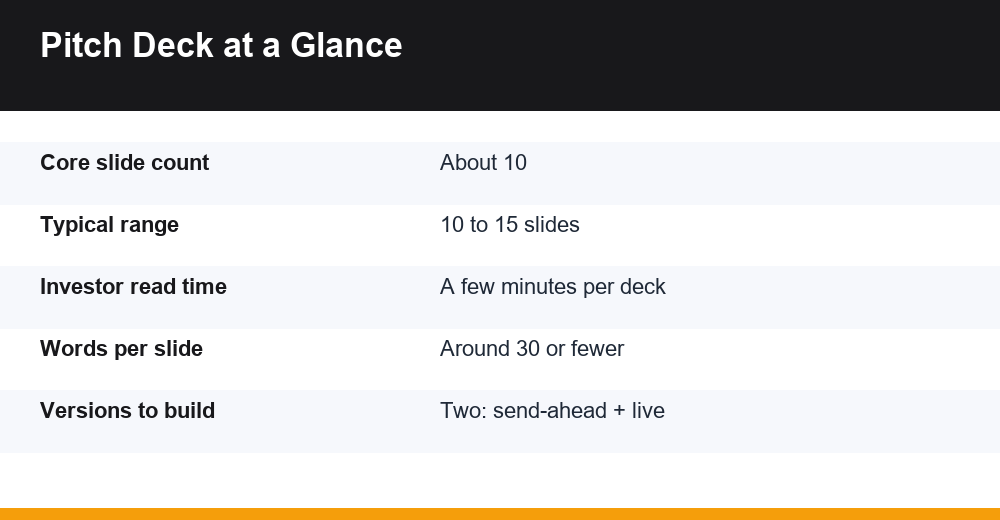
For a first meeting, aim for about 10 core slides, with a practical range of 10 to 15. Sequoia’s widely shared business plan format covers roughly ten topics, and most accelerator guidance lands in the same place. Below ten, something important is usually missing. Well above fifteen, the story tends to lose its thread.
The count matters less than density. A useful rule is one idea per slide, with roughly 30 words of text or fewer on a presenting deck. If a slide needs a paragraph to make sense, it is probably two slides, or one slide plus a spoken explanation.
Stage changes the balance rather than the total. A pre-seed deck leans on problem, team and early signals, while a later seed or Series A deck gives more room to traction, unit economics and go-to-market. Context matters too: a short demo-day pitch may only have time for six or seven slides, so cut rather than cram.
What investors look at first
Investors skim fast. DocSend’s widely cited study of how decks are read found an average review time of under four minutes, and its later data has suggested that window has shrunk further. The same research found readers spent the most time on the financials, team and competition slides.
In practice, a first pass often follows a pattern like this:
- The title slide, to see whether the one-liner is clear and the space is one they invest in.
- Traction or financials, or the closest proxy for them, to judge whether the company is real.
- The team, to decide whether these founders fit this problem.
- The ask, to check whether the round size and stage match their fund.
- Only then the problem, market and product detail, if the first four earned it.
That order explains why the opening slide must do so much work. If you cannot say what you do in one sentence, investors will not dig for it. Practise that sentence out loud first; our elevator pitch guide covers how to tighten it until it sticks.
What is the most important slide in a pitch deck?
If one slide had to carry the whole deck, most investors would pick traction for companies with customers and the team for companies without them. Traction is proof that replaces argument. Every other slide is a claim; this one is evidence.
Traction does not have to mean revenue. At pre-seed it can be a waitlist that converts, paid pilots, letters of intent, or strong retention from a small group of users. What investors want is a sign that real customers pull the product toward them rather than needing to be pushed.
That pull is the core of product-market fit, and it is the reason a strong traction chart makes the other pitch deck slides easier to believe. A large market and a good team look far more credible when the numbers already point in the right direction.
When the team slide matters more
Deep-tech, biotech and hardware startups often raise before meaningful traction exists. Here, the team slide carries more weight: published research, prior exits, patents, or years spent inside the industry being changed. Be specific. ‘Ten years in logistics’ says less than ‘ran routing for a 400-truck regional fleet’.
Should you send your deck before the meeting?
Usually yes, but not the same file you present. Many investors ask to see a deck before they agree to a call, while others prefer a short teaser first. Check the fund’s website or ask; the preference is often stated. Either way, build two versions of your pitch deck slides from the same story.
| Feature | Send-ahead deck | Presenting deck |
|---|---|---|
| Purpose | Stands alone without you | Supports you while you talk |
| Text | Full sentences, self-explanatory | Short headlines, few words |
| Length | 10 to 15 slides plus appendix | Around 10 slides |
| Data | Key numbers with sources and dates | One headline number per slide |
| Visuals | Labelled charts readable on a phone | Large visuals for a shared screen |
| Format | PDF or tracked link | Slides in presenter mode |
The send-ahead version has to survive a reader who has never met you, often on a phone between meetings. The presenting version can leave gaps that you fill out loud, which keeps the audience listening to you rather than reading ahead.
- Export the send-ahead deck as a PDF so fonts and layout do not break on another device.
- Name the file clearly: company, round, month and year.
- Keep confidential details such as customer names or pricing terms for a later data room if you are unsure who will see the file.
- Put extra material in an appendix: detailed financials, press mentions, customer quotes, technical architecture.
Red flags that end the read
Investors see a large volume of decks, so they look for reasons to say no quickly. These are the issues that most often stop a reader before the end of your pitch deck slides.
| Red flag | Why it hurts | Fix |
|---|---|---|
| ‘No competitors’ | Signals naivety or no market | Show today’s workarounds honestly |
| Top-down market only | Looks like a guess | Build bottom-up from price x customers |
| Hockey-stick forecast with no drivers | Numbers feel invented | Show assumptions behind each line |
| Vanity metrics | Sign-ups without usage prove little | Use retention, revenue or active use |
| No clear ask | Investor cannot judge fit | State amount, runway and milestones |
| Walls of text | Reader skims and misses the point | One idea per slide, move detail to appendix |
| Mismatched numbers | Raises doubts about rigour | Check every figure matches everywhere |
A further warning sign is a team slide that hides gaps. If no one on the team has built or sold to this customer before, say how you will cover that, whether through an adviser, an early hire or a design partner. Investors find unexplained gaps more worrying than acknowledged ones.
A final check before you share
Before your pitch deck slides leave your laptop, run through this short list. It takes about twenty minutes and catches most of the problems that cost founders a second meeting.
- Read only the slide headlines in order. Do they tell the full story on their own?
- Give the send-ahead PDF to someone outside your industry. Can they explain the business back to you in a minute?
- Check that every number matches across slides, the appendix and your financial model.
- Date your metrics so a reader knows how fresh they are.
- Confirm the ask slide states the amount, runway and milestones.
- Open the file on a phone to make sure charts and text are readable.
A good deck does not raise the money by itself. Its job is to earn the meeting and then make the conversation easier. Keep it short, lead with evidence, and let every slide answer the question an investor is already asking.
Frequently Asked Questions
What slides should be in a startup pitch deck?
Most early-stage decks cover ten topics: title, problem, solution, product, market size, business model, traction, competition, team and the funding ask. Many founders add a go-to-market slide as an eleventh. Detailed financials, customer quotes and technical notes belong in an appendix, so the main story stays short while the supporting detail remains available for investors who want it.
How many slides should a pitch deck have?
Aim for about 10 core slides for a first meeting, with a workable range of 10 to 15. Fewer than ten usually leaves out something investors expect, while many more tends to bury the story. Keep each slide to a single idea and move supporting detail, such as full financial models, into an appendix at the end.
What do investors look at first in a pitch deck?
Investors typically skim the one-liner on the title slide, then jump to traction, the team and the funding ask to judge whether the company is real and fits their fund. DocSend’s research suggests average review time is only a few minutes, so those slides must make sense at a glance or the rest may never be read.
Should you send your pitch deck before the meeting?
Usually yes, as many investors want to review a deck before agreeing to a call, though some prefer a short teaser first. Send a self-explanatory PDF version written to be read without you, and keep a lighter, more visual version for presenting live. Check each investor’s stated preference on their website before sending.