Learning how to start a small business is less about one brave leap and more about a sequence of small, deliberate decisions made in the right order. This guide walks you through ten practical steps, from testing your idea to landing your first paying customers, with no hype and no promises of overnight riches. Because legal and tax details differ from place to place, treat the specifics below as an adaptable framework rather than a fixed rulebook.
Table of Contents
How to Start a Small Business: The 10-Step Overview
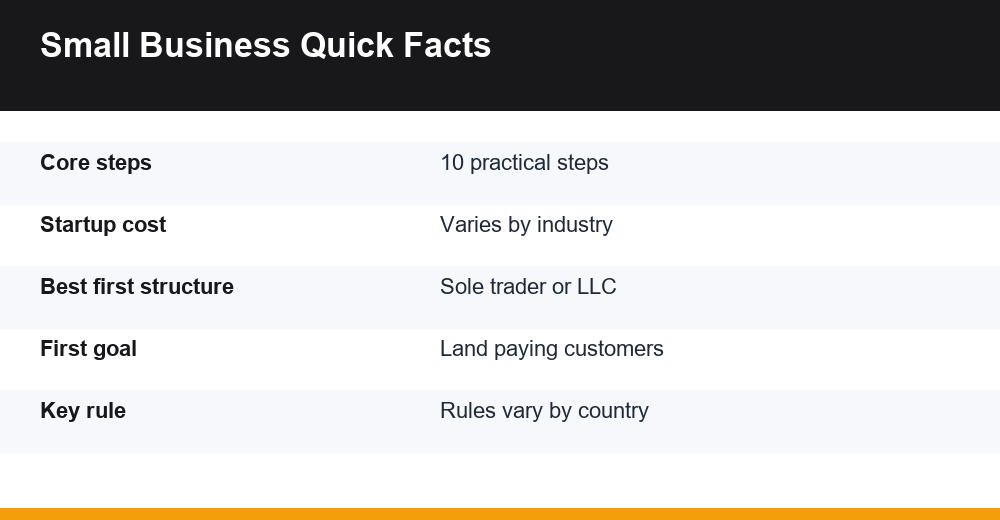
Most founders who succeed follow a similar path, even across very different industries. When people ask how to start a small business, they usually want a clear order of operations, not a motivational speech. The ten steps below move from raw idea to real income, and depending on your field you can work through them in a few weeks or across several months.
Two principles run through every step. First, spend as little money as possible until real customers confirm they will pay, so validation always comes before investment. Second, keep your records clean from the very first transaction, which keeps tax filing, loan applications and future growth simple instead of turning them into a scramble.
| Phase | Steps | Goal |
|---|---|---|
| Foundation | 1-2: Idea and validation | Confirm real demand |
| Setup | 3-4: Plan and structure | Choose a legal footing |
| Compliance | 5-6: Register and finances | Operate legally, track money |
| Growth | 7-9: Price, market, sell | Turn effort into revenue |
| Scale | 10: Tools | Save time, stay organized |
Use the roadmap above to see how the phases connect, then work through the detailed steps that follow. Each one builds on the last, so resist the urge to jump ahead to marketing before you have confirmed anyone actually wants what you plan to sell.
Steps 1-2: Find an Idea and Validate Real Demand
Every durable business begins with a problem worth solving for people who already spend time or money trying to fix it. Start from what you know, whether that is your job experience, a hobby you have mastered, or your own daily frustrations, rather than chasing whatever looks trendy this year. Passion helps you persist, but demand is what pays the bills.
If you are still weighing directions, our roundup of small business ideas can help you generate options to compare. Whatever you land on, remember that the idea itself matters far less than the strength of the demand sitting behind it.
Before spending real money, test whether people will actually buy. Pre-sell to a small group, publish a simple landing page that collects sign-ups, or offer your service to your first five customers at a genuine price. Enthusiasm is cheap and easy to give; a deposit, a pre-order, or a signed agreement is the proof that counts.
- People pay a deposit or pre-order before you build anything
- Strangers, not just friends, say yes at your real price
- You can name a specific customer and where they already look for solutions
- Existing competitors are busy, which proves the market exists
If you cannot find anyone willing to commit, treat that as valuable information rather than failure. It is far cheaper to change direction now than after you have spent months building something nobody wanted.
Steps 3-4: Write a Lean Plan and Choose a Structure
You do not need a forty-page document to begin. A one-page plan that answers four questions, namely what you sell, who buys it, at what price, and how you reach them, is enough to launch and refine. Add your expected costs, your break-even point, and clear goals for your first ninety days.
Next comes your legal structure, which shapes your taxes, your paperwork, and how much personal liability you carry. The best choice depends on your risk level, your country, and whether you are going it alone or with partners. The table below compares the most common options in general terms.
| Structure | Best for | Trade-off |
|---|---|---|
| Sole proprietor / trader | Solo, lower-risk starts | Simple, but no liability shield |
| Partnership | Two or more owners | Shared control and shared risk |
| Limited company / LLC | Most growing businesses | Liability protection, more admin |
| Corporation | Raising outside investment | Strongest shield, most compliance |
Names and rules differ by country: what is an LLC in the United States might be a private limited company in the UK or India, or a GmbH in Germany. The underlying concept of separating your personal assets from the business is similar, but the paperwork is not. Confirm the local equivalent before you commit.
Steps 5-6: Registration, Licensing, and Business Money
Registration is one part of how to start a small business that you genuinely cannot skip. Once you have chosen a structure, you make it official by reserving a business name, filing the formation documents, and obtaining a tax identification number. Because requirements vary widely, read our guide on how to register a business and confirm each step with your local authority.
Many trades also need a specific licence or permit, with food service, childcare, construction, healthcare, and finance being common examples. National portals list what applies to your activity. In the United States, for instance, the U.S. Small Business Administration publishes plain-language checklists, and most countries run an equivalent agency. Operating without a required licence can mean fines or closure, so check before you trade.
From your very first sale, keep business and personal money apart. Open a separate business bank account, choose straightforward accounting software, and set aside a fixed share of every payment for tax. Tidy books make you look professional to lenders and protect you if you are ever audited.
- Open a dedicated business bank account
- Use accounting software such as QuickBooks, Xero, or Wave
- Track every expense and keep digital copies of receipts
- Reserve a share of each payment for tax from day one
Building good financial habits early is far easier than untangling a year of mixed transactions later. Automate what you sensibly can, and review your numbers monthly rather than waiting for a once-a-year panic.
Step 7: How to Price Your Product or Service
Pricing is where many new owners quietly sink themselves: they undercharge, win plenty of customers, and still run out of cash. Your price has to cover your costs, pay for your time, and leave a margin for growth, not merely undercut a competitor. Most businesses end up blending the three approaches below.
| Method | How it works | Best when |
|---|---|---|
| Cost-plus | Add a markup to total cost | Costs are easy to calculate |
| Competitor-based | Price near the market rate | The market is crowded |
| Value-based | Price on the outcome delivered | You solve a costly problem |
Whatever mix you choose, calculate your true cost first, including your own hourly time and the tools you depend on. A price that ignores your labour is not really a price at all; it is a slow, invisible loss.
Raising prices later is normal and expected, so do not feel you must win every early deal on price. A slightly higher rate with fewer, better-fit clients almost always beats a race to the bottom that leaves you overworked and underpaid.
Steps 8-9: Marketing and Your First Customers
Knowing how to start a small business is only half the job; the other half is getting people to notice and buy. You do not need to be everywhere at once. Pick two or three channels where your customers already spend their time and show up on them consistently, rather than spreading yourself thin across all of them.
- A simple website plus a Google Business Profile for local search
- One or two social platforms your audience genuinely uses
- Email, which remains the highest-return channel for repeat sales
- Word of mouth and referrals from happy early customers
Your first ten customers rarely arrive through paid ads. They come from people you already know, direct outreach, and being visible where your market gathers, whether that is a local group, an online community, or a trade event. Ask for the sale plainly, then deliver more than you promised.
Once those early customers are happy, ask each of them for a review or a referral. A handful of genuine recommendations builds far more trust than any launch campaign, and it costs you nothing but the small courage it takes to ask.
Step 10: Choose Tools That Save You Time
The right software removes busywork so you can spend your hours on customers and product. Start lean and add tools only when a real bottleneck appears, because an over-engineered stack quickly becomes its own tax on your time and budget.
- Accounting: QuickBooks, Xero, or Wave
- Payments and invoicing: Stripe, Square, or PayPal
- Website: Shopify for products, WordPress or Squarespace for services
- Email and productivity: Google Workspace or Microsoft 365
These are established, widely used tools, and most offer free or low-cost starter tiers. Begin with the basics, learn them well, and upgrade only when your volume clearly demands it. Chasing every shiny new app is usually a distraction dressed up as progress.
Common Mistakes That Sink New Businesses
Most small businesses fail for a short list of avoidable reasons, not sheer bad luck. Anticipating them is part of learning how to start a small business in a way that lasts well beyond the first year.
- Building the product before confirming that anyone will pay for it
- Mixing personal and business finances into one messy pot
- Underpricing to win customers, then running out of cash
- Ignoring licences, tax deadlines, or local regulations
- Trying every marketing channel instead of mastering a few
None of these require special talent to avoid, only attention and a little discipline. Start small, keep your fixed costs low, and let paying customers guide your next decision instead of guesswork.
Progress compounds when you ship, listen, and adjust, rather than waiting for a flawless plan that never arrives. The founders who last are rarely the boldest; they are the ones who keep learning and keep their finances honest.
Frequently Asked Questions
How much does it cost to start a small business?
It varies enormously. A home-based service can launch for a few hundred dollars, while a retail shop or restaurant may need far more for premises, stock, and equipment. Start lean, validate demand first, and only spend on things a paying customer clearly justifies.
How long does it take to start a small business?
Some founders register and make their first sale within a few weeks, while others spend months on licensing, product, or funding. The idea-and-validation phase is quick and cheap; regulated industries take longer. Focus on reaching your first paying customer as fast as you safely can.
Do I need a business plan to get started?
You do not need a lengthy document, but you do need a plan. A single page covering what you sell, to whom, at what price, plus your costs and break-even point, is enough to begin. Expand it into something fuller only if you seek loans or investors.
What legal structure should a new business choose?
It depends on your risk, your taxes, and whether you have partners. Many solo founders start as a sole trader for simplicity, then move to a limited company or LLC for liability protection as they grow. Rules differ by country, so confirm your local options before deciding.