Learning how to run effective meetings starts before anyone opens a calendar invite: with the question of whether the meeting should happen at all. Most advice jumps straight to agendas and timekeeping. This guide adds the step people skip, plus an agenda template, rules for trimming the invite list and a follow-up routine that takes five minutes.
Table of Contents
Before You Book: Meet or Go Async?
The cheapest meeting is the one you never schedule. Before you send an invite, decide whether the work actually needs people talking at the same time, or whether a written update, a shared document or a short message would get the same result.
A useful test: meetings are good at decisions under disagreement, sensitive conversations and creative work that benefits from fast back-and-forth. They are bad at broadcasting information that people could read in three minutes. Anyone serious about how to run effective meetings should treat this filter as step zero.
The meet-or-async checklist
Answer these five questions. If you say yes to two or more, a live meeting is probably justified. If you say no to all of them, write it up instead.
- Does a decision need to be made, and do the people involved currently disagree?
- Is the topic sensitive (performance, conflict, bad news) where tone matters?
- Will the discussion need several rounds of questions that would take days by email?
- Are we generating ideas where people build on each other in real time?
- Is there a relationship or trust problem that text tends to make worse?
| Situation | Better format | Why |
|---|---|---|
| Weekly status updates | Written update in a shared doc | Reading is faster than listening |
| Choosing between two vendors | Live meeting, 25 minutes | Trade-offs need debate and a final call |
| Announcing a policy change | Email plus optional Q&A slot | Information first, questions second |
| Giving difficult feedback | Private live conversation | Tone and listening matter |
| Reviewing a draft | Comments in the document | Feedback is specific and traceable |
| Kicking off a new project | Live meeting | Aligns goals, roles and timelines at once |
If a meeting fails the checklist but someone senior still wants it, propose a trial: send the written version first and offer a short call only if questions remain. Often the call is never needed.
How to Run Effective Meetings: 10 Essential Rules
Once you have decided a meeting is worth holding, these ten rules cover the full cycle, from invitation to follow-up. They are the short answer to the question people ask most often: how do you run an effective meeting?
- State one purpose in one sentence. “Decide the Q1 hiring plan” beats “Discuss hiring.” If you cannot write the sentence, you are not ready to meet.
- Define the output. A decision, a ranked list, an approved draft or a plan with owners. Name it in the invite.
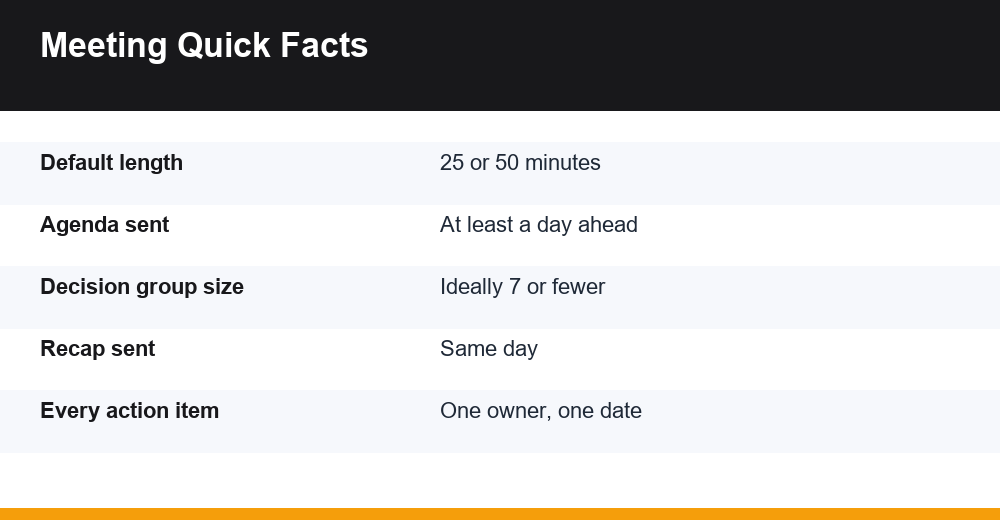
- Send the agenda in advance. At least a day ahead for routine meetings, so people arrive with input rather than first reactions.
- Invite only people who contribute or decide. Everyone else gets the notes.
- Assign roles. One facilitator, one timekeeper (can be the same person) and one note-taker.
- Start on time, even if people are missing. Waiting rewards lateness and punishes the punctual.
- Timebox every agenda item. When the time runs out, decide, defer or schedule a follow-up. Do not quietly overrun.
- Hear from everyone. Ask quieter participants directly and give them a moment to think before answering.
- Close with decisions and actions. Read them aloud in the final five minutes so there is no confusion later.
- Follow up the same day. A short written recap turns talk into commitments.
None of these rules is complicated. The difference between teams that hold good meetings and teams that dread them is usually consistency: applying all ten every time, not just when the stakes feel high.
Meetings are only one part of running an organization well. For small-business owners who want a wider view of planning, managing people and day-to-day operations, the U.S. Small Business Administration business guide is a free, neutral starting point.
What Should a Meeting Agenda Include?
An agenda is not a list of topics. A good one tells people why they are there, what they must prepare and what will be decided. If someone reads only the agenda, they should know whether they need to attend.
The essential elements
- Purpose: one sentence describing the reason for the meeting.
- Desired outcome: what will exist when the meeting ends.
- Pre-work: links to documents attendees must read beforehand.
- Items with owners and time slots: who leads each item and how many minutes it gets.
- Item type: mark each one as inform, discuss or decide.
- Wrap-up slot: five minutes reserved for decisions and action items.
Copy-ready agenda template (30-minute meeting)
| Time | Item | Type | Lead |
|---|---|---|---|
| 0:00-0:03 | Purpose and desired outcome | Inform | Facilitator |
| 0:03-0:13 | Item 1: main decision | Decide | Item owner |
| 0:13-0:22 | Item 2: open question or risk | Discuss | Item owner |
| 0:22-0:25 | Quick updates (only if unavoidable) | Inform | Any |
| 0:25-0:30 | Recap decisions, owners, deadlines | Decide | Note-taker |
Put the decision item first, while energy is high. Updates go last because they are the easiest part to cut or move to writing. If an item has no owner, it does not belong on the agenda yet.
If you are still working out how to run effective meetings on a busy team, the agenda is the highest-leverage habit to fix first. A meeting with a clear agenda can survive a weak facilitator; a meeting without one rarely survives even a strong one.
Who Belongs in the Room: Attendee-Trimming Rules
Every extra person adds cost: their hourly time, another voice to manage and a slower path to agreement. Large meetings also encourage people to stay quiet, which defeats the purpose of meeting live.
A common rule of thumb is to keep decision-making meetings to roughly seven people or fewer. This is a practical guideline, not a law, but most facilitators find that groups beyond that size drift toward presentation mode.
Five trimming rules
- Decider, contributors, nobody else. Each invitee should either make the decision or bring information the group lacks.
- One person per team. If three people from the same department are invited, ask them to send one representative.
- Optional means optional. Mark FYI attendees as optional and tell them the notes will cover everything.
- Invite per item, not per meeting. Let people join only for the agenda item that concerns them.
- Review recurring invite lists quarterly. Standing meetings accumulate attendees who no longer need to be there.
Trimming invitations can feel political. Frame it as respect for people’s time, not exclusion, and make sure the notes are good enough that nobody feels left out. This is part of the broader skill of managing a team well: protecting focus time is one of the clearest signals that a manager values their people’s work.
How Long Should a Meeting Be?
Meetings should be as long as the agenda requires and no longer. In practice, calendar defaults of 30 and 60 minutes stretch most discussions to fill the slot. A simple fix is to default to 25 or 50 minutes, which leaves a buffer before the next commitment. Several calendar tools offer a setting that shortens new events automatically.
Attention also fades as a session drags on. As a practical rule, if you genuinely need more than about an hour, build in a break or split the session into two parts with a clear goal for each.
| Meeting type | Suggested length | Notes |
|---|---|---|
| Daily stand-up | 10-15 minutes | Standing format, blockers only |
| One-on-one | 25-30 minutes | Weekly or biweekly; employee sets most of the agenda |
| Decision meeting | 25-50 minutes | One or two decisions maximum |
| Brainstorm | 45-60 minutes | Needs warm-up and idea time |
| Project kickoff | 50-60 minutes | Goals, roles, timeline, risks |
| Quarterly planning | Half day with breaks | Split into focused blocks |
One-on-ones deserve special mention. They are short but high-value, and they work best when the employee comes prepared. If you need prompts, this list of one-on-one meeting questions covers goals, workload, feedback and career growth.
All lengths above are approximate starting points, not research-backed limits. Shorten them the moment the agenda allows; nobody has ever complained about a meeting ending early.
How Do You Keep a Meeting on Track?
Even a well-planned meeting can drift. The facilitator’s job is to protect the purpose, not to dominate the conversation. These techniques help without making anyone feel shut down.
- Open with the outcome. Restate it in the first minute so everyone measures tangents against it.
- Use a parking lot. Write off-topic ideas in a visible list and promise to deal with them later. Then actually do so in the recap.
- Call time out loud. “We have two minutes left on this item” is a gentle, neutral nudge.
- Summarize to close loops. “So we agree on option B, with Sam checking the budget.” Summaries stop circular debate.
- Ask the quiet people. Address them by name with a specific question rather than “Any thoughts?”
- Set device norms. Laptops and phones only for notes or the shared document.
Handling the most common derailers
| Problem | What to say or do |
|---|---|
| One person dominates | “Thanks, let’s hear two other views before we decide.” |
| Discussion goes in circles | Summarize positions, then ask the decider to choose |
| Missing information | Assign someone to find it; move to the next item |
| New topic appears | Add it to the parking lot or a future agenda |
| Running out of time | Decide what can wait; never cut the wrap-up |
In remote or hybrid meetings, keep cameras optional but use the chat and a shared document actively. A live agenda that everyone can see on screen is one of the simplest ways to keep a distributed group focused.
For hybrid groups, one extra rule helps: if one person is remote, everyone joins from their own device. It removes the two-tier meeting where people in the room talk over those on the call.
How to Reduce the Number of Meetings at Work
Running better meetings matters, but holding fewer of them often matters more. Calendars fill up gradually, one recurring invite at a time, until there is no space left for deep work. Knowing how to run effective meetings includes knowing when to cancel one.
A practical meeting audit
- List every recurring meeting you attend or run.
- For each one, write its purpose and the last decision it produced.
- Cancel any meeting that has not produced a decision or meaningful output in a month.
- Reduce frequency for the rest: weekly becomes biweekly, biweekly becomes monthly.
- Shorten what survives by 10 to 15 minutes.
- Review again in one quarter.
Beyond the audit, set team norms that make async work the default. Agree that status updates go in writing, that documents are reviewed with comments rather than in calls, and that anyone can decline an invite without an agenda.
Some teams also protect meeting-free blocks, such as one afternoon a week or every morning before 11. These blocks work best when leaders respect them first. They pair naturally with broader time management techniques like time blocking and batching shallow tasks.
Finally, when you do cancel a meeting, say what replaces it. “The Monday sync is now a written update in the team doc by 10 a.m.” prevents the vacuum that leads people to schedule five smaller meetings instead.
The 5-Minute Follow-Up Routine
Many meetings fail after they end. Decisions get remembered differently, action items lack owners and nothing happens until the next meeting rediscovers the same problem. A five-minute routine right after the meeting prevents this.
- Minute 1: Write the decisions made, in plain sentences.
- Minute 2: List action items, each with one owner and one deadline.
- Minute 3: Note open questions and parking-lot items, with who will handle them.
- Minute 4: Send the recap to attendees and anyone who needed the outcome but was not invited.
- Minute 5: Add the deadlines to your task tracker and schedule any follow-up only if truly needed.
| Recap section | Example |
|---|---|
| Decisions | Approved vendor B for the CRM migration |
| Actions | Priya: sign contract by Friday |
| Open questions | Data export format, owner: Leo |
| Next check-in | Written update next Wednesday |
Over time, the recap becomes a record that new team members can read and a reference that settles disagreements about what was agreed. Every few months, ask attendees one question: was this meeting worth the time? Their answers will tell you where to cut next.
That is how to run effective meetings in practice: decide whether to meet, plan with a real agenda, keep the group small, protect the clock and follow up the same day. Each step is small, but together they can give your team back hours every week.
Frequently Asked Questions
How do you run an effective meeting?
Start by confirming a meeting is needed rather than a written update. Then set one clear purpose, send an agenda with time slots in advance, invite only contributors and decision-makers, assign a facilitator and note-taker, timebox each item, and close by reading out decisions and action items. Send a short written recap the same day.
What should a meeting agenda include?
A useful agenda includes the meeting’s purpose, the desired outcome, any pre-reading, and a list of items with owners, time allocations and a label showing whether each item is for information, discussion or decision. Reserve the last five minutes for confirming decisions, owners and deadlines so nothing is left ambiguous.
How long should a meeting be?
As short as the agenda allows. Many teams default to 25 or 50 minutes instead of 30 or 60 to create buffers between calls. Stand-ups typically run 10 to 15 minutes and decision meetings 25 to 50. For anything longer than about an hour, plan a break or split the session, since attention tends to fade.
How do you reduce the number of meetings at work?
Audit every recurring meeting, cancel those that have not produced a decision recently, and lower the frequency of the rest. Move status updates and document reviews to written, async formats, protect meeting-free blocks in the week, and normalize declining any invite that arrives without a clear agenda or purpose.