Good one on one meeting questions turn a calendar slot that drifts into status updates into the most useful half hour of a manager’s week. This guide gives you 40 questions sorted by what you are trying to learn, so you pick five or six with intent instead of reading from a list. You also get a reusable agenda, guidance on frequency and length, and tips for running remote 1:1s.
Table of Contents
Why most 1:1s fail and how structure fixes it
Most managers schedule one-on-ones with good intentions. Within a month the meetings become a spoken version of the project tracker: what got done, what is late, what is next. That information matters, but it rarely needs a private meeting with your manager to share.
The real value of a 1:1 lies in what does not surface in group settings. Frustration with a process, a quiet wish to move into a different role, a conflict with a colleague, early signs of burnout. People only raise these when they are asked the right way, at the right moment, by someone they trust.
That is why question intent matters more than question volume. A list of 150 prompts is useless in practice. What helps is knowing which kind of conversation you need this week and having a few strong questions ready for it.
The 40 questions below fall into five purposes:
- Wellbeing: how the person is actually doing, beyond the work.
- Blockers: what slows them down and what you can remove.
- Growth: skills, ambitions and the next step in their career.
- Feedback: in both directions, including feedback on you.
- Retention: engagement, motivation and early warning signs.
If you are building your management practice more broadly, our guide on how to manage a team covers how 1:1s fit alongside team meetings, goal setting and delegation.
40 one on one meeting questions by purpose
Every question here is open-ended. Avoid prompts that can be answered with a single word; they invite a polite “fine” and end the thread. Rotate through categories over several weeks rather than covering everything at once.
Wellbeing: how are they really doing?
- What has been the best part of your week so far?
- How would you describe your energy levels lately, from one to ten?
- Is anything outside work taking up headspace that I should know about?
- How manageable does your workload feel right now?
- When did you last feel properly switched off from work?
- What part of your day do you look forward to most?
- Is there anything about how we work that is adding stress you do not need?
- What would make next week feel better than this one?
Blockers: what is in the way?
- What is slowing you down the most at the moment?
- Is there a decision you are waiting on from me or anyone else?
- Which meeting or process could we drop without losing anything?
- Where do you feel you lack the information or access to do your best work?
- What is one thing I could take off your plate this week?
- Who on another team do you need a better connection with?
- Is any priority unclear or competing with another?
- If you had an extra free day this week, what would you spend it on?
Growth: where do they want to go?
- What skill would you most like to build over the next six months?
- Which recent piece of work are you proudest of, and why?
- What kind of work would you like to do more of? Less of?
- Where do you see yourself in two or three years?
- Is there someone in the company whose role interests you?
- What stretch project would excite you, even if it feels slightly out of reach?
- What support would help you grow faster: training, mentoring, more responsibility?
- What did you learn this month that surprised you?
Feedback: both directions
- What is one thing I could do differently to support you better?
- Is there anything I do that gets in your way?
- How do you prefer to receive feedback: written, in the moment, or saved for our 1:1?
- Is there feedback you have been holding back for me or for the team?
- How do you think the last project went, and what would you change?
- Do you feel recognized for the work you do?
- What should I keep doing as your manager?
- Is there anything you would like feedback on that you have not received?
Retention: are they still engaged?
- What keeps you motivated in this role?
- On a tough day, what makes you want to stay?
- If you could change one thing about your job, what would it be?
- Do you feel your work connects to the bigger goals of the company?
- How do you feel about your career progress here so far?
- Have you ever considered leaving? What prompted it?
- What would make this the best job you have ever had?
- Is there anything we have not talked about that you would like to?
What should you ask an employee in a 1:1?
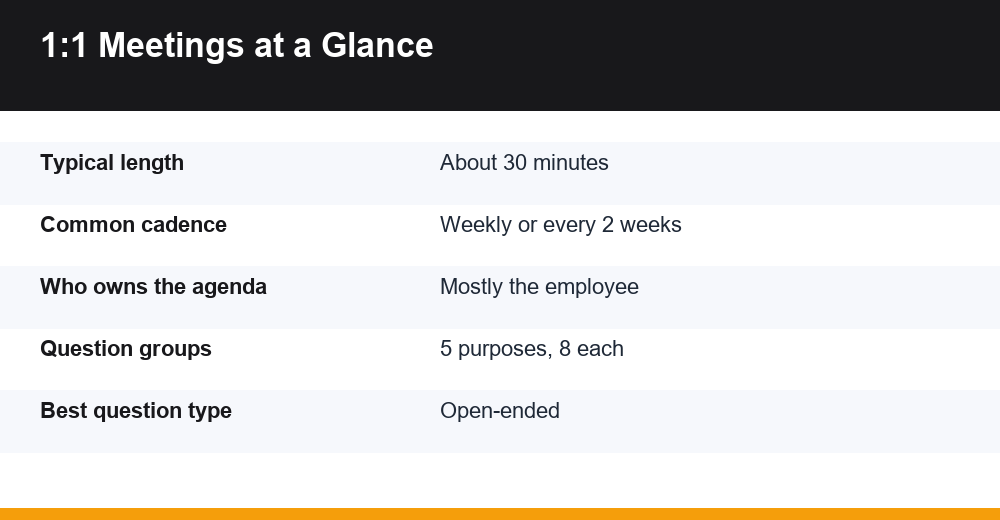
Choose based on what you notice, not on habit. A good rule is to bring one opening question, two or three focused questions from a single category, and one closing question. That is enough for a 30-minute conversation with room for whatever the employee brings.
Use this table to match signals with the right category of one on one meeting questions:
| What you notice | Category to lead with | Example question |
|---|---|---|
| Shorter replies, missed deadlines | Wellbeing | How manageable does your workload feel right now? |
| Work stalls at the same point | Blockers | Is there a decision you are waiting on? |
| Strong performer, seems restless | Growth | What stretch project would excite you? |
| Just finished a big project | Feedback | What would you change about how it went? |
| Quieter in team meetings | Retention | What keeps you motivated in this role? |
| New hire, first 90 days | Blockers and feedback | Where do you lack the information you need? |
Two principles help regardless of category. First, follow up on the answer rather than racing to the next question. “Tell me more about that” is often the most productive line in a 1:1. Second, revisit earlier answers. If someone mentioned wanting to learn data analysis in March, ask about it in May.
Listening well depends on reading tone and hesitation as much as words. Our article on emotional intelligence at work explains how to pick up those signals and respond without overreacting.
A simple 1:1 agenda template
An agenda keeps the meeting from defaulting to status updates. Keep it in a shared document that both of you can edit before each meeting, with the newest meeting at the top so history stays easy to scan.
The employee should own most of the agenda. Their items come first; yours fill the remaining time. This signals that the meeting exists for them.
| Block | Time (30-min 1:1) | Purpose |
|---|---|---|
| Check-in | 3-5 min | One wellbeing question, catch up as people |
| Employee topics | 10-15 min | Whatever they added to the shared doc |
| Manager topics | 5-7 min | Your questions from one chosen category |
| Growth or feedback | 5 min | Rotate focus each week or two |
| Actions and wrap-up | 2-3 min | Agree on next steps and who owns them |
A few habits make the template work:
- Ask the employee to add items at least a day before. If nothing is added, start with “What is on your mind this week?”
- Write down actions with an owner. Review them at the start of the next meeting.
- Keep project status out unless it needs discussion. Status belongs in your tracker or a team stand-up.
- Note which one on one meeting questions you used and what you learned, so you can rotate categories instead of repeating the same ones.
- Reserve one meeting a month or so for a longer career conversation.
How often and how long should 1:1s be?
There is no official standard, but common practice among managers is weekly or every two weeks, lasting around 30 minutes. That cadence is frequent enough to catch issues early and short enough that it rarely feels like a burden.
Adjust based on the person and the situation. The table below is a practical starting point, not a fixed rule:
| Situation | Suggested cadence | Suggested length |
|---|---|---|
| New hire or new to role | Weekly | 30-45 min |
| Experienced, stable team member | Every 2 weeks | 30 min |
| Senior or highly autonomous | Every 2-4 weeks | 30-60 min |
| During a reorganization or crisis | Weekly, temporarily | 30 min |
| Large team (10+ direct reports) | Every 2 weeks | 20-30 min |
Consistency matters more than the exact number. Canceling or postponing repeatedly tells people they rank below everything else on your calendar. If you must move a 1:1, reschedule it within the same week rather than skipping it.
If you want outside support while developing these habits, SCORE, the nonprofit mentoring network and resource partner of the U.S. Small Business Administration, publishes guidance on how coaching and managing require different skills. A good 1:1 leans on the coaching side: asking, listening and letting people work out their own solutions.
What should not be discussed in a one on one?
A private meeting creates trust, and certain topics can damage that trust or create risk for both sides. Steer clear of the following:
- Gossip about colleagues. Discuss working relationships and specific behaviors, not personal opinions about other people.
- Pure status updates. If it fits in a written update, it does not need your private time.
- Surprise criticism of major problems. Serious performance issues deserve a dedicated, prepared conversation, not an ambush midway through a routine check-in.
- Pressure to share private matters. Invite openness, but never push on health, family or personal life. Let them decide what to share.
- Salary promises you cannot keep. Listen to compensation concerns and commit to finding out, but do not promise numbers outside your authority.
- Confidential information about others. Never share someone else’s performance, pay or personal circumstances.
Feedback is welcome in a 1:1, but it needs care. Be specific, focus on behavior and impact, and give the person space to respond. Our guide on how to give constructive feedback walks through models you can use in these moments.
If an employee raises harassment, discrimination or a safety concern, do not try to resolve it informally. Thank them, take notes, and follow your company’s reporting process or involve HR promptly.
How to make 1:1s less awkward
Awkwardness usually comes from unclear purpose. The employee is not sure what you want from the meeting, and you are not sure how far to push. A few simple changes help both sides relax.
- Explain the purpose upfront. In the first 1:1, say plainly: this is your time, we will talk about what helps you, and status updates can go elsewhere.
- Share the questions in advance. Dropping two or three one on one meeting questions into the shared doc a day ahead removes the feeling of being put on the spot.
- Get comfortable with silence. After a hard question, wait. People often need a few seconds to decide whether to answer honestly.
- Go first. Share something about your own week or a mistake you made. Openness from the manager makes it safer for the employee.
- Change the setting. A walking meeting or a coffee outside the office can feel less formal than a meeting room.
- Act on what you hear. Nothing kills candor faster than raising a problem and seeing no follow-up.
Expect the first few meetings to feel stiff, especially with someone new or with a team that has never had regular 1:1s. Trust builds through repetition, so it often takes several meetings before the most honest conversations begin.
Tips for remote one-on-ones
For remote and hybrid teams, the 1:1 may be the only regular face-to-face time an employee has with their manager. That makes it more important, and it changes a few dynamics.
- Turn cameras on when possible, but do not make it mandatory. Facial expressions help you read the room, yet some days people need a break from video.
- Close other tabs and silence notifications. Remote employees can tell when you are reading messages during the call.
- Ask about isolation directly. Remote staff can miss informal contact. A question such as “Who have you connected with on the team this week?” can surface loneliness early.
- Mind time zones. Rotate the slot if one person always takes calls early in the morning or late in the evening.
- Use the shared agenda more heavily. Written notes replace the hallway follow-ups that happen naturally in an office.
- Follow up in writing. Send a short recap of agreed actions after each call.
Choosing the right one on one meeting questions for remote staff often means leaning slightly more on wellbeing and connection, since those issues are harder to notice from a distance. The same 40 questions apply; the balance shifts.
Finally, treat the 1:1 as a long-term investment. One meeting rarely changes much, but months of steady, well-prepared conversations build the kind of trust that keeps strong people on your team.
Frequently Asked Questions
What should you ask in a one on one meeting with an employee?
Start with an open wellbeing check, then pick two or three focused questions from one category: blockers, growth, feedback or retention. Let the employee raise their own topics first. Close by asking whether anything was missed. Open-ended questions work best because they invite real answers instead of a quick yes or no that ends the conversation.
How often should managers hold one on one meetings?
Weekly or every two weeks is the most common rhythm. New hires and people in new roles benefit from weekly meetings, while experienced, autonomous staff may only need one every two to four weeks. Whatever cadence you choose, keep it consistent and reschedule rather than cancel, so the employee knows the time is protected.
How long should a one on one meeting be?
Around 30 minutes suits most weekly or biweekly 1:1s. That leaves time for a check-in, the employee’s topics, a few manager questions and agreed next steps. Longer sessions of 45 to 60 minutes work well for monthly career conversations or for senior team members who meet less often but cover more ground.
How do you make one on one meetings less awkward?
Explain the purpose clearly in the first meeting, share a few questions in advance, and let the employee set most of the agenda. Be comfortable with pauses after difficult questions, share something about your own week, and always follow up on what you hear. Trust grows with repetition, so the first few meetings may feel stiff.