
Learning how to delegate is one of the highest-leverage skills a leader can build, yet it is the one most founders and managers quietly avoid. The problem is rarely a lack of willingness; it is not having a repeatable system for handing work off without losing quality or control. This guide gives you that system: a clear seven-step process, plus the judgment calls that make it stick.
Table of Contents
Why Delegating Is So Hard for Leaders
Most delegation problems start in the leader’s head, not the team’s ability. If you built the business or the process yourself, you carry a quiet belief that no one will do it quite the way you would. Early on, that is often true, which makes the instinct to keep everything hard to shake.
Then there is the time math. Explaining a task, answering questions, and fixing a rough first attempt genuinely takes longer than doing it yourself once. The trap is that you only do it once in your head, while in reality the task returns every week. Treating delegation as an investment rather than a cost is the mental shift that breaks the loop, and pairing it with solid time management techniques compounds the payoff.
The deeper reason many managers never quite learn how to delegate is fear: fear of looking replaceable, fear of being blamed for someone else’s mistake, fear of the awkward conversation when work comes back wrong. Naming those fears honestly is the first real step toward getting past them.
The cost of not delegating is steep and predictable. You become the bottleneck every decision waits on, your best people stop growing because they never get stretched, and your own time management collapses under work only you are allowed to touch. Founders who stay in this mode rarely burn out from big failures; they burn out from a thousand small tasks they refused to release.
- “It is faster if I just do it myself” — true for one instance, false over a year of repeats
- Perfectionism that treats any deviation from your method as a failure
- No clear system, so every handoff feels risky and improvised
- Fear that a visible mistake by someone else will reflect badly on you
What to Delegate and What to Keep
Before you can work out how to delegate a specific task well, you have to decide which work should move off your plate at all. A useful filter: hand off tasks that are repeatable, teachable, or that someone else could do at least 80% as well as you. Keep the handful of things that genuinely require your role.
A quick audit makes this concrete. For one week, note every task you touch and roughly how long it takes. Patterns appear fast: the recurring, rules-based, and purely administrative items are usually your first candidates to hand off, while the few that draw on your specific relationships or judgment are the ones to protect for now.
The table below is a quick gut-check when you are unsure which side a task falls on.
| Good to delegate | Keep for now |
|---|---|
| Routine, repeatable work (reports, scheduling, data entry) | Core strategy and direction setting |
| Tasks someone can learn from a clear brief | Sensitive people decisions (hiring, firing, pay) |
| Work that develops a team member’s skills | High-stakes client or investor relationships |
| Anything that drains your time but not your unique value | Legal, financial, or compliance sign-off |
One category deserves extra caution: anything touching legal, tax, or compliance obligations. The specifics here vary by location and change over time, so keep sign-off close and check official sources rather than relying on a general rule of thumb or advice you read online.
A second warning: do not only offload the boring work. If you keep every interesting project for yourself, your strongest people stall and eventually leave. Mix in stretch assignments — tasks slightly above someone’s current level — so delegation grows the team while it clears your calendar. The goal is not just less work for you; it is more capability around you.
How to Delegate: A 7-Step Process
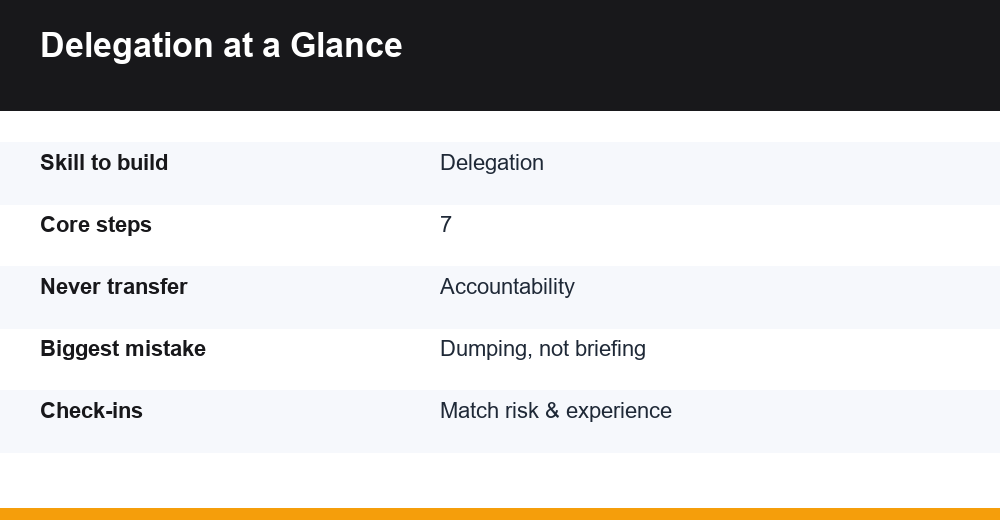
The steps below break how to delegate into a repeatable sequence you can run for any task, from a one-off errand to an ongoing responsibility. Early on, work through all seven deliberately; with practice, most of them become second nature and take only a few minutes.
- Choose the task and the outcome. Define what “done” looks like in concrete terms — the deliverable, the standard, and the deadline — not the exact method for getting there.
- Pick the right person. Match the task to someone’s skills, current capacity, and growth goals. A slight stretch builds people; an impossible leap sets everyone up to fail.
- Write a clear brief. Cover the what, the why, the deadline, the resources, and the guardrails. The “why” is the part leaders skip most, and it is exactly what lets people make good calls when you are not in the room.
- Set the level of authority. Be explicit about which decisions they own outright and which need a check with you first. Confusion here is the leading cause of both micromanaging and dropped balls.
- Agree how you will check in. Decide the cadence and format up front — a weekly update, a milestone review, or a quick message when they hit a blocker — so follow-up feels planned rather than like surveillance.
- Step back and let them work. Resist redoing things in your style. If the outcome is right, a different route is fine; if they are stuck, coach with questions instead of quietly taking the task back.
- Review, give feedback, and close the loop. Acknowledge what went well, be specific about what to adjust, and capture anything worth reusing next time.
A good brief does not need to be long. This one-screen template covers everything most handoffs require, and reusing it turns delegation from a nervous improvisation into a habit.
| Brief element | What to include |
|---|---|
| Outcome | What “done” looks like, in one or two sentences |
| Why it matters | How the task connects to a bigger goal |
| Deadline | The real due date, plus any interim milestones |
| Authority | Decisions they can make alone vs. check first |
| Resources | Tools, budget, contacts, and where to find examples |
| Check-in | When and how you will review progress |
Deliver the brief in a short conversation, not a wall of text, and finish by asking the person to play it back to you in their own words. That single habit surfaces misunderstandings while they are still cheap to fix.
Authority vs. Responsibility: Getting the Balance Right
This is the distinction that separates real delegation from task-dumping. Responsibility is the duty to get the task done. Authority is the power to make the decisions and use the resources needed to do it. Hand over responsibility without authority and you have set someone up to keep returning for permission, which feels like, and effectively becomes, micromanaging.
One thing you can never fully transfer is accountability. As the leader, you still answer for the outcome to those above you, which is exactly why matching authority to a person’s experience matters. A practical way to think about it is in levels of autonomy:
| Level | What the person does | Best for |
|---|---|---|
| 1. Do as instructed | Follows a defined process; makes no decisions | New tasks or newer team members |
| 2. Research and recommend | Gathers options and suggests one; you decide | Building judgment on important calls |
| 3. Decide, then inform | Makes the call and tells you what they did | Trusted work of moderate stakes |
| 4. Full ownership | Owns the decision and the result end to end | Proven people on low-to-moderate risk work |
Move people up these levels as they earn trust. Starting everyone at level four is reckless; leaving your best people stuck at level one is a fast way to lose them. Whichever level applies, say it out loud when you assign the work, so no one has to guess how much rope they actually have.
Putting the level in writing helps where the stakes are real. A single line — “you own this decision” or “run the shortlist past me first” — removes the guesswork that quietly breeds either over-caution or overreach. Revisit the level as circumstances change; a bigger budget or a first-time task may justify pulling authority back a notch, and saying so openly keeps trust intact rather than dented.
Checking In Without Micromanaging
The goal is oversight without hovering. Micromanaging usually comes from anxiety about the unknown, so the cure is a check-in rhythm you both agree on in advance. Once the schedule is set, you stop needing to “just quickly check,” and your team stops feeling watched over their shoulder.
Match the cadence to the stakes and the person’s experience, not to your nerves in the moment:
- High-risk or new-to-them work: short, frequent milestone reviews
- Familiar work with a capable person: a single weekly update
- Routine ownership: check the result only, with an open door for blockers
A useful check-in is short and forward-looking. Ask three questions: what is on track, what is blocked, and what decision you can help unblock today. Keeping the focus on obstacles rather than a line-by-line review signals that you trust the person to run the work, while still giving you an honest read on progress.
When you do review progress, focus on outcomes and obstacles rather than rewriting the work in your own voice. Ask what they need from you, not why they did not do it your way. Getting this rhythm right across a group is central to how to manage a team, and it is one of the biggest predictors of whether people feel genuinely trusted.
Common Delegation Mistakes to Avoid
Even leaders who delegate regularly fall into a few predictable traps. Watching for these keeps handoffs from quietly failing and eroding trust on both sides.
- Dumping, not delegating: handing over a task with no context, brief, or authority, then blaming the person when it goes sideways.
- Taking the task back at the first wobble, which teaches people you will always rescue them and guarantees the problem returns to you.
- Delegating the task but not the credit, so people stop volunteering for anything visible or ambitious.
- Vague deadlines like “soon” or “when you get a chance,” which quietly become never.
- Only offloading drudgery, so no one grows and you become the ceiling on your own team’s development.
Reverse delegation deserves a special mention. It happens when a team member hands a problem back up to you — “can you just handle this part?” — and you accept. Coach instead: ask what they think the sensible next step is, and let them keep ownership of the task rather than quietly adopting it yourself.
The fix for most of these is the same: slow down at the handoff. A few extra minutes spent on context, authority, and a real deadline prevents hours of rework and the slow erosion of trust that follows a botched delegation. Treat the brief as the cheapest insurance you can buy against work coming back wrong.
Turning Delegation Into Team Growth
Done well, delegation is not just about clearing your plate; it is how you build people who can operate without you. Every task you hand off is a chance for someone to grow a level in judgment, and for you to reclaim time for the work only you can do.
Once you know how to delegate consistently, track your progress the way you would any skill. A simple sign of improvement is the shrinking list of tasks only you can do, alongside a growing list your team owns outright. When people start bringing you finished decisions instead of open questions, delegation is working — and your calendar begins to reflect the priorities only you can move.
Start small if trust is still low. Delegate one contained task, run the full loop, give honest feedback, and raise the autonomy level next time. Within a few cycles you will have both a more capable team and a calendar that reflects your real priorities. As writers at Harvard Business Review have long argued, the leaders who scale are the ones who let go on purpose.
The founders who plateau are almost always the ones still doing everything themselves in year three. The ones who keep growing treat delegation as a discipline they practice on purpose — a little uncomfortable at first, then the very thing that frees them to lead instead of just do.
Frequently Asked Questions
What is the first step in learning how to delegate?
Start by deciding what should move off your plate. Before choosing a person or writing a brief, filter your tasks: hand off work that is repeatable, teachable, or that someone could do about 80% as well as you, and keep only what genuinely requires your role.
How do I delegate without losing control of quality?
Define the outcome and standard clearly, set the person’s level of authority, and agree on check-in points before they begin. You keep control through clear expectations and scheduled reviews, not by hovering. Quality problems usually trace back to a vague brief, not a weak team member.
What is the difference between authority and responsibility?
Responsibility is the duty to complete the task; authority is the power to make the decisions and use the resources it requires. Give both together. Accountability, however, stays with you as the leader, because you still answer for the final result to others.
How often should I check in on delegated work?
Match the cadence to risk and experience. New or high-stakes work needs short, frequent milestone reviews; familiar work with a capable person may need only a weekly update. Agree the rhythm up front so follow-up feels planned rather than like surveillance.