
Ask a small business owner how they set their prices and the honest answer is usually some version of adding up costs, adding a bit, then quietly reducing it because the total felt uncomfortable. That is not a pricing strategy. It is a flinch, and it is the single most expensive habit in small business, because every point of margin given away at the quote stage is a point that never appears anywhere else. Pricing is also the fastest lever available: no new customers, no extra hours, no additional cost. What follows is seven models that are actually in use, what each one is good and bad at, and how to move prices up without the conversation going badly.
Table of Contents
Why most small firms get pricing strategy wrong
Three habits account for most of it. The first is pricing from the inside out: starting with what the work costs you rather than what it is worth to the buyer. The buyer does not care what it costs you, and in many cases would happily pay several times it.
The second is pricing for the customer you fear rather than the one you want. There is always somebody who will say it is too expensive. Building your numbers around that person means the people who would have paid properly are now getting a discount they never asked for.
The third is treating price as a single number rather than a structure. How you package, stage and present a price changes what people accept far more than the figure at the end of it.
The arithmetic nobody runs
On a business with a 20 per cent margin, a 10 per cent price rise is a 50 per cent increase in profit, even if you lose a tenth of your customers along the way. Run that calculation on your own numbers once and the rest of this becomes easier to act on.
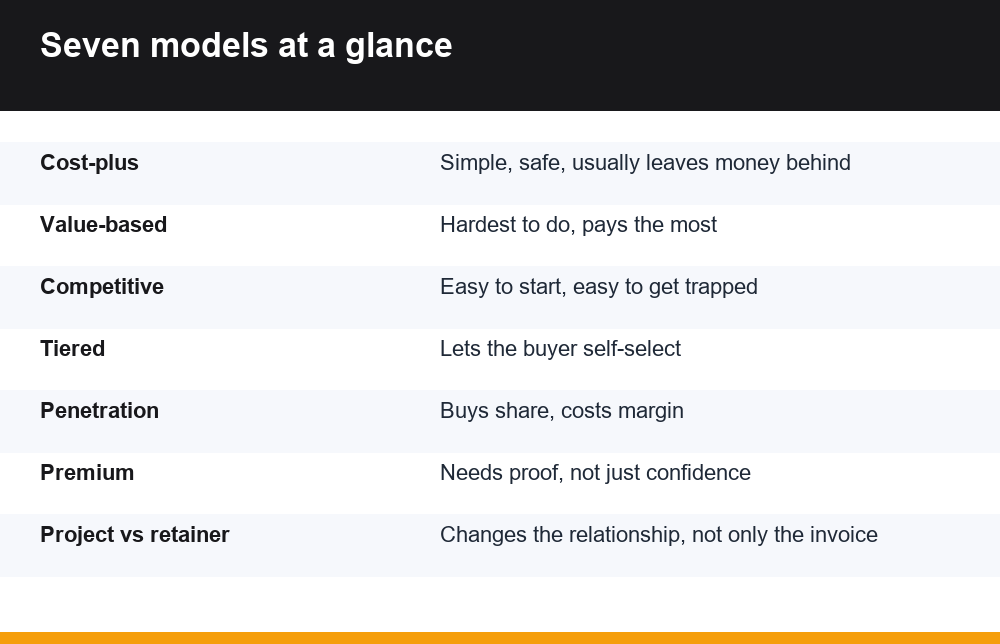
Cost-plus: the default worth outgrowing
Work out what delivery costs, add a percentage, quote it. It is the most common approach in small business and it has genuine virtues: it is quick, it is defensible, and it makes losing money difficult provided you have counted your costs honestly.
Most people do not count them honestly. The costs that get forgotten are the ones without an invoice attached: the hours spent quoting work you did not win, the admin, the revisions, the payment that arrives sixty days late. A markup calculated on direct costs alone is usually a markup on roughly half the real figure.
The deeper limitation is that cost-plus caps your upside at your own efficiency. Get twice as fast at something and cost-plus pays you half as much for it, which is a strange incentive to build a business on.
Value-based: the hardest and the best paid
Value-based pricing starts from the other end: what is the outcome worth to this buyer? A piece of work that takes a week and saves a client forty hours a month is not a week’s worth of value, and pricing it as one is a choice.
It is harder because it requires a conversation most people skip. You cannot price on value without knowing what the problem is costing, which means asking before quoting rather than after.
- What is this costing you now, in time, money or missed work?
- What happens if it is still like this in six months?
- Who else is affected by it besides you?
- What have you already tried, and what did that cost?
- If this were solved, what does that make possible?
Those five questions change quoting more than any pricing model does, because the answers tell you the ceiling. Firms that ask them routinely price two to five times higher than firms that do not, for the same work.
Competitive: borrowing somebody else’s homework
Looking at what competitors charge and sitting slightly below is the easiest pricing strategy to implement and the easiest to get trapped by. You inherit their assumptions, their cost base and their mistakes, none of which you can see.
It also starts a race you are unlikely to win. Undercutting invites undercutting, and the firm with the deepest reserves outlasts the one with the best intentions. Competing on price is only a durable position when you genuinely have a structural cost advantage, which most small businesses do not.
Competitor prices are useful as context, not as a target. Know them so you can explain your difference, not so you can sit just beneath them.
Tiered: let the buyer choose for you
A single price is a yes-or-no question. Three options turn it into a which-one question, and that shift alone raises the proportion of conversations that end in a sale.
The standard structure is three tiers, with the middle one designed to be chosen. The lowest exists to anchor the range and to be refused by most people. The highest exists to make the middle look sensible, and it is routinely bought by a minority who were never going to pick the middle anyway.
| Tier | What it is for |
|---|---|
| Entry | An honest floor. Real, but visibly limited. |
| Middle | The one you expect most people to take. Price and scope both deliberate. |
| Top | Anchors the range upward, and quietly sells more often than anyone predicts. |
The common error is making the tiers differ only in quantity. Tiers work best when they differ in the thing the buyer actually worries about, which is usually speed, access or risk rather than volume.
Penetration and premium: two bets in opposite directions
Penetration pricing means going in deliberately low to win share, intending to raise prices later. It can work where switching costs are high and customers stay for years. It fails where they are low, because the people who came for cheap leave for cheaper, and you have trained your market to expect the introductory number.
Premium pricing is the opposite bet: price high and justify it. It works when the buyer can see why, and collapses when they cannot. The requirement is proof rather than confidence, and the proof has to be visible before the quote, not promised after it.
Neither is a strategy on its own. Both are positions that only hold if the rest of the business is consistent with them, and a premium price attached to a slow reply and a template proposal will not survive contact with a real buyer.
Project, hourly or retainer
How you charge changes the relationship as much as what you charge. Hourly billing is transparent and easy to start with, and it quietly punishes you for being good: the faster you work, the less you earn, and every efficiency you develop reduces your own income.
Project pricing fixes that by selling an outcome rather than time, which lets expertise pay. It requires a scope written tightly enough that you are not absorbing endless revisions, and the discipline to treat changes as changes.
Retainers trade some upside for predictability. Both sides get stability, you get a base you can plan around, and the relationship shifts from transaction to ongoing. The risk is scope creeping month by month until the retainer covers twice what it was agreed for, which is avoided only by writing down what it includes and revisiting it on a schedule.
Most established small firms end up with a mix: retainers for the base, projects for the upside, hourly reserved for genuinely unpredictable work. Finding clients to apply any of this to is its own problem, and we covered that separately in how to get customers.
Raising prices without losing the room
Almost everyone is underpriced and almost everyone delays fixing it, because the imagined conversation is worse than the real one. A few things make it easier.
Raise for new customers first. You get live evidence of how the market responds with nothing at risk, and by the time you reach existing clients you are quoting a price people have already accepted rather than a hypothetical.
Give existing clients notice and a reason, and keep the reason short. A date, the new figure, one line of context. Long explanations read as apology, and apology invites negotiation that was not otherwise going to happen.
- Announce it once, in writing, with a date far enough out to be fair
- Do not offer a discount before anyone has asked for one
- Expect to lose a few, and work out in advance which ones you can afford to lose
- Have one concession ready that costs you little, for the conversations worth saving
The clients who leave over a sensible rise are usually the ones consuming the most support for the least margin. That is not a consolation; on most books it is an improvement, and firms that raise prices frequently report doing less work for more money within a quarter.
Discounting, and the damage it does quietly
No pricing strategy survives a habit of discounting on request. The discount itself is rarely the real cost; the precedent is.
Once a client has had ten per cent off for asking, every future quote is read as having ten per cent of air in it, and the negotiation starts from there rather than from your number. Worse, it travels. Clients talk to each other more than most owners assume, particularly within an industry or a town.
Where a reduction is genuinely warranted, trade it rather than give it. Less scope, a longer timeline, payment up front, a case study, an introduction. Any of those keeps the relationship between price and value intact, and all of them are easier to defend later than a round number knocked off because somebody asked.
The one discount worth offering freely is for early or upfront payment, because it buys something real: cash now rather than cash in sixty days, and no chasing. That is a trade, not a concession, and it is the only version most small firms should keep on the table.
One last point on timing. Owners tend to wait for a quiet period to raise prices, reasoning that a busy month is the wrong time to risk losing anyone. It is exactly backwards. A full order book is the strongest negotiating position you will ever have, because you can afford the answer to go either way, and the confidence that comes from that is audible in the conversation. Raise them while you are busy.
Frequently Asked Questions
What is the best pricing strategy for a small business?
Value-based pricing pays best where you can have a proper conversation about what the problem costs the buyer. Where that is not practical, tiered pricing is the most reliable improvement on a single figure, because it turns a yes-or-no decision into a choice between options.
How do I know if I am charging too little?
Three signals: almost nobody questions your price, you are busy but not profitable, and you resent certain clients. The first is the clearest. If every quote is accepted without hesitation, the number is below what the market would bear.
Should I publish prices on my website?
Publishing filters enquiries, which saves time but loses some conversations you might have won. A useful middle path is publishing a starting figure or a range, which qualifies people out without committing you to a number before you understand the work.
How much should I raise prices by?
Enough to matter. A rise of two or three per cent costs you the awkward conversation and changes nothing on the bottom line. Ten per cent is usually absorbed without much argument, and on a twenty per cent margin it is a very large increase in profit.
What do I say when someone calls my price too expensive?
Ask what they are comparing it to. Often they mean more than they expected rather than more than it is worth, and those need different answers. Resist discounting on the spot; if you reduce the price the moment it is questioned, you have taught them the first number was not real.