The online cricket id model is one of the most instructive business case studies to come out of India’s digital economy in recent years — not because anyone should rush to copy it, but because it shows how a simple channel choice can build a fast-scaling service on top of someone else’s platform. This is a founder’s breakdown of how that model works, what makes it tick, and the hard ceiling that defines it. It is written for business readers aged 18 and over as analysis, not as a recommendation to operate or use a betting service.
Table of Contents
What the online cricket id model actually is
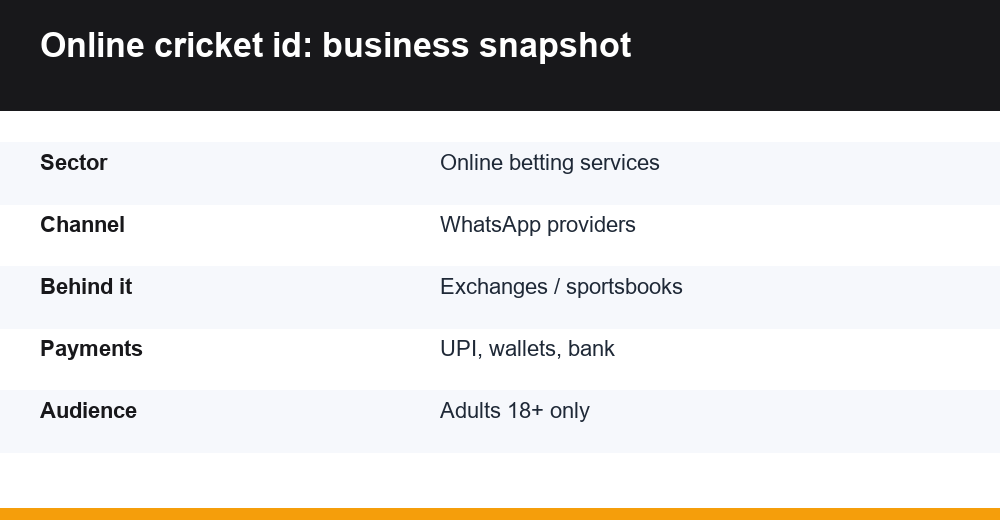
Strip away the jargon and an online cricket id is simply an account on a cricket betting exchange or sportsbook, sold and serviced through an intermediary. The intermediary — usually called a provider — does not build the betting platform. Instead it sits between the customer and an existing exchange, handling onboarding, payments and support. In start-up terms, it is a classic distribution-and-service layer wrapped around infrastructure someone else already owns.
That structure is worth pausing on, because it is exactly how many software businesses are built: find a powerful platform, then win the customer relationship by removing friction the platform ignores. The providers behind an online cricket id did the same thing in a very analog way — over a messaging app.
Lesson 1: A WhatsApp-first funnel
The defining choice of the model is the channel. Rather than pushing users to a self-service website, providers acquire and serve customers almost entirely on WhatsApp. A prospect messages a number, a human answers, and an account is issued within minutes. For a business, this conversational funnel has three advantages: it meets users where they already are, it lets a person handle objections in real time, and it turns a cold, unfamiliar product into a warm, guided experience.
There is a genuine lesson here for any founder. The best channel is rarely the most sophisticated one; it is the one your customer already trusts. A well-run operator that publishes its process openly — for example a site like online cricket ID, which lays out its account types and steps in plain view — effectively uses transparency as a conversion tool, lowering the anxiety that kills sign-ups.
Lesson 2: Lean unit economics
Because the provider does not build or run the underlying platform, its cost base is unusually light. There is no exchange to engineer, no odds engine to maintain, no settlement system to own. The main costs are customer acquisition, payment handling and support staff. Revenue comes from the volume routed to the platform behind it.
That asset-light shape is why the model scales so quickly and why it attracts so many small operators. But lean economics cut both ways: with low barriers to entry, differentiation collapses to service quality and trust, and price or margin competition can be brutal.
| Cost driver | Weight | Why it matters |
|---|---|---|
| Customer acquisition | High | WhatsApp outreach and referrals dominate spend |
| Payment handling | Medium | Reconciling UPI, wallet and bank flows |
| Support staff | Medium | Real-time chat is the whole experience |
| Platform / tech | Low | Outsourced to the underlying exchange |
Lesson 3: Trust is the real moat
When the product is nearly identical across dozens of providers, the only durable advantage is trust. In the online cricket id market, that means answering quickly, paying withdrawals cleanly, naming the platform your account sits on, and putting terms in writing. Operators who do these things build referral engines; those who do not churn through customers and reputations.
This mirrors a truth in almost every service business: when features converge, reliability becomes the brand. You can read more about our approach to analysing business models on our about page. The operators that endure are the ones that treat trust as an operating discipline, not a marketing slogan.
Lesson 4: Retention beats acquisition
Acquisition on WhatsApp is cheap to start but expensive to sustain, so the economics of the model rest heavily on retention. A customer who trusts a provider tends to stay, transact repeatedly and refer others, dramatically lowering the effective cost of acquisition over time. Providers that obsess over the first withdrawal experience — making sure it is fast and painless — convert nervous first-timers into repeat users.
The founder’s takeaway is familiar but easy to forget: the moment a customer first gets value back is the moment that decides your lifetime value. Everything before it is a promise; that moment is proof.
Lesson 5: Operations are the product
In a software business, code is the product. In the online cricket id model, operations are the product. The customer never sees a clever backend; they experience response time, payment accuracy and clear communication. A missed message or a delayed payout is not a support failure at the edge of the business — it is a defect in the core offering.
This is a useful reframing for any service founder. If your differentiation is service, then your operations team is your product team, and the metrics that matter are response latency, resolution rate and payment reliability, not vanity growth numbers.
Lesson 6: Regulatory risk is the ceiling
No honest analysis of this model can skip its defining constraint: regulatory risk. Real-money online gaming sits in a contested and tightening legal landscape in India, and rules differ sharply by state and change with little warning. A business whose entire existence depends on the current interpretation of the law has a ceiling that no funnel, retention tactic or operational excellence can raise.
For founders, this is the most important lesson of all, and it is a cautionary one. A model can be elegant, capital-efficient and beloved by customers and still be fragile, because its foundation is a regulatory permission that can be withdrawn. Studying the online cricket id model teaches you as much about risk as it does about growth.
The metrics that actually matter
If operations are the product, then the dashboard that runs the business looks nothing like a typical growth deck. Vanity numbers — total sign-ups, message volume, downloads — say little about whether the model is healthy. The metrics that actually predict survival in a service layer like this are about reliability and relationships, not reach.
Three numbers do most of the explaining. The first is response latency: how quickly a real person answers, because in a conversational funnel every minute of silence is a leaking sign-up. The second is payout reliability: the percentage of withdrawals settled cleanly and on time, which is the single strongest driver of trust and word of mouth. The third is repeat rate: how many customers transact again after their first experience, which quietly determines whether acquisition spend ever pays back.
- Response latency — speed of the first human reply, tracked in minutes.
- Payout reliability — share of withdrawals completed cleanly and on time.
- First-withdrawal success — whether new users get money back without friction.
- Repeat rate — the true test of whether trust was actually earned.
- Complaint resolution time — how fast problems are closed, not just logged.
Notice that none of these are marketing metrics. They are operational ones, and that is the point: in a business where service is the product, the health of the company is measured at the counter, not in the campaign.
How it compares to other platform-layer businesses
The online cricket id model is far from unique in shape. Plenty of respected businesses are built as a service-and-trust layer on top of infrastructure they do not own. Comparing them side by side makes the transferable lessons clearer — and throws the sector’s specific fragility into sharp relief.
| Model | Sits on top of | Wins by | Main risk |
|---|---|---|---|
| Payment reseller | Bank / processor rails | Onboarding + support | Margin compression |
| Marketplace agent | A large platform | Curation + service | Platform policy change |
| Online cricket id provider | Betting exchanges | Trust + fast payouts | Regulatory change |
The structural similarities are striking: light assets, service as differentiation, trust as the moat. What sets the betting layer apart is not its mechanics but its foundation. A payment reseller worries about margins; a marketplace agent worries about a platform’s rules. The online cricket id provider worries about whether its entire category remains permitted. That is a different order of risk, and it is why the model belongs in a case study rather than a business plan.
Lesson 7: What founders can borrow
So what travels from this case study to a legitimate business you might actually build? Quite a lot, if you separate the mechanics from the sector. Borrow the channel discipline: go where your customer already trusts a conversation. Borrow the asset-light instinct: build the relationship layer on top of powerful infrastructure. Borrow the retention obsession and the idea that operations can be the product.
- Choose the channel your customer already trusts, not the most advanced one.
- Build a lean layer on top of infrastructure you do not have to own.
- Treat the first moment of value as the metric that defines lifetime value.
- Make reliability your brand once features converge.
- Never build a company whose ceiling is a regulatory permission you do not control.
Understanding what an online cricket id is, and why its model both scaled and stalled, is a compact lesson in distribution, trust and risk. Take the transferable parts, leave the sector where it belongs, and remember that the most durable businesses are the ones whose foundations they actually own. Any real-money activity discussed here is strictly for adults 18 and over and carries real financial and legal risk.
Frequently Asked Questions
What is the online cricket id business model?
It is a service layer on top of established betting platforms. A provider onboards customers over WhatsApp, issues them an account, and manages deposits and withdrawals, earning from the volume it routes to the underlying exchange or sportsbook.
Why is WhatsApp central to it?
WhatsApp removes friction: a real person answers, payments move through familiar Indian rails, and an account appears in minutes. That conversational funnel is cheaper and more trusted than sending a cold user to an unfamiliar international website.
Is it a legally safe business to study?
You can study any model analytically, but this one carries heavy legal and regulatory risk that varies by location and is tightening in India. This article is business analysis for readers aged 18+, not encouragement to operate or use such a service.
What can other founders learn from it?
The transferable lessons are channel choice, lean operations, trust as a moat, and retention economics. The cautionary lesson is that a business built on shifting regulation has a ceiling no growth tactic can raise.