If you want to know how to stop procrastinating, start with an uncomfortable truth: putting things off is rarely about laziness or a broken calendar. It is your brain trying to dodge an unpleasant feeling — boredom, anxiety, self-doubt — by trading long-term payoff for a hit of short-term relief. The good news is that once you treat it as an emotional habit rather than a character flaw, it becomes something you can actually change.
Table of Contents
Why We Procrastinate (It’s Emotional, Not Lazy)
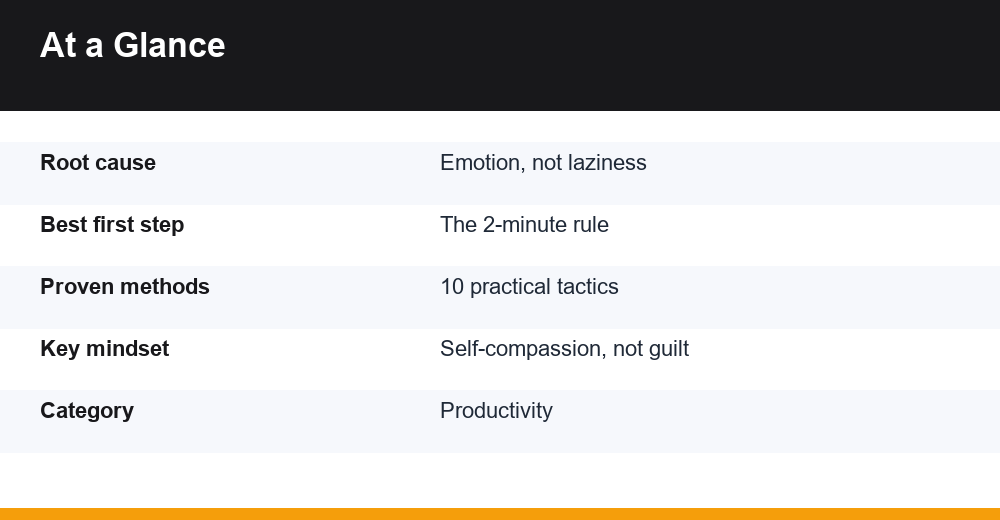
Researchers who study procrastination describe it as a failure of emotional regulation, not a failure of willpower. When a task makes you feel incompetent, bored, or overwhelmed, avoiding it delivers instant relief. Your mood lifts the moment you switch to email or your phone, and that tiny hit of relief quietly teaches your brain to do the same thing next time.
There is also a wiring problem underneath it. The human brain heavily favors rewards it can have now over rewards it has to wait for, a bias psychologists call present bias. The version of you who has to write the report tomorrow feels almost like a stranger, so future-you keeps getting handed the bill.
This matters because the usual advice — just try harder — aims at the wrong target. If putting things off is really an escape from discomfort, then piling on pressure only adds more discomfort to flee. The workable fix is to make the task feel smaller, safer, and less emotionally loaded, so there is simply less to run away from.
It often becomes a loop. You avoid, you feel guilty, the guilt makes the task even more unpleasant, and so you avoid again. Understanding that cycle is the first practical step, because it points you toward calming the emotion instead of demanding ever more discipline from yourself.
- It isn’t laziness: chronic procrastinators often work hard on other things to dodge the one task that counts.
- It isn’t a scheduling gap: you can keep a flawless calendar and still avoid the scary task.
- It isn’t harmless: delay tends to raise stress, disrupt sleep, and lower the quality of rushed, last-minute work.
First, Name What You’re Avoiding
Before you grab a tactic, get specific about the feeling driving the delay. Different triggers respond to different fixes, so matching the two matters. Take thirty seconds and ask yourself: what emotion actually shows up when I picture starting this?
| What you feel | What it usually means | The fix to try first |
|---|---|---|
| The task feels huge | You can’t see step one | Shrink it to a two-minute action |
| Fear of doing it badly | Perfectionism or self-doubt | Lower the bar; aim for a rough draft |
| It’s just boring | No immediate reward | Bundle it with something you enjoy |
| Too many distractions | Escaping is too easy | Redesign your environment |
| No real deadline | The stakes feel far away | Add a date and tell someone |
It also helps to notice your patterns over time. Maybe you stall hardest on creative work, or on anything with a fuzzy definition of ‘done,’ or on tasks tied to someone else’s judgment. Those patterns are useful signals; they tell you where to prepare before the avoidance starts.
None of these mean something is wrong with you; they are signals. Once you can name the feeling, you can choose the right tool instead of grinding harder with the wrong one and calling it discipline.
How to Stop Procrastinating: 10 Proven Ways
Now for the practical part. These ten methods for how to stop procrastinating come from behavioral science, and, more usefully, they hold up in ordinary life. You don’t need all ten at once — pick the two or three that match your trigger and start this week.
- Make the first step tiny. Shrink the task until getting started takes under two minutes: open the document, write one sentence, or just put your shoes by the door. Starting is the hardest part, and momentum handles a surprising amount after that.
- Define the next physical action. Vague to-dos like ‘plan the launch’ practically invite delay. Tie each task to the clear goals you’ve set, then break it into a concrete next move such as ‘draft three subject lines.’
- Remove the friction. Make the useful task easier to begin and the distraction harder to reach — close the extra tabs, silence notifications, and lay out your materials the night before.
- Bundle temptation with the task. Only play your favorite podcast while doing admin, or earn a proper coffee with a focused block. Pairing a chore with a genuine pleasure makes it far easier to start.
- Use if-then plans. Decide in advance: ‘If it’s 9 a.m., then I write for 25 minutes.’ These implementation intentions cut out the in-the-moment bargaining where avoidance usually wins.
- Time-box the work. Set a 25-minute timer and work on one thing only, then take a real break. A short, finite sprint feels far safer than an open-ended slog with no end in sight.
- Add a real deadline. Self-set dates work best when they are specific and visible to someone else. A concrete due date creates just enough urgency to break through inertia.
- Recruit accountability. Tell a colleague, book a shared working session, or sit alongside someone tackling their own tasks. Being gently observed is one of the most reliable nudges there is.
- Make the reward immediate. The real payoff for hard tasks is usually far off, so build in a small, instant win: tick the box, take a short walk, or tell someone what you finished.
- Forgive the last slip. Beating yourself up only feeds more avoidance. Self-compassion, which is well supported by research, actually lowers how much you put things off next time.
Notice that almost none of these rely on feeling motivated. They work by lowering the emotional cost of starting and by borrowing structure from your environment and the people around you. The aim is simple: make beginning easier than avoiding.
Build a System, Not a Burst of Willpower
Motivation is unreliable; systems are not. If you wait until you feel ready, you will be waiting a long time. The stronger move is to design your days so the right task is the easy one to reach and distraction is the thing that takes effort.
This is where solid time-management techniques earn their keep — not as rigid, color-coded schedules, but as guardrails. Block one or two focused windows when your energy is highest, defend them, and put your hardest task there while your willpower is still fresh.
Friction is your quietest lever. Small changes to your surroundings tend to shift behavior more than pep talks do, a theme that runs through much of the research on the science of procrastination. Make the good choice a little easier and the bad one a little harder, and let the environment do the work.
- Keep only the task you’re working on open, and hide everything else.
- Put your phone in another room rather than merely face-down.
- Set up tomorrow’s first task before you shut down for the day.
- Batch shallow work so it can’t leak into your deep-work windows.
Treat these as defaults you set once, not decisions you remake every morning. A choice you don’t have to keep making is a choice avoidance can’t talk you out of. When the next step is obvious, there is less deciding, less dread, and much less to put off.
Add Accountability and Real Deadlines
Left to our own devices, we negotiate with ourselves and lose. A little outside structure changes the math. Even light accountability — a check-in, a shared deadline, a person expecting your draft by Friday — makes skipping the task cost something socially, and that small cost is often enough to get you moving.
Accountability works because it borrows the social wiring we already have. We will happily let ourselves down in private, yet most of us dislike the small awkwardness of telling someone we didn’t do the thing we said we would. Used gently, that instinct becomes a helpful ally rather than a source of shame.
Deadlines pull in the same direction. Research on self-imposed deadlines suggests they genuinely help, but they perform best when they are specific, spaced out, and known to someone else. A private ‘sometime this week’ rarely survives a busy Tuesday.
- Book a recurring working session with a colleague or a friend.
- Try body doubling: work quietly beside someone doing their own task, in person or on a video call.
- Share your deadline out loud, even with one person, and report back when it’s done.
- Use a coach, mastermind, or accountability group for bigger, longer projects.
The point isn’t pressure for its own sake. You are borrowing a bit of external structure until the new habit is strong enough to stand on its own.
Be Kind to Yourself (It Actually Works)
Here is the counterintuitive core of how to stop procrastinating for good: guilt makes it worse. When you berate yourself over a wasted afternoon, you pile more negative emotion onto a task that was already emotionally charged, and your brain wants to escape it even more than before.
Studies on self-compassion have found that students who forgave themselves for procrastinating before one exam went on to procrastinate less before the next. Dropping the shame freed up the energy they needed to simply begin again.
Being kind is not the same as letting yourself off the hook. In practice it sounds like: ‘That was a hard day — what is one small step I can take right now?’ You acknowledge the slip, put down the self-attack, and re-enter the task through the smallest possible door.
Kindness here is strategic, not soft. Shame narrows your options and keeps you stuck replaying the failure; self-compassion widens them and lets you problem-solve. If you would encourage a friend in this spot rather than insult them, extend the same courtesy to yourself.
- Swap ‘I’m so lazy’ for ‘This task makes me anxious, and that’s normal.’
- Measure yourself by whether you showed up, not by whether it was perfect.
- Treat a missed day as information to learn from, not a verdict on your character.
When It’s More Than Procrastination
Most procrastination is ordinary and responds well to the tactics above. Sometimes, though, chronic avoidance is a symptom of something larger — persistent anxiety, depression, burnout, or a condition such as ADHD that affects focus and getting started.
A few signs it may be worth seeking support: the delay is constant across nearly every area of life, it’s causing real harm at work or at home, or nothing sticks no matter how genuinely you try. That is not a willpower problem, and knowing how to stop procrastinating isn’t the full answer in that case.
If that sounds familiar, talking to a doctor or a licensed therapist is a sensible next step. Approaches like cognitive behavioral therapy are well established for this kind of avoidance. There is no shame in needing more than a productivity tip; some problems are medical, not motivational. Support and treatment options vary by location, so it’s worth checking official sources for what’s available where you live.
Frequently Asked Questions
What is the fastest way to stop procrastinating right now?
Shrink the task until starting takes under two minutes, then just begin — open the file, write one line, or set a 25-minute timer. Action creates momentum, and momentum lowers the dread. You can decide whether to keep going once you are already moving.
Why do I procrastinate even on things I want to do?
Because procrastination is about managing emotion, not measuring importance. Even wanted tasks can trigger fear of doing them badly, uncertainty about step one, or a lack of any immediate reward. Naming that feeling, then shrinking the first step, usually breaks the stall and gets you started.
Is procrastination a sign of laziness?
No. Procrastinators often work hard elsewhere to avoid one loaded task, which isn’t laziness but avoidance. Learning how to stop procrastinating means treating it as an emotional habit you can retrain with small steps and self-compassion, not a fixed character flaw you’re simply stuck with.
How long does it take to overcome procrastination?
There is no fixed timeline, and expecting an overnight cure sets you up to quit early. Many people notice real progress within a week or two of using tiny first steps and accountability. Treat it as a skill you keep practicing, with the occasional slip built into the plan.