Emotional intelligence at work is the ability to read your own emotions and other people’s, then use that awareness to make better decisions, communicate clearly, and keep relationships productive under pressure. It isn’t about being nice or dodging conflict — it’s a practical skill set that quietly shapes how teams perform. This guide covers what EQ is, why it matters, and how to build it without the pop-psychology gloss.
Table of Contents
What Emotional Intelligence Actually Means
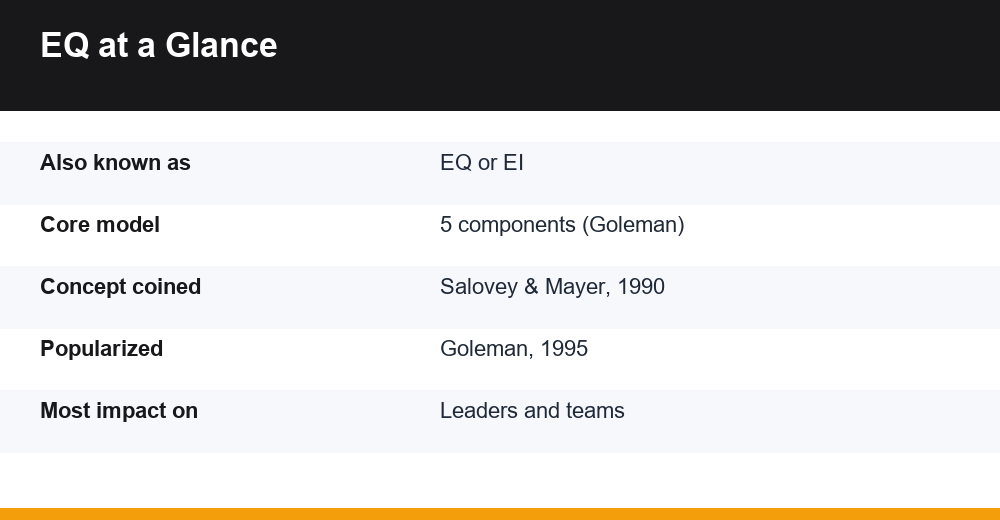
Emotional intelligence — usually shortened to EQ or EI — is the capacity to perceive, understand, and manage emotions, both your own and other people’s. Psychologists Peter Salovey and John Mayer defined the concept in 1990, and Daniel Goleman brought it to a mass audience with his 1995 bestseller.
A useful way to frame it: IQ helps you get hired, but EQ largely decides how far you go once you’re on a team. A gifted developer who can’t absorb feedback, or a founder who spirals under pressure, will hit a ceiling that technical skill alone cannot lift.
The encouraging part is that emotional intelligence behaves like a skill, not a fixed personality trait. You can assess it roughly, practise it deliberately, and improve it over time. For a neutral academic overview of the research and its open debates, see the Wikipedia entry on emotional intelligence.
It also helps to say what emotional intelligence is not. It is not the same as being calm all the time, and it is not a personality type. Two people can feel the same flash of anger; the one with higher EQ tends to notice it sooner, understand where it comes from, and choose a response rather than being carried along by the feeling.
Why Emotional Intelligence at Work Actually Matters
Emotional intelligence at work matters because almost nothing meaningful gets done alone. Projects move through conversations, disagreements, and handoffs — and every one of those moments goes better when people can stay composed, listen, and respond instead of react.
Research across decades consistently links higher EQ with better teamwork, clearer communication, and lower staff turnover. It doesn’t replace competence, but it’s often the difference between a technically correct decision and one people will actually get behind.
The effect is largest in management. Strong leadership skills rest on a foundation of self-awareness and empathy: a manager who spots tension early, gives feedback that lands, and keeps their head in a crisis will usually outperform a smarter but colder counterpart.
The cost of low EQ is easy to underestimate because it rarely shows up on a balance sheet. It leaks out instead as missed signals, avoidable arguments, good people quietly leaving, and decisions that stall because no one fully trusts the person making them. Those losses are real, even when they never appear in a report.
The shift toward remote and hybrid work has raised the stakes rather than lowered them. When most contact happens over text and video, tone is easy to misread and small frictions can grow in silence. Reading the room now often means reading a terse message or a camera that stays switched off, then responding to what is actually going on underneath.
- Faster, cleaner conflict resolution before small issues fester
- Feedback that changes behaviour instead of breeding resentment
- Higher trust, which speeds up decisions and delegation
- More resilience during change, layoffs, or rapid growth
The Five Components of Emotional Intelligence
Goleman’s widely used model splits EQ into five parts. The first three are about managing yourself; the last two are about handling relationships. You’ll rarely be strong in all five — most people have two or three natural strengths and one clear blind spot.
| Component | What it is | What it looks like at work |
|---|---|---|
| Self-awareness | Knowing your emotions and triggers | Naming your stress before it leaks into a meeting |
| Self-regulation | Managing impulses and reactions | Pausing before firing off an angry reply |
| Motivation | Internal drive beyond money or status | Pushing a project forward when energy dips |
| Empathy | Reading others’ emotions accurately | Sensing a teammate is overwhelmed and adjusting |
| Social skills | Building rapport and influence | Aligning a group around a hard decision |
Notice that none of these require you to be extroverted or endlessly agreeable. A quiet, introverted person can score very high, while a charismatic one can score low. If you want a place to start, develop self-awareness first — the other four are hard to build without it.
The five parts also feed each other in order. Self-awareness gives you the raw information; self-regulation lets you act on it well; motivation keeps you steady when the work is hard; empathy extends the same attention to other people; and social skill turns all of it into results with a group. Skip the early steps and the later ones tend to wobble.
It is worth noting that the academic model and Goleman’s popular one are not identical. Salovey and Mayer frame emotional intelligence as a set of mental abilities, closer to a form of reasoning; Goleman’s version folds in traits such as motivation and drive. For everyday use the difference rarely matters, but it explains why definitions you read online don’t always line up.
EQ Is a Skill, Not a Cure-All
Because EQ gets marketed so heavily, it’s worth separating the useful core from the hype. Three corrections keep you honest and stop the concept from turning into vague feel-good advice.
Empathy is not people-pleasing
High-EQ people set clear boundaries and deliver hard messages. Understanding how someone feels does not obligate you to agree with them or to shield them from consequences. Empathy without honesty is not kindness; it is avoidance, and people usually see through it before long.
EQ doesn’t excuse weak performance
Being emotionally skilled never substitutes for doing the actual job well. The strongest professionals pair emotional competence with real expertise; either one on its own takes you only so far.
The measurement is imperfect
Popular EQ tests vary widely in quality, and the science still has genuine debate. Treat any single score as a rough signal, not a verdict — use it to spot patterns in your behaviour, not to label yourself or anyone else.
- Myth: EQ means suppressing emotions. Reality: it means using them well.
- Myth: you either have it or you don’t. Reality: it’s trainable at any age.
- Myth: it’s only for HR and managers. Reality: it lifts every role.
Held to that standard, EQ stops being a slogan and becomes something you can actually use: a set of habits that make your existing skills land better with other people. Keep the practical core, drop the marketing, and the idea holds up well.
How to Build Emotional Intelligence
Building emotional intelligence at work is a gradual habit, not a weekend workshop. None of these steps is complicated on its own, but they compound when you run them consistently over a few months.
Pick one habit to start, not all six. Trying to overhaul everything at once usually collapses within a week. Choose the single response that costs you the most right now — snapping under pressure, going quiet in conflict, avoiding hard feedback — and work only on that until it feels less effortful. Then add the next one.
- Name your emotions as they surface. Labelling ‘I’m frustrated’ or ‘I’m anxious’ shrinks the feeling and buys you a second to choose your response.
- Build a gap between trigger and reaction — a breath, a short walk, or a reply you draft but don’t send for an hour.
- Ask for honest feedback on how you come across, then thank people for it instead of defending yourself.
- Keep a two-minute weekly reflection: what set me off, what did I handle well, what would I redo?
- Get curious in conflict. Try ‘help me understand your thinking’ before you argue your own case.
- Manage your energy — sleep, exercise, and workload directly shape how much emotional bandwidth you have.
Expect this to feel awkward at first. Pausing before you reply, or asking for feedback you would rather not hear, cuts against habits you have practised for years. That discomfort is a sign the work is real, not a reason to stop. Track small wins — one hard conversation handled well — and the new responses slowly start to feel normal.
If you lead others, layering these habits onto solid systems for how to manage a team multiplies the payoff, because your own regulated behaviour quietly sets the emotional temperature for everyone around you.
Emotional Intelligence in Real Workplace Situations
Theory is easy; the real test is what you do in the moment. Here’s how the same everyday situations tend to play out with low versus high emotional intelligence.
| Situation | Low-EQ response | High-EQ response |
|---|---|---|
| Getting harsh feedback | Defend, blame, or shut down | Ask questions, thank them, then act on it |
| A teammate misses a deadline | Public call-out or silent resentment | Private check-in on what got in the way |
| Delivering bad news | Sugarcoat it or dump it coldly | Be direct, clear, and open to questions |
| A tense meeting | Raise your voice or go quiet | Name the tension, slow the pace, refocus |
| A mistake you made | Hide it or over-apologise | Own it briefly, fix it, share the lesson |
The high-EQ column isn’t the softer option — it’s usually the harder one in the moment. It takes more self-control to stay direct and calm than to react, which is exactly why it’s so valuable and so rare.
One pattern runs through every row: the high-EQ response slows things down just enough to choose. It puts a small gap between what happens and what you do about it. That gap is where judgment lives, and it is the single habit most worth building, because it quietly improves almost every other response you make.
How to Spot and Hire for Emotional Intelligence
Hiring for emotional intelligence at work is easier than most managers assume, because behaviour under mild pressure reveals it fast. Skip the personality quizzes and ask candidates for real stories from their own experience.
Interview questions that reveal EQ
- Tell me about feedback you disagreed with. What did you actually do?
- Describe a conflict with a colleague and how it was resolved.
- When did you last change your mind because of someone else’s input?
- What frustrates you at work, and how do you handle it?
Listen for self-awareness and accountability. A strong answer owns a genuine share of the problem and names a lesson; a weak one quietly blames everyone else in the room.
Green flags and red flags
- Green: specific stories, admits mistakes, credits teammates by name
- Green: asks thoughtful questions and listens to your answers
- Red: every past manager or colleague was somehow ‘the problem’
- Red: can’t name a single real weakness or something they learned
One caution: don’t confuse confidence or charm with emotional intelligence. Some people interview smoothly and still struggle to handle real friction with a team. Where you can, check references with the same questions, and pay attention to how someone treats people who cannot do anything for them. That often tells you more than a rehearsed answer.
Building a Team Culture That Rewards EQ
Individual EQ only scales if the environment supports it. A single self-aware manager inside a blame-heavy company will usually burn out or leave, taking their good habits with them.
Culture is really just the behaviour you tolerate, repeated at scale. If you want emotionally intelligent teams, you have to reward composure and candour, and stop rewarding results that come at the expense of the people who deliver them.
- Model it from the top — people copy how leaders handle stress
- Make feedback routine and two-way, not a once-a-year event
- Protect psychological safety so people admit mistakes early
- Stop promoting high performers who damage the people around them
Systems help more than good intentions here. Build the behaviour you want into how you hire, review, and promote, so it doesn’t depend on any one manager’s mood. When feedback, recovery from mistakes, and steady communication are simply how the team operates, new people absorb the standard without anyone having to lecture them about it.
When teams see that staying calm and telling the truth are rewarded — and that being good at the job never excuses treating people badly — emotional intelligence stops being a line in a values statement and becomes the way work actually gets done.
Frequently Asked Questions
What is emotional intelligence at work in simple terms?
Emotional intelligence at work is the ability to notice and manage your own emotions and read other people’s, then use that awareness to communicate, decide, and collaborate well. In practice it shows up as staying calm under pressure, giving useful feedback, and resolving conflict without unnecessary drama.
Can you actually improve your EQ, or is it fixed?
Yes, EQ is trainable at any age. Unlike IQ, which stays fairly stable, emotional skills respond to deliberate practice — labelling emotions, pausing before reacting, seeking feedback, and reflecting weekly. Most people notice real gains within a few months of consistent effort rather than after a single course.
Is high EQ the same as being nice or agreeable?
No. Emotional intelligence often means doing the harder thing: giving direct feedback, setting boundaries, or delivering bad news clearly. Empathy helps you understand how a message will land, but it never requires you to avoid conflict or shield people from honest, necessary truths.
Which matters more for career success, IQ or EQ?
Both matter, but they do different jobs. IQ and technical skill tend to get you hired and handle the task itself. EQ increasingly determines how far you rise, because senior roles are mostly about leading, persuading, and coordinating other people rather than solo output.