
Learning how to manage a team is less about authority and more about creating the conditions where good people do their best work. The jump from doing the work yourself to getting results through others is one of the hardest transitions in any career, and most new managers get the title with almost no training. This guide walks through the practical systems — expectations, one-on-ones, feedback, delegation, motivation and conflict — that separate managers who burn out from those who build teams that run without them.
Table of Contents
What Team Management Really Means
Before any tactics, it helps to name what actually changed. As an individual contributor you were paid for your own output. As a manager, you are paid for the output of everyone who reports to you — a shift that sounds obvious but quietly reshapes how you spend every hour of your week.
This is why so many strong performers struggle at the start. The instinct to jump in and fix things yourself is exactly the instinct you now have to unlearn. Your leverage comes from hiring well, setting direction, clearing obstacles and developing people — not from being the fastest hands in the room.
None of this happens by accident. Managers who make the jump cleanly block time for the work of managing — planning, coaching and thinking ahead — instead of squeezing it between their old tasks. Protecting those hours early is what stops you from sliding back into being a senior individual contributor with a nicer title.
- Your calendar fills with other people’s problems, and that is the job, not a distraction from it.
- Success is measured in team outcomes over months, not in your personal daily task list.
- Your words carry more weight — an offhand comment can land as a directive.
It also means the mix of skills you lean on changes. Technical mastery still matters, but communication, judgment and the ability to earn trust matter more. If you want a broader foundation, our guide to leadership skills pairs well with the practical steps below.
How to Manage a Team: The Core Fundamentals
If you strip team management down to its essentials, most of it comes back to clarity. Knowing how to manage a team starts with making sure every person understands what success looks like, how their work connects to the bigger picture, and where the edges of their role actually sit.
Vague expectations are the root of most performance problems. “Do your best” is not a target. Instead, agree on specific outcomes, deadlines and quality standards, then write them down somewhere both of you can return to. What lives only in your head cannot be delivered against.
Set expectations you can measure
- Define outcomes, not activity — describe what “done” looks like, not just hours logged.
- Name the priority order so people know what to drop when everything feels urgent at once.
- Clarify decision rights: what a person can decide alone versus what needs a check-in first.
- Revisit expectations when priorities shift, instead of assuming people can read your mind.
The other half of clarity is consistency. If you praise initiative one week and punish it the next, people quietly stop taking risks. Predictable standards, applied evenly across the team, are what let a group move fast without constantly checking back with you for permission.
One-on-Ones and Feedback That Actually Land
Nothing builds trust faster than a protected, recurring one-on-one. This is not a status update — status belongs in a shared doc. The one-on-one is for the conversations that happen nowhere else: what is blocking them, where their career is heading, and how they are honestly doing.
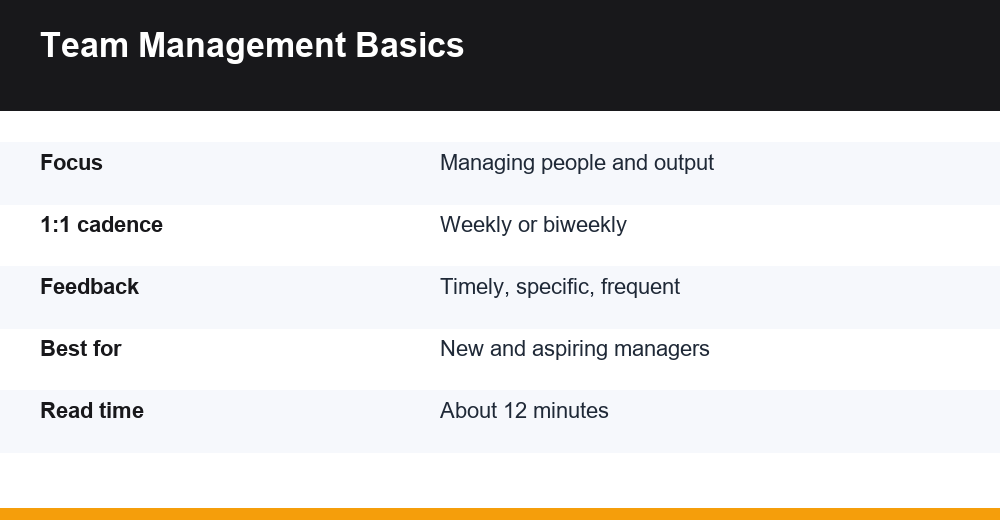
Weekly works for most teams; every two weeks is the floor. Thirty minutes is plenty if you actually keep it. The fastest way to signal that someone does not matter is to cancel their one-on-one every time you get busy, so guard the slot like a client meeting.
A simple one-on-one agenda
- Their topics first — wins, worries, and anything stuck or slowing them down.
- Your feedback, plus any context or decisions they are missing.
- One question about growth or career direction, even briefly.
- Agree on clear next steps and who owns each one.
Feedback works best when it is timely, specific and frequent, not saved up for a formal review. A reliable structure is situation, behavior, impact: describe what happened, what the person did, and the effect it had. Guidance from Harvard Business Review consistently links regular, candid feedback to stronger performance and retention.
Balance matters too. If the only time you speak up is when something goes wrong, feedback starts to feel like an ambush. Catch people doing things right, and be just as concrete about the praise as you are with the criticism — specific recognition is what makes it believable.
Write down what you agree to, even briefly. A shared note from the last few one-on-ones means you both remember the commitments, and it turns the eventual performance review into a summary of things already discussed rather than a stack of surprises. Surprises in a review are almost always a sign the regular conversations were missing.
Delegation: Getting Work Off Your Plate
Delegation is where most new managers get stuck. Handing off work feels slower than doing it yourself — and at first it genuinely is. But a manager who hoards tasks becomes the bottleneck the whole team ends up waiting on, and their own strategic work never gets done.
A rough rule: delegate the work that is routine, teachable, or a growth opportunity for someone else. Keep the work that is genuinely strategic, sensitive, or yours alone to own — performance conversations and crisis calls, for example. Start with reversible tasks so early mistakes are cheap to fix.
Delegation is not all-or-nothing. Being explicit about how much authority you are handing over prevents the two classic failures — micromanaging and abandoning. The levels below give you and your team shared language for every hand-off:
| Level | What you say | When to use it |
|---|---|---|
| 1 — Do exactly this | Follow these steps, then report back | New hire or high-risk task |
| 2 — Research and recommend | Look into it and suggest options | Building someone’s judgment |
| 3 — Decide, then tell me | Choose, and keep me posted | Proven, reversible decisions |
| 4 — Full ownership | Own it from start to finish | Trusted, capable people |
Match the level to the person and the stakes, and raise it as they earn it. For a deeper walkthrough with hand-off scripts and checklists, see our guide on how to delegate effectively.
Motivation and Keeping Your Team Engaged
Money keeps people from leaving; it rarely makes them care. A big part of how to manage a team over the long run is understanding what actually drives engagement — and for most knowledge workers, that comes down to autonomy, mastery and purpose.
Autonomy means giving people control over how they do their work rather than watching every move. Mastery means they are learning and getting visibly better at something. Purpose means they understand why the work matters and to whom. Pay fairly, then compete on these three.
- Recognize good work specifically and in public; deliver corrections privately.
- Connect tasks to outcomes — show the customer or colleague on the other end.
- Offer stretch assignments before people get bored, not after they have quietly checked out.
- Ask what each person wants next in their career, then help them take a step toward it.
- Protect focus time and shield the team from low-value busywork.
Engagement tends to fade quietly rather than collapse in one dramatic moment. It drains when good work goes unnoticed, when promises about growth are not kept, or when people cannot see the point of what they are doing. Small, consistent signals that you notice and care do more for morale over time than any one-off perk.
Watch for the quiet signs of burnout — slipping quality, withdrawal, growing cynicism — and treat them as data, not attitude problems. A sustainable pace beats heroics; the team that sprints flat out every single week eventually breaks, and the best people tend to leave first.
Handling Conflict Before It Festers
Disagreement is not the problem; avoided disagreement is. When people stop raising issues, you have not reached harmony — you have lost visibility. Part of the job is making it safe to surface tension early, then dealing with it directly instead of hoping it resolves on its own.
When a real conflict lands on your desk, resist the urge to pick a side based on the hallway version of events. Slow down and work through it in order:
- Talk to each person separately and listen for the interest behind their stated position.
- Bring them together with a clear, neutral framing of the issue.
- Focus on the specific behavior and its impact, never on personality or character.
- Agree on one concrete change and a date to check back in.
- Follow up — an unresolved “resolution” teaches people that raising issues is pointless.
Some conflict is healthy and even necessary, because debating ideas sharpens them. The line to hold is between the work and the person: argue about the plan all day if it helps, but never let the disagreement curdle into contempt or point-scoring.
Keep a brief record of recurring issues, especially anything touching conduct, fairness or safety. Simple notes on what was said and agreed protect everyone and jog your memory later. If a situation involves harassment, discrimination or anything that could carry legal weight, involve HR or a qualified professional early — rules vary by location, so check your official local sources rather than guessing.
Managing Remote and Hybrid Teams
Distributed teams do not need different management principles; they need the same principles applied with more intention. The cues you leaned on in an office — body language, hallway check-ins, the mood of the room — mostly disappear, so you have to rebuild them deliberately.
The biggest risk is not slacking; it is drift and isolation. People miss context, miss recognition, and slowly disconnect. Over-communicate direction, write decisions down, and make sure remote members are never treated as an afterthought behind the group that happens to share an office.
| Challenge | Practical response |
|---|---|
| Lost context | Default to written updates in shared channels |
| Fewer social cues | Use video for sensitive talks and ask more questions |
| Uneven visibility | Rotate meeting times and credit remote work openly |
| Weaker bonds | Schedule informal time; meet in person when you can |
Set explicit norms: expected response times, which channel is for what, and which meetings truly need to be live rather than a written thread. Clear agreements remove the low-grade anxiety that comes from never quite knowing what is expected of you.
None of this needs expensive software. A shared document for decisions, a predictable meeting rhythm and the habit of writing things down cover most of it. The tools matter far less than the discipline of using them, so anyone can catch up on what they missed without having to be online at the same moment as everyone else.
First-Time Manager Tips: Your First 90 Days
Nobody is born knowing how to manage a team, and your first ninety days set the tone. Resist the pressure to prove yourself by changing everything at once. Early credibility comes from listening well and delivering a few visible wins, not from a dramatic reorganization.
A 90-day starting plan
- Days 1–30 — Listen: meet everyone one-on-one, learn how the work really flows, and hold off on big changes.
- Days 31–60 — Clarify: reset expectations, fix the most obvious friction, and start regular one-on-ones and feedback.
- Days 61–90 — Improve: make one or two meaningful changes with the team’s input, then check whether they actually helped.
Two mistakes are almost universal. The first is staying an individual contributor in disguise — doing the work instead of leading it. The second is swinging too far the other way, disappearing into back-to-back meetings while the team drifts without direction.
Finally, make peace with acting on incomplete information. You will sometimes get a call wrong, and that is part of the role rather than a verdict on you. Learning how to manage a team is a craft you build over years, not a box you tick — and asking for feedback on your own management is one of the fastest ways to get better at it.
Frequently Asked Questions
How do I start managing a team with no experience?
Begin by listening. Spend your first month meeting each person one-on-one, learning how the work flows, and holding off on big changes. Set clear expectations, start regular check-ins, and ask for feedback on your own management — credibility grows from consistency, not from having every answer on day one.
How often should I hold one-on-ones?
Weekly is ideal for most teams, and every two weeks is the minimum. Keep them to about thirty minutes and protect the time, since canceling regularly signals that people do not matter. Let your report set the agenda first, then add your feedback and one question about their growth.
What is the hardest part of learning to manage a team?
For most people it is delegation. Handing off work feels slower and riskier than doing it yourself, so new managers hoard tasks and become the bottleneck. The fix is to delegate deliberately, matching how much authority you hand over to the person’s skill and the stakes involved.
How do I manage a remote or hybrid team fairly?
Apply the same principles with more intention. Default to written updates so context is not lost, and make sure remote members get equal visibility and credit. Set clear norms for response times and channels, and meet in person occasionally to build the trust that video calls cannot fully replace.