A minimum viable product is the simplest version of your idea that real customers can actually use — enough to test whether people want it before you pour months into the full build. It isn’t a rough draft or a half-broken app; it’s a deliberate experiment built to answer one question: is this worth pursuing? Get it right and you save time, money, and a lot of guesswork.
Table of Contents
What a Minimum Viable Product Is — and What It Isn’t
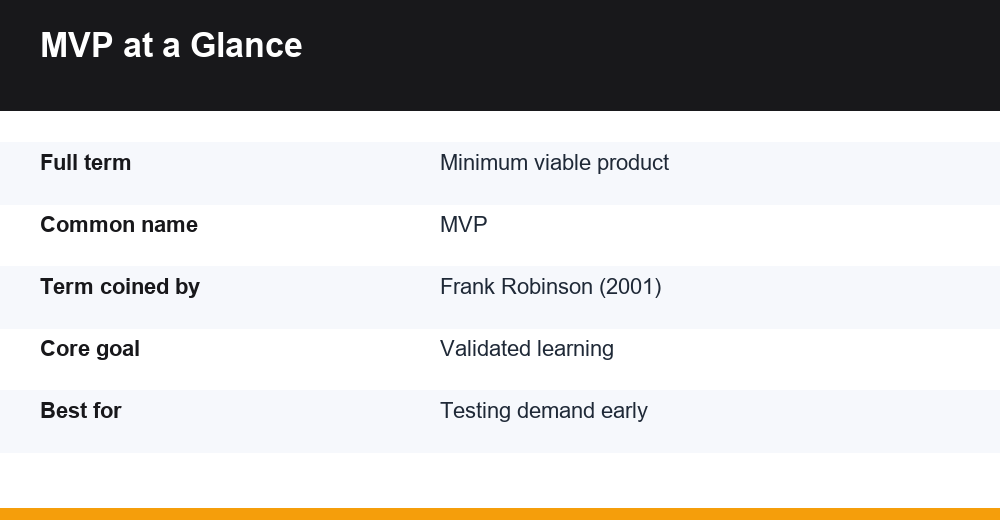
An MVP is the smallest version of your product that real customers can use, built so you get honest feedback in return. The aim isn’t to impress anyone — it’s to learn whether the problem you think you’re solving is one people will actually pay to have solved.
The term was popularized by entrepreneur Eric Ries in The Lean Startup, building on the MVP concept credited to Frank Robinson. Ries framed it around one line worth remembering: an MVP is the version of a product that earns the most validated learning for the least effort.
Notice what that leaves out. An MVP is not a cheap, buggy copy of the finished product. It is not every feature you can squeeze in before launch. And it is not something you build in private for a year, then unveil to silence.
- A polished, feature-complete product
- A prototype nobody outside your team ever touches
- An excuse to ship something broken and call it “lean”
- A one-time launch rather than a starting point
Both words in the name earn their place. “Minimum” pushes you to strip out everything non-essential. “Viable” reminds you it still has to deliver real value, or the feedback you gather is worthless. The “minimum” describes scope — never quality. Early users should be able to finish the core task without hand-holding or apologies.
Why an MVP Matters More Than a Perfect Launch
Most first-time founders fall for a plan and build toward it in a straight line. They add features, polish screens, and delay launch until everything feels ready. Then they release it and discover the market wanted something slightly — or completely — different.
A minimum viable product flips that logic. Instead of betting everything on one big release, you test your riskiest assumption early and cheaply, while changing direction is still easy. Every week spent building the wrong thing is a week you don’t get back.
There is a hidden cost few founders count: opportunity cost. Every month spent perfecting an untested idea is a month not spent learning, selling, or building what customers actually want. Speed to feedback, not speed to launch, is what matters most here.
Timing amplifies this. The earlier you test, the cheaper it is to change course, because you have written less code, hired fewer people, and made fewer promises. As a venture grows, each pivot costs more, so the habit of testing small pays off most in the first few months.
This matters most at the very start. If you are mapping out the earliest moves of a new venture, our guide on how to start a startup pairs naturally with this one — an MVP is usually the first hard proof that an idea holds up outside your own head.
- Validates demand before you commit real budget
- Gets you to real users and feedback faster
- Shows which features people actually use
- Lowers the cost of being wrong
The Main Types of MVP (With Examples)
There is no single format for an MVP. The right one depends on what you need to learn and how much you can afford to build. Four approaches cover most situations, and they are often mixed together.
| MVP type | What it tests | Effort | Good when |
|---|---|---|---|
| Landing page | Real demand and messaging | Low | You need proof people want it |
| Concierge | Whether the service delivers value | Medium | You can serve users by hand |
| Wizard of Oz | Demand for an automated experience | Medium | Automation is costly to build |
| Prototype | Usability and flow | Low–Medium | Design is the main risk |
Landing page MVP
You build a single page describing the offer and measure how many visitors sign up, join a waitlist, or click “buy.” Nothing is built yet — you are testing whether the promise lands. It also doubles as an early demand channel; our guide on how to get customers covers turning that interest into a real list.
Concierge MVP
You deliver the service manually, one customer at a time, with no automation behind the scenes — and customers know it is hands-on. You learn exactly where the value sits and what people struggle with before writing a line of code.
Wizard of Oz MVP
The product looks fully automated to the user, but people are doing the work out of sight. It fits when real automation would be expensive to build and you want proof that customers want the automated experience first.
Prototype MVP
A clickable mockup or interactive model tests design, flow, and usability without a working backend. It answers “can people find their way around this?” rather than “will they pay for it?”
In practice, founders often combine these. You might run a landing page to confirm demand, use a concierge approach to serve the first customers by hand, then automate only once the pattern is clear. Start with the lightest test that answers your current question, and move to heavier ones as the risks change.
Real MVPs That Started Small
The clearest way to understand an MVP is to see how real companies used one. None of these began as the polished platforms we know today.
- Amazon launched in 1995 selling only books, ordering them from distributors as customers placed orders — no giant warehouse to start.
- Dropbox released a short demo video showing how the product would work before the full version existed, using sign-ups to gauge interest.
- Airbnb began with its founders renting air mattresses in their own apartment to test whether strangers would pay to stay.
- Zappos started with its founder photographing shoes in local stores and buying pairs only once someone ordered online.
Each tested a single risky assumption with the least possible effort — will people buy books online, will they want file syncing, will they sleep in a stranger’s home, will they buy shoes sight unseen? That restraint is the whole point of the approach.
These examples share another trait: the founders stayed close to their first users. They watched real behavior instead of relying on surveys or opinion, which is what turned a small test into a reliable answer about demand.
The pattern is consistent: none of them waited for a complete product. They found the fastest honest way to put the core idea in front of real people, then let the response guide what came next.
How to Scope Your First MVP
Scoping is where most MVPs go wrong. The instinct is to include a bit of everything so the product feels complete. Resist it. The whole point of a minimum viable product is restraint — you are building the smallest test of your single riskiest assumption.
- Name your riskiest assumption — what has to be true for this business to work at all?
- Map the core user journey: the one path a customer must complete to get value.
- Cut everything off that path. Each feature you defer is time saved and focus gained.
- Define what success looks like before launch — a specific number, not a feeling.
- Pick the cheapest MVP type that can prove or disprove the assumption.
A simple filter helps: for each feature, ask “if I remove this, can a user still get the core value?” If yes, it does not belong in version one. You can always add it back once real usage shows it matters.
Write the scope down and share it with anyone helping you build. A one-page description of the core journey and the single assumption keeps a small team aligned, and it makes obvious when a “quick addition” is really scope creep.
Say you are building a booking app for local tutors. The riskiest assumption probably is not the calendar or payments — it is whether tutors and students will use a platform at all. A landing page or a manually run pilot tests that far faster than a full build.
Measuring an MVP: Signal vs. Noise
An MVP is only as useful as what you measure. Before launch, pick three to five metrics tied directly to your core hypothesis. A few numbers watched closely beat a dashboard full of data nobody acts on.
Focus on actionable metrics — behaviors that reveal whether people find genuine value. These are the signals worth basing decisions on.
- Activation: did users reach the core value?
- Retention: do they come back without being nudged?
- Task completion: can they finish the main job?
- Conversion: will they sign up, or pay?
Then be wary of vanity metrics — page views, social followers, sign-ups that never return. They feel good and prove little. A spike in traffic after a launch post says nothing about whether the product works.
Talk to users, too. Numbers tell you what is happening; short conversations tell you why. Together they turn raw data into a decision you can trust.
Set a review date as well as targets. Give the MVP a fair window to gather data — long enough for a real pattern, short enough to keep momentum. Reviewing too early reacts to noise; reviewing too late wastes the time the test was meant to save.
One more caution: do not redefine success after the fact. Decide what a good result looks like before the data arrives. It is easy to reinterpret weak numbers as success once you are emotionally invested, which quietly defeats the point of testing at all.
From Feedback to Iteration
Launching is the middle of the process, not the end. Once real people use your MVP, you enter the build–measure–learn loop from lean startup thinking: build the smallest thing, measure how people respond, learn, and adjust.
Each pass around the loop should either strengthen your idea or challenge it. If the data supports your assumption, you build the next piece with more confidence. If it does not, you pivot — change the feature, the audience, or the problem — before you have spent more than you can afford.
A pivot does not mean starting over. You might keep the customer but change the feature, keep the feature but target a different customer, or keep both and change how you charge. The aim is to preserve what the evidence supports and replace only the part that failed.
- Ship the smallest testable version
- Measure it against your success criteria
- Interview a handful of real users
- Decide: persevere, adjust, or pivot
- Repeat until you reach product-market fit
This is the moment your minimum viable product has done its job. It has not handed you a finished company — it has handed you evidence. The founders who succeed are rarely the ones with the best first version; they are the ones who learn fastest from it.
Common MVP Mistakes to Avoid
Even experienced founders repeat the same handful of errors. Knowing them in advance makes them far easier to avoid.
- Building too much before testing anything
- Confusing “minimum” with “low quality”
- Skipping success criteria, so no result feels conclusive
- Ignoring feedback that contradicts the plan
- Chasing vanity metrics instead of real behavior
- Treating the launch as the finish line
A practical habit helps here: write down your assumption and your success threshold before you build. When the results arrive, you have something objective to hold them against, instead of a story you can bend to fit.
Most of these share one root: emotional attachment to the idea. That is natural — you would not be building it otherwise. But the market does not reward how much you love your plan.
Treat your minimum viable product as the start of a conversation with customers, not a fixed statement of your idea. Build the smallest honest test, listen closely, and let real evidence — not your assumptions — decide what comes next.
Frequently Asked Questions
How long should it take to build an MVP?
There is no fixed rule, but many founders aim for weeks rather than months. If your MVP is dragging past a few months, it usually means you are building too much. Start with the cheapest test that answers your riskiest question, then expand from there.
How much does an MVP cost?
It varies widely with the type. A landing page or concierge MVP can cost little beyond your time, while a working software product costs more. Choose the lowest-cost format that still gives you a trustworthy answer about real demand, and treat any figure you find online as a rough guide only.
What is the difference between an MVP and a prototype?
A prototype is a model used to test design and usability, often internally, with no real transactions. An MVP is released to actual customers to see whether they will use or pay for it. A prototype can be one type of MVP, but not always.
Is an MVP only for tech startups?
Not at all — any business can use one. A bakery can test a new item for a weekend, a consultant can offer a single paid session, a shop can pre-sell before stocking. The principle of testing small before you commit applies almost everywhere.