Startup funding is the money you raise to launch and grow a company, and getting it right means matching the type of capital to your stage rather than chasing the biggest cheque. This guide walks through every realistic option, from bootstrapping to venture capital, and explains the stages, the trade-offs, and what investors actually want before they part with a cent.
Table of Contents
What startup funding really means
At its core, funding is capital used to cover the gap between what your business earns today and what it needs to reach its next milestone. That milestone might be a working product, your first paying customers, or the revenue that makes a larger raise possible. Startup funding is not one thing — it is a spectrum of options, each with its own cost, speed, and set of strings attached.
There is no prize for raising the most money. Capital is a tool, not a scoreboard, and every source asks for something in return: repayment, ownership, control, or simply the pressure to grow faster than is healthy. The real skill is knowing how much you need, when you need it, and exactly what you are willing to give up to get it.
Money is also not a substitute for a viable business. If you have not validated the problem or built something people want, funding just buys a longer runway to fail on. Before you raise, get the fundamentals in place — our guide on how to start a startup covers the groundwork that makes any raise far easier.
Your main funding options compared
Broadly, startup funding splits into two camps: dilutive capital, where you sell equity for cash, and non-dilutive capital, where you keep full ownership but usually take on repayment or reporting duties. Most founders end up using a mix of both as the company matures.
| Option | Type | Best for | Main trade-off |
|---|---|---|---|
| Bootstrapping | Non-dilutive | Full control, steady growth | Limited speed and cash |
| Friends & family | Loan or equity | The very first cheque | Personal relationships at risk |
| Angel investors | Dilutive | Early belief plus advice | Selling equity early |
| Venture capital | Dilutive | Fast, large-scale growth | Pressure and less control |
| Crowdfunding | Varies | Consumer products with a story | Public effort, no guarantee |
| Grants | Non-dilutive | R&D and specific sectors | Slow, competitive, restricted |
| Loans / debt | Non-dilutive | Steady revenue or assets | Repay with interest |
| Revenue-based | Non-dilutive | Recurring-revenue models | Repay a share of sales |
Two sources dominate the earliest days. Friends and family are fast and forgiving, but mixing money with close relationships can strain both if things go wrong — put terms in writing and be honest about the risk. Angels invest their own money, often in the tens of thousands, and the best of them bring introductions and hard-won advice alongside the cheque.
Non-dilutive money is often overlooked because it is less glamorous than a venture round, yet it can be the smartest first move. Public programmes are a good starting point: in the US, for example, the U.S. Small Business Administration lists loans, grants, and investment schemes, and most countries run their own equivalents. Eligibility and rules vary widely by country and region, so always confirm the details with the official source.
Read the table as a menu, not a ladder. You do not have to progress from one row to the next; many strong companies mix a small loan with revenue and never sell a share, while others raise venture capital from day one because their market rewards speed. The right choice depends on your business model, not on what happens to be fashionable.
Funding stages: from pre-seed to Series A
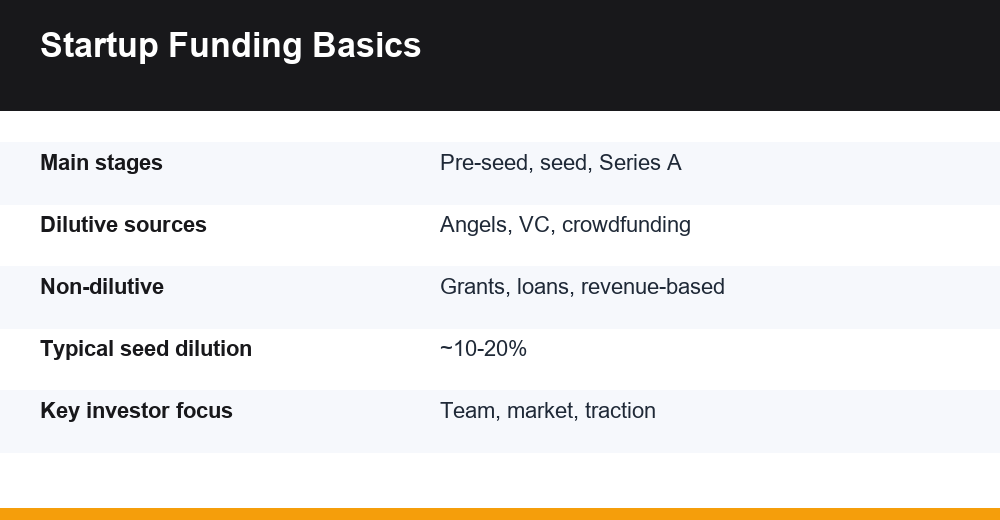
Equity is usually raised in rounds, each tied to what you have proven so far. The labels matter less than the logic: every round should buy enough progress to justify the next one at a higher valuation. Amounts vary enormously by market, sector, and year, so treat any figure as a rough guide, never a promise.
Pre-seed
Pre-seed is the earliest outside money, typically from founders, friends, family, or angels. It usually funds building a first version of the product and testing whether anyone actually wants it. This is the moment to get a minimum viable product in front of real users, because evidence of demand is worth far more than a polished deck.
Seed
Seed is often the first formal equity round, raised to reach product-market fit — the point where customers keep coming back. Backers are usually angels and early-stage funds. Here you are selling a credible plan to turn early traction into a repeatable, growing model rather than a one-off spike of interest.
Series A
Series A is the first large institutional round, typically led by a venture firm that takes a board seat. By now investors expect genuine traction: consistent revenue, retention, and growth they can model. The capital goes into scaling what already works — sales, hiring, and expansion — not into still searching for the idea.
Accelerators and incubators
Programmes like these sit alongside the stages rather than inside them. They typically offer a small amount of capital, structured mentoring, and a network in exchange for a modest slice of equity, ending in a demo day. For first-time founders they can shorten the learning curve and open doors that money alone cannot.
Later rounds — Series B, C, and beyond — repeat the pattern at bigger numbers, funding expansion into new products or markets. Most companies never reach them, and that is perfectly fine. Plenty of excellent businesses stop raising the moment they turn profitable and fund growth from their own revenue instead.
Equity and dilution basics
Every time you sell equity, you give up a slice of ownership. Dilution is the drop in your percentage when new shares are issued to investors or set aside for employees. Your share count can stay the same while the total number of shares grows, so your slice of the pie gets thinner.
Early rounds often use a SAFE (Simple Agreement for Future Equity) or a convertible note. These let investors put money in now and convert it to equity later, usually at your next priced round — faster and cheaper than negotiating a full valuation up front.
- Seed rounds commonly cost founders somewhere in the region of 10-20% of the company.
- Series A often lands in a similar or slightly higher band, roughly 15-25%.
- An employee option pool (frequently around 10%) also dilutes founders, and is usually created just before a round.
It also helps to think in terms of total dilution across every round, not just the one in front of you. Each raise stacks on the last, so a founding team can move from full ownership to a minority stake over several years. Plan for the whole path, not a single step, and you will avoid unpleasant surprises later.
A few related ideas are worth knowing. Founder vesting means your own shares are earned over time, often across four years, which reassures investors that you are committed. Pro-rata rights let early backers reinvest to keep their percentage. And a down round — raising at a lower valuation than before — is painful but survivable, and always beats running out of cash.
Dilution sounds alarming, but it is not the enemy. Owning a smaller share of a much larger company can be worth many times more than owning all of a tiny one. The real question is whether each point of equity you sell buys enough growth to more than pay for itself.
What investors look for
Whatever the stage, investors are underwriting risk. They keep asking one question in different forms: can this team turn this market into a big, durable business? Four things carry most of the weight in that judgement.
Your job in the room is to make that judgement easy. Show the numbers you already have, explain how you gathered them, and be candid about what is still unproven. Investors meet many founders each week, so a clear, honest account is easier to remember and back than an inflated one.
- Team: relevant experience, complementary skills, and the resilience to keep going when the plan breaks.
- Market: a real problem and a market large enough to build a serious company on.
- Product: evidence your solution genuinely solves the problem, not just a slick demo.
- Traction: signs of momentum — revenue, retention, engagement, or a waitlist that keeps climbing.
The emphasis shifts with each stage. At pre-seed, with little hard data to show, investors lean on the founding team and the size of the opportunity. By seed and Series A they want proof: paying customers, repeat usage, and a story the numbers support. Pitch to what you can honestly evidence, and no further.
It helps to know what pushes investors away, too: a market that is too small, founders who cannot explain their own numbers, wildly optimistic projections with nothing behind them, or a cap table already crowded with passive shareholders. In the room, clarity and honesty consistently beat hype.
How a raise actually works
Fundraising is a sales process, and it runs on a timeline. From first conversations to money in the bank commonly takes three to six months, sometimes longer, so start well before you are desperate. Line up your materials, then run a focused process rather than pitching one investor at a time.
- Prepare the essentials: a short deck, a simple financial model, and a clear ask (how much, for what, and what it buys).
- Build a target list of investors who back your stage and sector — a warm introduction beats a cold email almost every time.
- Run meetings in a tight window so interest compounds and you can compare terms side by side.
- Handle due diligence: expect questions on metrics, customers, the cap table, and legal basics.
- Agree terms, sign, close, and then get straight back to building.
Momentum matters more than many founders expect. Once one credible investor commits, others often follow, so a tight, well-run process tends to close faster than a drawn-out one. Keep a simple record of every conversation, and share a small set of key documents once serious interest appears.
Keep the paperwork clean from day one. A tidy cap table, clear ownership, and sensible early agreements make every future round smoother and protect you when the stakes are higher. If in doubt, get proper legal advice; the standard documents and the rules around them differ by country.
How to choose the right path
The best startup funding is the cheapest capital that carries you to your next milestone without giving up control you will later regret. Start by being honest about the kind of business you are building: a steady, profitable company and one built to scale fast on venture capital need very different funding.
Work through a few blunt questions before you raise anything:
- How much do you genuinely need to hit the next clear milestone — and no more?
- Can non-dilutive money — revenue, a grant, or a loan — cover it before you sell equity?
- Is this a venture-scale business, or one better funded by its own cash flow?
- What are you most willing to trade: ownership, control, or speed?
For many founders the smartest route is a hybrid: bootstrap or use non-dilutive capital to find product-market fit, then raise equity from a position of strength when you can command better terms. Raising when you do not strictly need to is far easier than raising when you are running out of cash.
Whatever you decide, revisit it as the business changes. The right source at pre-seed can be the wrong one a year later, and a plan that once made sense may age quickly. Treat the funding decision as something you review on a schedule, not a choice you settle once and forget.
Common funding mistakes to avoid
Most funding disasters are avoidable. A handful of traps show up again and again:
- Raising too early, before you can prove demand, which forces a low valuation and heavy dilution.
- Raising too much and building spending habits that collapse the moment conditions tighten.
- Taking money from the wrong investor — the cheque clears, but the relationship costs you for years.
- Ignoring non-dilutive options and selling equity you never needed to sell.
- Neglecting the paperwork: a messy cap table or unclear ownership scares off future backers.
Treat every raise as a deliberate trade — capital now in exchange for obligations later — and make the trade only when the maths clearly works. Approached that way, startup funding becomes a lever you pull on purpose, not a milestone you chase for its own sake.
Frequently Asked Questions
How much equity should I give up when I raise?
There is no fixed rule, but founders commonly part with roughly 10-20% of the company in a seed round and a similar or slightly higher share at Series A. Focus less on the exact percentage and more on whether the capital buys enough growth to raise the value of the stake you keep.
Do I need venture capital to build a successful company?
No. Venture capital suits businesses chasing very fast, large-scale growth, but many strong companies are built on bootstrapping, revenue, loans, or grants instead. VC brings speed and networks in exchange for equity and control, so treat it as one option among several rather than the automatic default.
When is the best time to raise money?
Raise when you have a clear milestone the money will unlock and enough evidence — traction, a working product, or committed customers — to raise on good terms. Fundraising from a position of strength, before you are desperate, almost always wins better valuations and better investors than a last-minute scramble.
What is the difference between dilutive and non-dilutive funding?
Dilutive funding, such as angel or venture investment, gives you cash in return for equity, so your ownership percentage shrinks. Non-dilutive funding — grants, loans, or revenue-based finance — lets you keep full ownership but usually involves repayment or restrictions. Most founders end up using a blend of both over time.