A business plan is the document that turns a rough idea into something you can fund, test, and measure against. It forces the hard questions before your money is on the line: who buys, why, at what price, and what happens when your first assumptions break. This guide walks through every core section, shows when a one-page version beats a full document, and flags the mistakes that sink otherwise sound ideas.
Table of Contents
Why a Written Plan Still Matters
Plenty of good companies started on the back of an envelope, which makes it tempting to skip the paperwork. But the value was never the finished file — it’s the thinking the file forces out of you. Writing things down exposes the gap between what you hope will happen and what you can actually defend to someone with money at stake.
A solid plan does three jobs at once. It gets you and any co-founders agreeing on the same facts, so you argue on paper instead of six months into trading. It gives lenders and investors the evidence they need to say yes. And it becomes a scoreboard: when results drift from the page, you catch it in week three, not quarter three.
There’s also a quieter benefit. The act of planning surfaces decisions you’d otherwise make by accident — your pricing, your first hire, the month you run out of cash. You may not follow the document to the letter, and you shouldn’t. But you’ll make sharper choices because you thought them through once, in advance, before the pressure was on.
It doesn’t have to be long to earn its keep. Whether you’re testing a weekend side project or working through how to start a small business, putting real numbers next to your assumptions is what separates a plan from a wish.
What Goes Inside a Business Plan
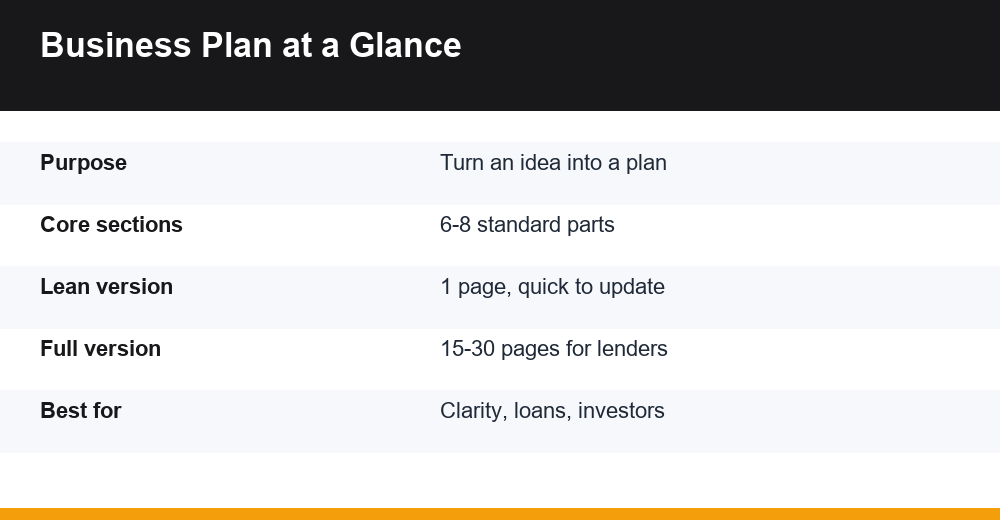
Most plans share the same skeleton, whether they run three pages or thirty. A conventional business plan spans roughly 15 to 30 pages and moves in a logical arc: what you do, who you serve, how you’ll reach them, how you’ll run the operation, and what the numbers say.
You don’t have to write the sections in the order a reader meets them. Most founders draft the market and financial parts first and save the summary for last, because you can’t distil numbers you haven’t run yet. Build the evidence, then write the pitch.
Government resources such as the U.S. Small Business Administration publish free templates and outlines. Registration, licensing, and tax rules vary by location, so treat any single template as a starting frame and confirm the legal specifics with an official source in your own jurisdiction.
Here’s the standard structure and what each part is for:
| Section | What it answers | Typical length |
|---|---|---|
| Executive summary | Why this business, why now, why you | 1 page |
| Company overview | What you sell and how you’re set up | 1 page |
| Market analysis | Who buys, how many, the competition | 2-3 pages |
| Business model | How you make money, at what margin | 1-2 pages |
| Marketing & sales | How buyers find and choose you | 1-2 pages |
| Operations & team | Who does the work, and how | 1-2 pages |
| Financial plan | Revenue, costs, cash, funding need | 3-5 pages |
| Appendix | Evidence: CVs, contracts, research | As needed |
The Executive Summary and Company Overview
The executive summary sits first and gets read first — often it’s the only page a busy investor opens before deciding whether to continue. In under a page it should state what you do, the problem you solve, the market you’re chasing, any traction you have, and how much money you need. It should summarise, not tell the whole story.
Write it last. Once every other section exists, pull the single strongest sentence from each and stitch them together. A summary written first tends to describe the business you imagined; one written last describes the business your evidence actually supports — and reviewers can tell which they’re reading.
The company overview that follows fills in the essentials: legal structure, location, ownership, founding story, and a one-line mission a stranger could repeat back to you. This is also where you state your business stage — idea, pre-revenue, or growing — so readers can calibrate their expectations.
Keep every claim concrete. ‘We help independent cafes cut card-processing fees’ beats ‘we deliver innovative fintech solutions’ every time, because one can be checked and the other cannot. Specifics build trust; vague phrasing drains it. If a sentence would fit any company in your industry, cut it or sharpen it.
Market Analysis and Business Model
The market analysis is where your assumptions meet real numbers. Describe your target customer specifically — their situation, budget, and the trigger that makes them buy. Size the market honestly, and name your real competitors, including the ‘do nothing’ option, which is what most customers choose today.
Avoid the top-down trap. ‘We only need 1% of a billion-dollar market’ is not a forecast; it’s a guess that skips every hard step in between. Build the number from the bottom up: how many customers can you realistically reach this year, how often do they buy, and at what price? Small, defensible numbers beat big, hopeful ones.
Your business model explains how those customers turn into revenue. Spell out pricing, unit economics, and gross margin in plain terms. If it costs 40 to win a customer who spends 30, no amount of growth fixes it — scale just loses money faster. Founders who grasp this early avoid one of the most expensive lessons there is.
A credible model answers four questions clearly:
- What exactly does a customer pay for, and how often do they come back?
- What does it cost to make and deliver a single unit?
- What does it cost to acquire one paying customer?
- How long does that customer stay before they leave?
If you can answer those with evidence — even rough evidence from a small test — you’re ahead of most first-timers, who assume the answers instead of checking them.
Marketing, Sales, and Operations
A plan that describes a great product but no way to sell it is only half a plan. Your marketing and sales section should trace the whole path from stranger to paying customer: which channels you’ll use, what a lead costs, how long the sales cycle runs, and how a deal actually closes.
Be specific about channels you can afford to test. ‘Social media and word of mouth’ is a hope, not a strategy. ‘We’ll run local search ads, publish two how-to articles a week, and partner with three suppliers who already reach our buyers’ is something you can budget and measure.
Operations covers the practical systems that keep your promises: suppliers, tools, inventory, fulfilment, staffing, and the handful of risks that could stop you. Name the software and partners you’ll genuinely use rather than padding the list to look busy — an experienced reader spots filler quickly.
Include a short section on the team and who does what. Investors back people as much as ideas, so be honest about the gaps you’ll need to hire for. This is also where a first-time founder should think hard about how to start a startup lean — proving demand before over-hiring or signing a long lease you can’t yet justify.
The Financials Investors Actually Read
This section scares non-finance founders, but it rests on three linked statements. The profit and loss shows whether you make money over time. The cash-flow statement shows whether you can pay the bills each month. The balance sheet shows what you own and what you owe at a point in time.
Cash flow is what kills companies. A business can look profitable on paper and still fold because customers pay in 60 days while wages and rent are due on the 1st. Model your cash month by month for the first year or two, and know exactly when the balance dips lowest.
What reviewers trust least is the totals, and what they trust most is the assumptions underneath them. State those plainly: conversion rate, average order value, repeat rate, churn, and the dates you plan to hire. When someone pushes back, they’re testing your inputs, not your spreadsheet formatting.
Keep three simple forecasts where you can — a realistic case, a cautious one, and a stretch one — so a reader sees you’ve thought about what happens if things go slower than hoped. The cautious case is often the most persuasive, because it shows you can survive a bad quarter.
If you’re raising, add a clear funding ask: how much, what it buys, and the milestone it reaches. ‘We need 150k to reach 500 paying users and cover our unit costs’ is a sentence an investor can weigh in seconds. Vague asks get vague answers.
Lean One-Page vs Full Plan
You don’t always need the full document. A lean, one-page plan captures your model, customers, channels, and key metrics in a single view you can revise in an afternoon. It’s built for speed and iteration, which makes it well suited to early validation and keeping a small team aligned week to week.
A full business plan earns its length when someone outside the building needs to weigh risk — a bank considering a loan, an investor running due diligence, or a grant, visa, or competition panel that expects depth. Some fields, such as manufacturing, healthcare, and regulated tech, need that detail no matter how early you are.
Whatever you do, don’t fake the shorter format by shrinking the font to eight points and cramming two thousand words onto one sheet. That defeats the entire purpose, which is forcing clarity. If the story genuinely needs more room, write the longer version honestly.
Here’s how the two formats compare:
| Factor | Lean one-page | Full plan |
|---|---|---|
| Length | 1 page | 15-30 pages |
| Best for | Testing ideas, internal use | Loans, investors, grants |
| Time to write | An afternoon | Days to weeks |
| Updates | Constantly | Quarterly or on big change |
| Financials | Key metrics only | Full statements & forecasts |
Common Mistakes That Sink a Plan
Most weak plans fail in the same handful of ways, and they are harder to spot in your own draft than in someone else’s. Read your work as a skeptical stranger would, then fix whatever makes you wince.
- Wishful financials. Hockey-stick charts with no assumptions behind them. Reviewers discount them on sight.
- Vague customers. ‘Everyone’ is not a target market. Narrow it until it feels almost too small, then narrow again.
- No competition named. Claiming you have none reads as naivety, not open space.
- Ignored cash flow. Profit on paper means nothing if you miss payroll in month four.
- Sloppy writing. Typos and broken formatting signal the same carelessness a lender fears in your bookkeeping.
- Set and forget. A document written once and filed away is out of date the moment your market moves.
That last point matters most. Your business plan is a living document, not a homework assignment you hand in once — revisit it whenever your numbers, market, or team shift, and update the page rather than defend an old version of it. Fast-growing companies review it quarterly; steady ones, once a year.
Frequently Asked Questions
How long should a business plan be?
It depends on the reader. A lean version fits on one page and works for testing ideas or aligning a small team. A document meant for a bank or investor usually runs 15 to 30 pages, because those readers expect detailed market and financial evidence before committing.
Do I really need one if I’m not raising money?
Yes. Self-funded founders benefit most from the process, not the file. Writing one forces you to test pricing, spot cash-flow gaps, and set milestones you can measure against. Treat it as a private stress test for your idea, not a document you write only to impress outsiders.
Which section is the most important?
For readers, the executive summary, since it’s often the only page they finish. For you as the founder, the financials — especially cash flow, where good ideas quietly run out of money. Write the summary last, once the numbers behind it exist.
Should I use a template or planning software?
Templates from official small-business portals, dedicated planning software, or a simple spreadsheet all work fine. Just don’t let the template think for you. The value lies in filling it with honest, specific numbers and evidence — not in the cover page, the fonts, or a polished design.