Most customer retention strategies you read about assume a loyalty platform, a CRM team and a marketing budget. A small business usually has none of those, so this guide sticks to twelve tactics a team of one to ten people can run with a spreadsheet, an email tool and some discipline, and pairs each one with the number that tells you whether it is working.
Table of Contents
Why Is Customer Retention Cheaper Than Acquisition?
Winning a new customer means paying for attention: ads, introductory discounts, sales calls, time spent explaining who you are. A returning customer has already paid that toll. They know where you are, what you sell and whether they trust you, so the next sale usually costs a fraction of the first.
You will often see the claim that acquiring a customer costs about five times more than keeping one. Treat it as a rule of thumb rather than a law; the real ratio depends on your industry, your channels and how much you spend on ads. The direction, though, holds for almost every small business.
The most quoted research comes from Frederick Reichheld of Bain & Company, whose work linked a five-percentage-point improvement in retention with profit increases of roughly 25% to 95% in the industries studied. Those figures came from specific sectors and specific cost structures, so do not plug them into your own forecast. The underlying logic is sound, though, and it is easy to see in your own books.
Where the extra profit actually comes from
- No second acquisition cost: you do not pay again to win someone who already buys from you.
- Higher frequency: loyal customers tend to buy more often and try more of your range.
- Cheaper service: they know how your product works, so they need less hand-holding.
- Referrals: satisfied regulars bring friends, and referred customers arrive with some trust already built.
- Price tolerance: people who value the relationship are less likely to leave over a small price change.
None of this means you should stop chasing new business. You cannot keep customers you never won, and our guide on how to get customers covers that side of the equation. It means the money you spend winning people is wasted if half of them never come back, which is why customer retention strategies deserve a fixed slot in your weekly routine.
How Do You Calculate Customer Retention Rate?
Before trying any of the ideas below, get a baseline. Otherwise you will never know whether the new follow-up email or loyalty card changed anything. The standard formula is:
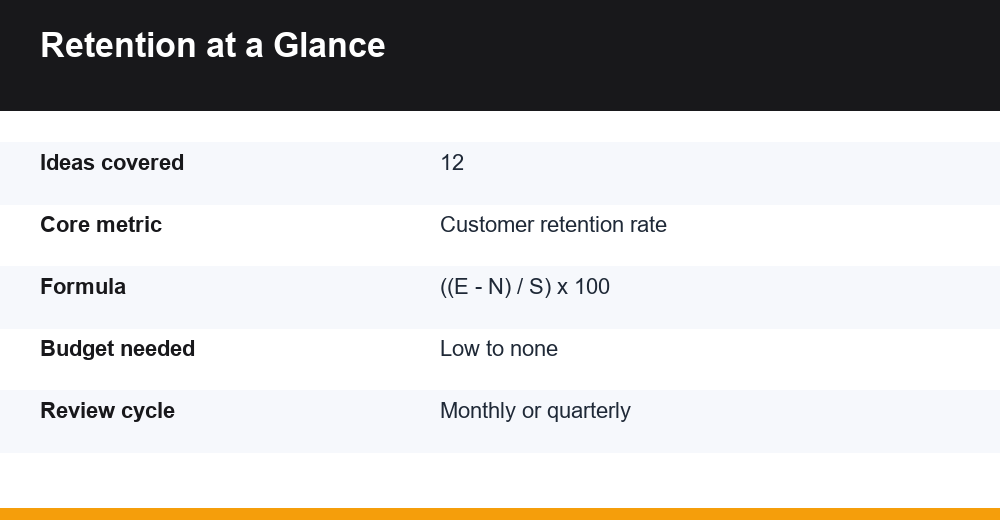
Customer retention rate = ((E – N) / S) x 100, where S is the number of customers at the start of the period, E is the number at the end, and N is the number of new customers gained during the period.
Example: you start the quarter with 200 active customers, win 50 new ones and finish with 210. Subtract the newcomers (210 – 50 = 160), divide by the starting 200 and you get 0.8, or an 80% retention rate. You lost 40 of your original customers, a churn rate of 20%.
Decide what counts as an active customer
The formula is only as good as your definition. A coffee shop might call someone active if they bought in the last 30 days; an accountant might use 12 months. Match the window to your natural buying cycle and keep it the same every time you measure, or your trend line becomes meaningless.
You do not need special software. Export orders or invoices from your till, booking system or accounting tool into a spreadsheet, use email addresses or customer IDs as the unique key, and count. Twenty minutes a month is enough for most small firms.
The five numbers worth tracking
| Metric | How to calculate it | What it tells you | Check it |
|---|---|---|---|
| Customer retention rate | ((E – N) / S) x 100 | Share of existing customers you kept | Monthly or quarterly |
| Churn rate | Customers lost / S x 100 | Share you lost (100 minus retention) | Monthly or quarterly |
| Repeat purchase rate | Customers with 2+ orders / all customers x 100 | Whether first-time buyers come back | Monthly |
| Purchase frequency | Total orders / unique customers | How often your regulars buy | Quarterly |
| Customer lifetime value | Average order value x purchase frequency x average customer lifespan | What a typical customer is worth over time | Twice a year |
Repeat purchase rate is the most useful figure for a young business, because the jump from one purchase to two is where most customers drop off. Once you have a lifetime value estimate, compare it with what you spend to win each customer using the LTV to CAC ratio. That single comparison tells you whether your growth is healthy or simply expensive.
What Are the Best Customer Retention Strategies for Small Businesses?
Usually the unglamorous basics, done consistently. The first four ideas below cost little more than attention, and they make every later tactic more effective. Each one comes with the number to watch, so you can tell within a quarter whether it is paying off.
1. Fix the first 30 days
The second purchase is the hardest one to win. Map what happens after someone buys for the first time: do they get a thank-you, clear instructions, a reason to return? A short welcome note, a setup guide or a quick call for service businesses can turn a one-off buyer into a regular.
Measure it: the share of new customers who make a second purchase within 30, 60 or 90 days, depending on your cycle.
2. Answer fast and as a person
Small firms can beat big competitors on responsiveness. Reply to emails and messages the same working day, sign with a real name and give customers more than one way to reach you. Many people leave not because of a problem but because of how long it took to get help.
Measure it: median reply time and the share of issues resolved in the first contact.
3. Ask for feedback and close the loop
Send a one-question survey after a purchase or project: what is one thing we could do better? Then tell customers what you changed because of their answers. People trust you more when they can see that their suggestions led to real changes, and the replies often reveal problems nobody mentioned at the till.
Measure it: survey response rate and the number of changes you made and announced each quarter.
4. Be boringly consistent
Customers return when they know what they will get. Write down your standards, such as delivery times, portion sizes, turnaround on quotes or how the phone is answered, and make sure everyone on the team follows them. Consistency is cheaper than any reward scheme and harder for competitors to copy.
For practical checklists on running and marketing a small firm, the U.S. Small Business Administration’s business guide is a free, neutral reference worth bookmarking.
Measure it: complaint count per month and the trend in your average review rating.
Stay in Touch Without Becoming Noise
Many customers do not leave on purpose. They simply forget about you when a competitor’s ad appears at the right moment. The next four ideas keep you in their mind without spamming them.
5. Build a simple post-purchase sequence
Three or four automated messages are enough for most businesses. A practical starting point:
- Day 1: thank-you and anything they need to get value from the purchase.
- Day 7: a useful tip, care instruction or how-to related to what they bought.
- Day 30: a check-in asking how things are going, with an easy way to reorder or rebook.
- Around their normal repurchase point: a friendly reminder, not a hard sell.
Measure it: compare the repeat purchase rate of customers who received the sequence with those who bought before you set it up.
6. Send email that helps more than it sells
A regular newsletter is still one of the cheapest retention channels available, because you own the list and pay little per message. Aim for something like three useful pieces of content for every promotion. Our guide to email marketing for small business walks through list building, tools and what to send.
Measure it: click rate and the number of orders from existing customers in the week after each send.
7. Use replenishment and service reminders
If what you sell runs out, wears out or needs servicing, remind people before they go looking elsewhere. A pet food shop can estimate when a bag runs low; a garage can remind drivers about the annual service; a salon can suggest the next appointment at checkout.
Measure it: the share of reminded customers who reorder or rebook within two weeks.
8. Remember people
Keep a notes column in your customer spreadsheet or booking tool: names of children, preferences, the project they mentioned. Using those details next time makes customers feel known, which is something a large chain struggles to match. A handwritten card to your top 20 customers once a year costs very little.
Measure it: tag your top customers and track their retention rate separately from everyone else.
Do Loyalty Programs Work for Small Businesses?
They can, with three conditions: the reward is worth having, the rules fit on a card, and the scheme sits on top of good service rather than replacing it. The main risk is giving discounts to people who would have come back anyway, so measure carefully before you scale.
A small team does not need a dedicated platform. A stamp card, a tag in your point-of-sale system or a column in a spreadsheet will do for the first year.
9. Start with a simple reward or tier
Buy nine, get the tenth free still works in cafes, car washes and barbers. For higher-value businesses, a small tier such as priority booking or a free check-up after a set spend often beats a discount, because it protects your margin.
Measure it: visit frequency of members against non-members. Remember that keen customers join first, so some of the gap would exist anyway.
10. Reward referrals on both sides
Give the referrer and the new customer something modest, such as credit, a free add-on or a gift. People are more comfortable recommending you when their friend benefits too.
Measure it: referred customers per month and their retention rate compared with customers from paid ads.
11. Offer a subscription or membership where it fits
Regular deliveries, maintenance plans and monthly memberships turn repeat buying into the default. They suit consumables, services with a natural rhythm and anything customers would otherwise forget to reorder. Make cancelling as easy as signing up; customers who feel trapped leave bad reviews on the way out.
Measure it: monthly subscriber churn and the reasons people give when they cancel.
12. Give regulars insider access
Early access to new products, a members-only evening or a small workshop costs little and makes people feel part of something. It also gives you face time to hear what they want next.
Measure it: repeat purchase rate of attendees in the 90 days after each event.
Which loyalty format suits you?
| Format | Setup cost | Best for | Watch out for |
|---|---|---|---|
| Stamp or punch card | Very low | Frequent, low-value purchases | Lost cards, little customer data |
| Points in POS or spreadsheet | Low | Shops with a till that tags customers | Rules getting too complicated |
| Spend-based perks tier | Low | Higher-value services | Perks that cost more than they earn |
| Referral reward | Low | Services people talk about | Rewards claimed without real referrals |
| Subscription or membership | Medium | Consumables, maintenance, classes | Quiet churn and failed payments |
How Do You Win Back Lost Customers?
Some churn is inevitable: people move, budgets change, needs end. But a share of lapsed customers simply drifted away and can often be brought back for less than it costs to find someone new. Run a win-back routine once a month.
- Define lapsed. A useful rule is two to three times your normal gap between purchases. If regulars buy monthly, someone silent for three months is at risk.
- Sort by value. Start with the customers who spent the most or bought most often; they are worth a personal message.
- Ask why before offering anything. A short, honest note asking whether something went wrong often uncovers a fixable problem.
- Give a reason to return. Mention a new product, a fixed issue or an improved service before you reach for a discount.
- Make it easy. Include a direct link, a booking slot or a reply-to-order option.
- Set a stop rule. After two or three attempts with no response, stop contacting them, honour any unsubscribe request and respect their choice.
Measure it: reactivation rate, meaning lapsed customers who buy again divided by lapsed customers you contacted. Log the reasons people give for leaving; after a few months you will see patterns that point to the next thing to fix.
A 90-Day Plan for Your Customer Retention Strategies
Trying all twelve ideas at once is the fastest way to do none of them well. Pick three, run them for a full quarter and let the numbers decide what stays. Here is a sequence that fits a small team:
| Weeks | Focus | Output |
|---|---|---|
| 1-2 | Baseline | Retention rate, repeat purchase rate and an active-customer definition |
| 3-4 | First 30 days | Welcome message and post-purchase sequence live |
| 5-6 | Feedback | One-question survey sent, first changes announced |
| 7-8 | Reminders | Replenishment or rebooking prompts set up |
| 9-10 | Win-back | Lapsed list built, personal messages sent to top-value group |
| 11-13 | Review | Compare metrics with baseline, keep what moved the numbers |
Only add a loyalty card, referral reward or subscription once the basics are running. Those tactics amplify a good experience; they rarely rescue a poor one.
The point of measuring is to stop guessing. If your repeat purchase rate rises from, say, 30% to 38% after a follow-up sequence, you know where to spend the next hour. That is what separates customer retention strategies that grow a business from a list of good intentions.
Frequently Asked Questions
What are the best customer retention strategies for small businesses?
The most reliable tactics are the basics: a strong first 30 days, fast and personal replies, asking for feedback and acting on it, consistent quality, and timely follow-up. They cost little and make loyalty cards, referrals or subscriptions work better later. Measure repeat purchase rate before and after each change to see what actually helps.
How do you calculate customer retention rate?
Use ((E – N) / S) x 100, where S is customers at the start of the period, E is customers at the end and N is new customers gained in between. Starting with 200, gaining 50 and ending at 210 gives 80%. Keep the same definition of an active customer and the same period each time.
Why is keeping customers cheaper than finding new ones?
Existing customers already know and trust you, so you do not pay again for ads, introductory discounts or sales time. They also tend to buy more often, need less support and refer others. The often quoted five-to-one cost ratio is a rough rule of thumb; the exact figure varies by industry and channel.
Do loyalty programs work for small businesses?
Yes, when the reward is meaningful, the rules are simple and service is already good. A stamp card or spreadsheet-based perk is enough to start. Compare members with non-members, but remember keen customers join first, so part of the difference would exist without the scheme. Prefer perks over deep discounts to protect margins.