Knowing how to give constructive feedback is one of the few management skills that pays off every single week, yet most leaders learn it by trial and painful error. This guide gives you a repeatable seven-step method built on the Situation-Behavior-Impact model, word-for-word scripts for the conversations managers dread most, and a calm playbook for when the other person gets defensive.
Table of Contents
Why most workplace feedback misses the mark
Bad feedback rarely fails because the manager is unkind. It fails because it is vague, late, or wrapped in so much padding that the real message never lands. “Be more proactive” or “your attitude needs work” gives the listener nothing to act on and plenty to argue with.
The opposite problem is silence. Many managers simply avoid the conversation, hoping the issue fixes itself. In a small team, that gap shows up quickly as repeated mistakes, quiet frustration and avoidable turnover, and the eventual conversation becomes harder because the pattern is now months old.
Useful feedback has three traits. It is specific (tied to something that actually happened), timely (delivered while the memory is fresh) and actionable (the person leaves knowing what to do differently). Everything in the method below exists to protect those three traits.
- Vague feedback invites the listener to fill the gaps with the worst interpretation.
- Late feedback feels like an ambush, because the person cannot remember the details.
- Unactionable feedback creates anxiety without improvement.
What is the SBI feedback model?
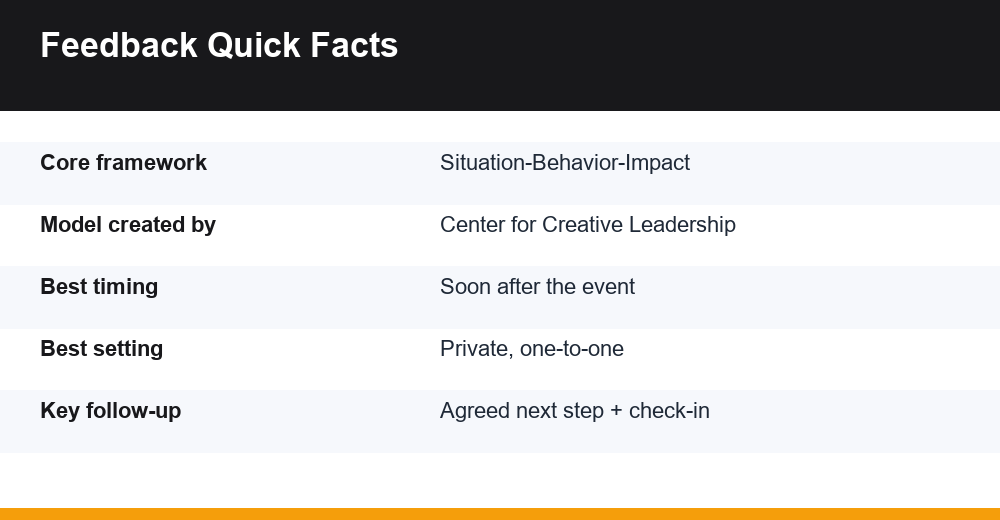
The Situation-Behavior-Impact (SBI) model was developed by the Center for Creative Leadership, a nonprofit leadership development institute. It splits any piece of feedback into three short parts, which keeps the conversation anchored in facts rather than opinions about someone’s character.
- Situation: name when and where it happened, so the person can recall the moment. “In Tuesday’s client call…”
- Behavior: describe only what you observed, the things a camera would have recorded. “…you interrupted the client twice while she was explaining the budget…”
- Impact: explain the effect on you, the team, the customer or the business, using “I” statements. “…and I noticed she stopped sharing details after that, which makes the proposal harder to scope.”
Some practitioners add a fourth step, Intent, sometimes called SBI-I. After stating the impact, you ask about the thinking behind the behavior. This turns a statement into a dialogue and often surfaces context you did not have. It is an extension rather than part of the original three-part model, but it is the single most useful addition for anyone learning how to give constructive feedback to an experienced professional.
| Part | Vague version | SBI version |
|---|---|---|
| Situation | “Lately…” | “In Monday’s stand-up…” |
| Behavior | “You’re not a team player.” | “You said the bug was QA’s problem and moved on.” |
| Impact | “It’s a bad look.” | “The QA lead felt blamed and the fix slipped a day.” |
| Intent (optional) | None | “What was going on for you in that moment?” |
How to give constructive feedback in 7 steps
SBI tells you what to say. The seven steps below cover the whole conversation, from preparation to the follow-up. If you want a single process for how to give constructive feedback to an employee that works for small and serious issues alike, this is it.
1. Check your purpose before you speak
Ask yourself what you want to change. If the honest answer is “I want to vent”, wait. Feedback with no constructive purpose damages trust and changes nothing.
2. Pick the right moment and place
Corrective feedback belongs in private, ideally within a day or two of the event. Avoid Friday afternoons and the minutes before a big presentation. A regular one-to-one is often the natural slot; our list of questions for one-on-one meetings can help you build that habit so feedback never feels like a summons.
3. Open with a clear signal
Do not bury the topic. A short, honest opener lowers anxiety: “I want to talk about the client call yesterday. I have one piece of feedback and I’d like to hear your side too.”
4. Deliver the SBI statement
State the situation, the behavior and the impact in two or three sentences. Then stop talking. The pause is where the other person processes what you said.
5. Ask, then listen
Invite their perspective: “How did it look from your side?” You may learn about a missing brief, a personal issue or a process gap. Listening is not agreeing, but it shows respect and often changes the solution.
6. Agree on one concrete next step
Co-create the fix. “Next call, let’s agree you’ll hold questions until she finishes each section, and you take notes for follow-ups.” One clear action beats a list of five.
7. Close and schedule the check-in
Summarize what you agreed and set a time to revisit it. Then, crucially, notice and acknowledge the improvement when it happens.
Constructive feedback examples: word-for-word scripts
What does good constructive feedback actually sound like? The scripts below follow the SBI structure and end with a question or next step. Adapt the wording to your own voice; the structure is what matters.
Missed deadline
“The market report was due Thursday and arrived Monday morning. Because of that, I presented to the board without the regional numbers. What got in the way, and what would help you flag a slip earlier next time?”
Interrupting in meetings
“In today’s planning meeting, you cut in while Priya was explaining the timeline, twice. She didn’t finish her point and we missed a risk she’d spotted. Could you let people finish and jot your question down instead?”
Sloppy work quality
“The invoice batch you sent out on the 12th had three totals that didn’t match the purchase orders. Two clients called to query them, which cost us about half a day. Can we walk through your checking process together?”
Tone in written messages
“Your reply in the team channel this morning, ‘Read the doc, it’s all there’, came across as dismissive to the new hire who asked. He messaged me privately afterward. Could you add a link and a line of context next time?”
Feedback to your manager (upward)
“When priorities change in Slack late in the day, as happened Wednesday, the team ends up redoing work overnight. Would it be possible to flag changes in the morning stand-up instead?”
Positive constructive feedback
Constructive does not only mean corrective. “In the pitch yesterday you opened with the client’s numbers instead of ours. They leaned in immediately. Keep doing that in every first meeting.” Specific praise tells people exactly what to repeat.
| Scenario | Behavior to name | Next step to agree |
|---|---|---|
| Missed deadline | Date due vs date delivered | Earlier warning signal |
| Interrupting | Count and context | Note questions, wait |
| Quality errors | Exact errors found | Shared checklist |
| Curt messages | Quoted wording | Add context and links |
| Good work | What they did well | Repeat it deliberately |
How to give feedback without sounding harsh
Harshness usually comes from three habits: judging character instead of describing behavior, using absolutes, and delivering criticism while you are still irritated. Fix those and your feedback becomes direct without being cold.
- Swap labels for observations. “You were rude” becomes “You said ‘that’s a dumb idea’ in front of the client.”
- Drop “always” and “never”. They are almost never accurate and invite the person to argue about exceptions.
- Use “I noticed” and “I’m concerned”. They own your perspective instead of declaring a verdict.
- Cool down first. If your pulse is up, wait an hour. Timely does not mean instant.
- Show belief in the person. “I’m raising this because I think you’re ready for bigger client work” frames the talk as investment.
Many guides still recommend the feedback sandwich: praise, criticism, praise. The problem is that the middle message gets diluted, and people quickly learn to brace whenever they hear a compliment. Give honest praise separately and often, so it stays credible and your corrections stay clear.
Tone is also about self-awareness. Managers who read the room well, and notice their own frustration before it leaks into their words, get a far better response. Our guide to emotional intelligence at work covers the practical side of that skill.
What to do when an employee gets defensive
Even well-crafted feedback sometimes triggers a defensive response: excuses, blame shifting, silence or tears. This is normal. The goal is not to win the argument but to keep the conversation productive.
Recognize the common forms
| Reaction | What it often signals | What to say |
|---|---|---|
| Denial | Surprise or embarrassment | “Let’s look at what happened together.” |
| Blaming others | Fear of being judged | “We can talk about that too. First, your part.” |
| Counter-attack | Feeling cornered | “I hear you. Let’s take one issue at a time.” |
| Silence | Processing or shutting down | “Take a moment. What’s your read on this?” |
| Strong emotion | Stress beyond this issue | “Shall we pause and pick this up tomorrow?” |
Five moves that de-escalate
- Stay calm and slow down. Lower your volume and pace. Defensiveness feeds on matching energy.
- Acknowledge the feeling, not the excuse. “I can see this is frustrating” is not the same as “you’re right”.
- Return to the facts. Restate the specific behavior and impact. SBI is your anchor because facts are hard to dispute.
- Get curious. Ask “What am I missing?” Sometimes the defensive reaction is justified and you learn something important.
- Pause if needed. If emotions run high, agree to continue within 24 hours. Pushing through rarely ends well.
What you should avoid is backing down entirely to restore comfort. If the behavior matters, it needs addressing. Calm persistence, delivered with respect, is a core part of the leadership skills that separate good managers from popular ones.
Following up so the feedback actually sticks
A single conversation rarely changes a habit. The follow-up is where feedback turns into improvement, and it is the step most managers skip.
- Write it down. Send a short recap after the meeting: what you discussed, the agreed action and the check-in date.
- Check in on schedule. A five-minute review in the next one-to-one is enough.
- Acknowledge progress quickly. When you see the new behavior, name it within a day.
- Escalate fairly. If nothing changes after two or three cycles, move to a formal performance conversation and say so plainly.
Annual reviews alone are a weak substitute for regular, real-time feedback throughout the year. If you run a small business and are building your first people processes, the U.S. Small Business Administration’s business guide covers the wider basics of managing a company, including working with employees.
Over time, learning how to give constructive feedback well builds something more valuable than any single fix: a feedback culture where people expect honest input, ask for it, and give it to each other.
Common feedback mistakes and quick fixes
Use this as a pre-conversation checklist. If any line describes your plan, adjust before you walk in.
| Mistake | Why it backfires | Quick fix |
|---|---|---|
| Feedback by email for serious issues | Tone is lost, no dialogue | Talk live, recap in writing |
| Criticizing in public | Triggers shame and defensiveness | Always private for corrections |
| Saving issues for the annual review | Feels like an ambush | Raise within days |
| Stacking several issues | Overwhelms the listener | One main issue per talk |
| Guessing at motives | Feels like an accusation | Describe behavior, ask about intent |
| No agreed action | Nothing changes | End with one concrete step |
The best managers treat how to give constructive feedback as a practiced skill, not a personality trait. Start with one SBI conversation this week, keep it short, follow up, and the next one will be easier.
Frequently Asked Questions
How do you give constructive feedback to an employee?
Meet privately soon after the event, state your purpose, then describe the situation, the specific behavior and its impact. Ask for their perspective and listen. Agree on one concrete next step together, summarize it in writing and schedule a short check-in. Acknowledge improvement as soon as you see it so the change sticks.
What is an example of constructive feedback?
“In Tuesday’s planning meeting, you interrupted Priya twice while she explained the timeline. She didn’t finish, and we missed a risk she had spotted. Could you note your questions and wait until she’s done?” It names the situation, the observable behavior and the impact, then ends with a clear, achievable request.
What is the SBI feedback model?
SBI stands for Situation-Behavior-Impact, a framework developed by the Center for Creative Leadership. You describe when and where something happened, what the person actually did, and the effect it had on you, the team or the business. Some managers add a fourth step, asking about intent, to turn it into a two-way conversation.
How do you respond when an employee gets defensive?
Stay calm and slow your pace. Acknowledge the emotion without accepting excuses, then return to the specific facts of the behavior and its impact. Ask what you might be missing, since there may be context you lack. If emotions run high, pause and agree to continue within a day rather than forcing a resolution.