Learning how to start a startup is less about one brilliant idea and more about a disciplined sequence: find a real problem, prove people will pay to solve it, then build only what is needed to test that. This guide follows that sequence plainly, from validating your idea to landing your first paying customers. Expect concrete steps you can act on this week.
Table of Contents
What Makes a Startup Different
A startup is not simply any new business. Its defining trait is the search for a repeatable, scalable business model under real uncertainty. A neighbourhood bakery is a small business; a company building software to help bakeries everywhere run better is a startup.
This difference shapes every decision that follows – how you fund the business, who you hire, and how quickly you try to grow. Keep two words in mind throughout: scalability and uncertainty.
- Small business: a proven model, steady and predictable growth, usually self-funded.
- Startup: an unproven model built for rapid growth, often seeking outside capital.
- Neither is better – the right choice depends on your goals, appetite for risk and the life you want.
Both paths are valid. Chasing the startup label because it sounds ambitious is a poor reason to take on the extra risk. Knowing which one you are building is the first real decision in how to start a startup, and it shapes everything after it.
None of this makes startups glamorous. Most of the work is ordinary – answering support messages, fixing small bugs, and having the same customer conversation for the tenth time. The founders who last tend to be the ones who keep showing up for that routine work long after the initial excitement fades.
How to Start a Startup: The Core Steps
At its core, how to start a startup comes down to a handful of stages that most successful founders move through in roughly the same order.
- Spot a problem worth solving and confirm other people feel it too.
- Test the idea cheaply, before committing months of work or money.
- Build a minimum viable product (MVP) that solves the core problem only.
- Get your first customers and learn from how they actually behave.
- Assemble a small, complementary team and handle the legal basics.
- Raise money only when you have evidence that it is justified.
The sequence matters more than any single step. Skipping validation to jump straight into building is the most expensive mistake founders make. It also helps to write a business plan early – even a rough one-page version forces you to connect the pieces and expose weak assumptions.
None of this happens in a straight line. You will loop back – a customer conversation reshapes the idea, or an MVP result sends you back to research. Treat the steps as a cycle you tighten with each pass, not a checklist you tick once and forget.
Validate Your Idea Before You Build
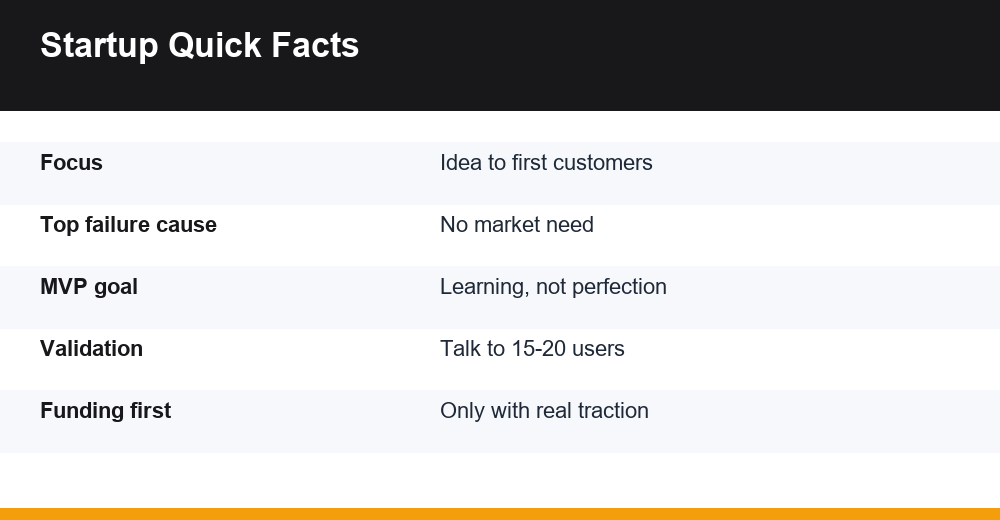
Most failed startups die for one reason: they built something nobody wanted. In CB Insights’ widely cited review of startup post-mortems, the most common cause of failure was the absence of a real market need. A large part of learning how to start a startup well is refusing to build until you have evidence.
Talk to real people
Before writing a line of code, have honest conversations with 15 to 20 people who match your ideal customer. Ask about their current habits and frustrations rather than whether they like your idea. People are polite about ideas; their behaviour tells the truth.
Look for problem/solution fit
You are hunting for problem/solution fit – proof that a specific group feels a pain sharply enough to pay for relief. The clearest signals are people already cobbling together workarounds or paying for inferior fixes.
- Put up a simple landing page describing the solution and measure sign-ups.
- Offer a paid pre-order or a small pilot; money is the strongest signal of intent.
- Study competitors and adjacent tools to gauge demand, gaps and pricing.
Set a clear bar for what counts as a yes before you start. It might be a target number of pre-orders, the share of interviewees who ask when they can buy, or the percentage of visitors who join a waitlist. Deciding the threshold in advance stops you from reading polite encouragement as real demand.
You do not need a forty-page market report. Estimate how many people share the problem, how they solve it today, and what they currently spend. Free public data and a few focused searches will take you a long way.
Build a Minimum Viable Product
An MVP is the smallest thing you can put in front of real users to test your core assumption – not a shrunken version of your dream product. Its job is to generate learning, not to impress anyone with polish.
The classic trap is scope creep: adding features nobody asked for while time and cash quietly drain away. Ship the one thing that solves the core problem, then improve it based on how people actually use it.
- Define the single hypothesis your MVP has to test.
- Cut every feature that does not serve that one hypothesis.
- Decide the metric that will tell you it worked before you launch.
Give the build a deadline. A fixed window – a few weeks rather than a few months – forces hard choices about what truly matters and puts feedback in your hands sooner. If the timeline keeps slipping, that usually means the scope is still too wide.
What an MVP can actually be
An MVP does not have to be software, and it rarely needs to be complicated. Some of the most effective ones are deliberately manual behind the scenes.
- A landing page and a waitlist to test whether the promise resonates.
- A concierge MVP, where you deliver the service by hand before automating anything.
- A single core feature done well, instead of ten half-finished ones.
The real goal of this stage is product-market fit – the point where the market starts pulling the product out of you rather than you pushing it onto people. Until you feel that pull, keep learning instead of scaling.
Team, Co-Founders and Legal Basics
Choosing co-founders and early hires
Many startups are built by two or three founders with complementary skills. Pick people you trust under pressure, agree on who owns what early, and put equity splits and vesting terms in writing. Vague handshake deals cause the ugliest disputes later.
Hire slowly at first. Early team members shape your culture more than any later hire, so favour attitude, ownership and range over a long resume. One committed generalist often beats three passive specialists in the first year.
Agree early on how you will make decisions when you disagree, not only on who owns what. Write down each founder’s role, how much time they will commit, and what happens if someone leaves. These conversations feel awkward now and prevent far worse ones later.
Legal and administrative basics
Registering a company, choosing a legal structure and handling taxes vary widely from one country and state to the next, so treat the points below as general guidance and confirm the details with official sources before you act.
- Choose a structure (sole trader, LLC or limited company, corporation) that fits your liability and fundraising plans.
- Separate personal and business finances from day one – it saves real trouble at tax time.
- Protect your intellectual property and use clear written contracts with everyone you work with.
A government small-business or tax portal in your own country is usually the most reliable and current source for registration, licensing and tax rules. When in doubt, a short conversation with a local accountant is usually worth the fee.
Funding Options for Your Startup
You do not always need investors. Plenty of strong companies bootstrap – funding growth out of their own revenue – and keep full control. Raise outside money only when it clearly accelerates something that is already working.
Here is an honest comparison of the most common paths. For a deeper breakdown of each stage and what investors expect, see our startup funding guide.
| Funding source | Best for | Main trade-off |
|---|---|---|
| Bootstrapping | Early stage, full control | Slower growth, personal risk |
| Friends & family | First small amounts | Strains relationships if it fails |
| Angel investors | Early traction | You give up equity and some control |
| Venture capital | Fast, scalable growth | Pressure to grow quickly, dilution |
| Grants & loans | Non-dilutive capital | Paperwork and eligibility limits |
A useful rule: raise when money is the only thing standing between you and predictable growth. If you cannot yet explain, with numbers, what an extra dollar will do, you probably are not ready to raise it – and investors will sense that too.
Whichever path you choose, track your runway – how many months of spending your cash covers at the current rate. That single number keeps decisions grounded and shows how long you have to reach the next milestone. Raising money or cutting costs is far easier before the runway runs short.
Whatever route you take, understand its true cost. Equity is the most expensive money you will ever raise, because you give it away permanently. Debt has to be repaid on schedule no matter how the business is doing. Neither is free.
Getting Your First Customers
Your first customers rarely arrive through advertising. They come from doing things that do not scale – direct outreach, showing up in communities where your audience already gathers, and drawing on your personal network without embarrassment.
- Go where your target users already spend time and be genuinely useful before you pitch.
- Give early adopters extra attention and support in exchange for honest feedback.
- Ask happy users for introductions; referrals are the cheapest, warmest channel you have.
Charge sooner than feels comfortable. A price, even a modest one, separates genuine demand from polite interest and teaches you what people truly value. Free users often behave nothing like paying ones, so early revenue – however small – is some of the most useful feedback you can gather.
Treat every early customer as a research partner. What they do with your product – and exactly where they get stuck – tells you what to build next. Retention matters more than sign-ups at this stage; adding new users cannot make up for losing them just as fast.
Keep a simple record of every conversation – what the customer wanted, what confused them, and what finally made them buy. Patterns appear faster than memory suggests, and that written trail becomes the clearest guide to what your product should do next.
Set a simple weekly rhythm: talk to users, ship one improvement, then measure whether it moved the number that matters. That loop, repeated patiently, is how genuine early traction builds over time.
Why Startups Fail (and How to Avoid It)
Understanding how to start a startup also means understanding how they end. The failure patterns are remarkably consistent across industries, and most of them are avoidable with a little discipline.
- No market need – building a solution before validating the problem.
- Running out of cash – letting costs outrun revenue, or scaling too soon.
- The wrong team – critical skill gaps or unresolved founder conflict.
- Getting outcompeted, or pricing the product wrong.
- Poor product decisions – ignoring feedback and shipping features nobody wants.
Cash problems deserve particular attention, because they are usually the visible symptom of an earlier mistake rather than the root cause. Weak demand, hiring too fast or scaling before the product was ready all show up eventually as an empty bank account. Careful spending buys the time to fix the deeper issue.
It also helps to name your biggest assumption out loud and check it often. Most founders can point to the one belief their whole plan rests on; testing that belief early, rather than defending it, is what keeps a small mistake from becoming a fatal one.
The common thread is acting on assumptions instead of evidence. Stay close to your customers, spend deliberately, and grow only the parts of the business that are clearly working. That plain discipline is what separates the startups that last from the ones that quietly disappear.
Frequently Asked Questions
How much money do I need to start a startup?
Less than most people expect. Many startups begin with only a small budget spent on validation – a landing page, modest ad tests and customer conversations. You need significant capital once you have proven demand and are ready to scale, not before.
Do I need a co-founder to start a startup?
No, but it helps. Solo founders do succeed, yet a co-founder shares the workload, fills skill gaps and keeps you accountable. If you go solo, build a strong network of advisors and be honest with yourself about where you are weakest.
How long does it take to build a startup?
There is no fixed timeline. Validating an idea can take a few weeks, while reaching product-market fit often takes one to three years. Measure progress by learning and revenue rather than hours spent building alone.
What is the biggest mistake first-time founders make?
Building in isolation. Founders become attached to a solution and skip talking to customers, then launch something nobody wants. Validating the problem first is the cheapest way to avoid wasting months and money.