Strong leadership skills are what separate a manager people tolerate from a leader people actually choose to follow. They aren’t a fixed personality you’re born with — they’re a set of habits you build, test in real situations, and refine over an entire career. This guide covers the twelve that matter most in 2026: why each one counts, and a concrete way to start developing it.
Table of Contents
What Leadership Skills Really Mean
It helps to separate two things that often get lumped together. Management keeps a system running — schedules, budgets, status updates. Leadership decides where that system should go and gets people to move with it. Most roles need both, and the founders and managers who grow fastest stop treating them as the same job.
The encouraging part: none of this is locked in at birth. Confidence and charisma help, but the abilities that actually shift outcomes are learnable through practice and honest feedback. If most of your week is spent coordinating people and workload, ground yourself in the mechanics of how to manage a team first, then layer these skills on top.
One more myth worth dropping: leadership isn’t reserved for people with ‘manager’ in their title. The person who calms a tense meeting, mentors a new hire, or takes on a messy problem nobody else will touch is leading, with or without the org chart’s permission. That is good news, because it means you can start practicing today.
What good leadership is not:
- A job title or a corner office
- Being the smartest person in every room
- Talking the most in meetings
- Having every answer before anyone else does
Six Skills That Move People
Half of leadership is what happens between you and other people. These six skills shape whether your team trusts you, hears you, and does their best work anywhere near you. Get them right and the technical parts of the job get easier, because people tend to give a leader they trust the benefit of the doubt.
1. Communication
Teams execute what they clearly understand, not what you meant to say. The quickest test of your clarity: can you state the goal and the reason behind it in one sentence? If you can’t, you’re not ready to ask others for it yet. Good communicators also match the message to the medium, so a quick decision fits a text and a sensitive one needs a call. Draft that one-sentence goal before every meeting or brief you send.
2. Emotional intelligence
Reading the mood of a room and managing your own reactions under pressure keeps small frictions from turning into real problems. It is also one of the most trainable abilities on this list, and it starts with a pause. Before you react to something that irritates you, name the feeling to yourself; that half-second gap is where better choices happen. Our guide to emotional intelligence at work breaks down the daily habits that build it.
3. Active listening
Most people don’t listen; they wait for their turn to talk. Leaders who genuinely listen catch problems while they are still small and make people feel taken seriously, which is half of why anyone follows them. The practical move is to paraphrase: before you reply, summarize the other person’s point in your own words and check that you got it right. It feels slow at first and saves hours of rework later.
4. Giving feedback
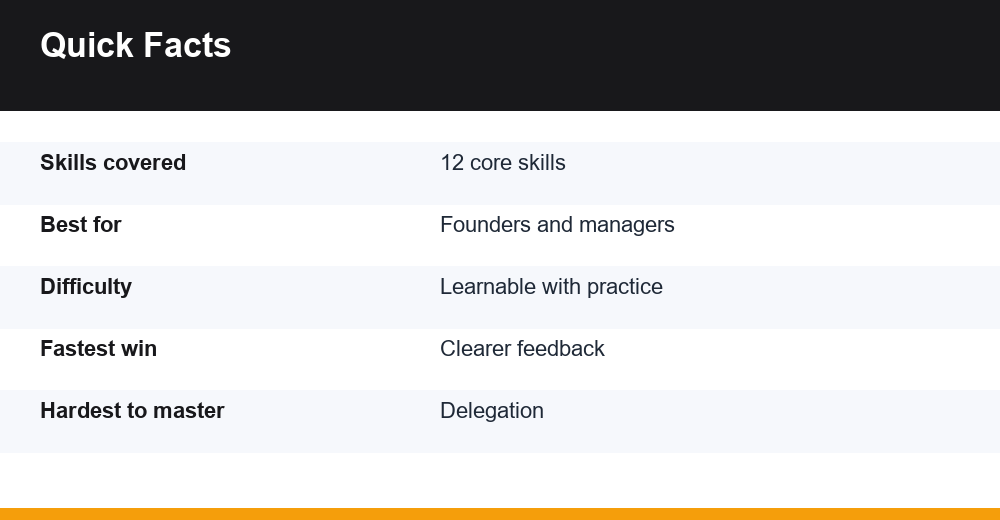
Feedback that is vague or personal rarely changes anything. What works is specific, timely, and focused on behavior rather than character. Deliver criticism in private and close to the event, and praise in public. A simple structure keeps it fair and easy to hear:
- Situation — where and when it happened
- Behavior — exactly what you observed, no labels
- Impact — the effect it had on the work or the team
5. Coaching and developing others
Your job isn’t to solve every problem in front of you; it’s to build people who can solve them without you. Resist the urge to jump in with the answer, ask a question that helps someone find it themselves, and hand out tasks that stretch them slightly beyond what’s comfortable. A team that only functions when you’re in the room is not a sign of your value; it’s a bottleneck you created.
6. Delegation
Delegation breaks down when you hand over the task but keep all the judgment, then hover. Done right, you assign a clear outcome and deadline, spell out how much authority the person has, and then genuinely step back, resisting the urge to redo their work in your own style. Weak delegation is the single most common reason capable founders and managers stall as their responsibilities grow.
Six Skills That Move Work Forward
The other half of leadership is turning intent into results. These six decide whether good ideas actually ship or just sound nice in a meeting. They lean less on charisma and more on follow-through: the unglamorous habit of closing the gap between what you said you would do and what actually got done.
7. Decision-making
Leaders are paid to decide with incomplete information; that is the job. Perfectionists freeze waiting for a certainty that never arrives, so the skill is recognizing when you have enough to move. It also means owning the call afterward instead of quietly distancing yourself if it goes wrong. A simple loop keeps you decisive without being reckless:
- Frame the real decision and what a good outcome would look like
- Gather enough information to be roughly right, not all of it
- Decide, and note what would make you change course
- Review the outcome later to sharpen your judgment
8. Vision and strategic thinking
People need a reason to push through the hard weeks, and that reason is rarely the task itself. Vision is your ability to describe a future worth the effort and to connect someone’s daily to-do list to it. You don’t need to be a grand orator; you need to zoom out regularly, ask what actually matters six months from now rather than what’s loud today, and repeat it often enough that the team can say it back to you.
9. Accountability
Accountability runs both ways: owning your own misses plainly, without excuses or blame-shifting, and holding others to what they committed to, warmly but without flinching. Teams read the leader closely. If you let your own deadlines quietly slip, you have just told everyone theirs are optional too. The standard you accept becomes the standard your team follows.
10. Adaptability
Plans meet reality, and reality usually wins. Adaptable leaders change course without treating it as a personal failure, and they stay steady when priorities shift under them. You build this by running small, reversible experiments instead of betting everything on one plan, and by getting comfortable saying out loud that the situation changed, so here is the new call. Rigid plans feel safe right up until they break.
11. Prioritization
Not everything can be urgent, even when it all feels that way. The real skill is protecting time for what is important before the urgent crowds it out, and saying a clear no to good work that isn’t the right work right now. Each week, choose the one to three outcomes that would make the biggest difference, and defend the time to actually do them.
12. Conflict resolution
Avoided conflict doesn’t vanish; it goes underground and festers. Effective leaders raise tension early, keep the focus on the problem rather than the person, and look for the shared interest sitting under the disagreement. Handled with a little care, conflict clears the air and often produces a better answer than either side walked in with. Handled by avoidance, it slowly erodes trust across a team.
The 12 Skills at a Glance
Use this table as a working checklist for the leadership skills you want to sharpen first. Pick one row, commit to the small practice next to it for a week, and you will learn more than a stack of business books would teach you. One deliberate repetition beats a vague goal to get better at leading.
| Skill | Why it matters | Practice this week |
|---|---|---|
| Communication | Aligns the team on the goal | State each goal in one sentence |
| Emotional intelligence | Stops small issues escalating | Name your reaction before replying |
| Active listening | Catches problems early | Paraphrase before you respond |
| Giving feedback | Changes behavior, builds trust | Use Situation-Behavior-Impact once |
| Coaching | Grows people, removes bottlenecks | Ask a question before answering |
| Delegation | Frees you to lead, not do | Hand over one full outcome |
| Decision-making | Keeps momentum going | Decide one thing you’ve delayed |
| Vision | Gives effort meaning | Link a task to the bigger why |
| Accountability | Sets the team’s standard | Own one miss out loud |
| Adaptability | Survives change intact | Run one small experiment |
| Prioritization | Protects what matters | Pick your top three outcomes |
| Conflict resolution | Clears tension fast | Raise one issue you’ve avoided |
What Changed for Leaders in 2026
The fundamentals above are steady, but the context around them keeps shifting. The biggest change is AI literacy: leaders don’t need to code, but they do need to judge when an AI-generated recommendation is genuinely useful and when it’s confidently wrong. Delegating to tools well is now part of the job, not a novelty.
A few shifts worth planning around:
- AI literacy — knowing when automated output helps and when to overrule it
- Distributed teams — leading people you rarely see in person
- Faster change — shorter planning cycles and more frequent resets
- Higher transparency — people expect honest reasons, not just directives
Distributed and hybrid teams are the other big shift. When people aren’t in one room, clear writing, deliberate check-ins, and visible trust matter far more than physical presence. As the Harvard Business Review notes in its work on the skills that define good leaders, the core capabilities stay the same; you just have to apply them with more intention.
None of this replaces the human core. Faster tools raise the value of judgment, trust, and plain communication, the things software still can’t do for you. Focus only on the new tools and neglect those, and no amount of automation will hold together a team that doesn’t want to follow you.
How to Improve, One Skill at a Time
You build leadership skills the same way you build any craft: pick a focus, get repetitions, and shorten the loop between action and feedback. Trying to improve all twelve at once tends to mean you improve none. Depth on one skill for the next 90 days beats a scattered checklist every time.
- Get an honest baseline. Ask two or three people you trust where you help the team most and where you cost it.
- Choose one skill to work on this quarter, and be specific about what better looks like.
- Practice in real situations. A hard conversation this week teaches more than any online course.
- Find a mentor or peer a step ahead of you, and compare notes often.
- Review monthly. Keep what worked, drop what didn’t, and pick your next focus.
Progress won’t be linear, and that is normal; you’ll have weeks where an old habit resurfaces under stress. The leaders who keep growing aren’t the ones who never slip; they’re the ones who keep asking how their choices actually landed on other people, and then adjust. Do that consistently and the twelve build on each other for the rest of your career.
Honest Mistakes Even Good Leaders Make
Even strong leaders slip into predictable traps, usually under pressure and usually without noticing. Naming them makes them much easier to catch in yourself.
- Doing instead of leading — staying hands-on because it feels productive
- Avoiding hard conversations until they turn into crises
- Confusing being liked with being respected
- Hoarding decisions the team is more than ready to own
- Chasing every urgent thing while the important work drifts
- Assuming silence in a meeting means everyone agrees
The fix for all six is the same: slow down enough to notice which mode you’re in, then choose the harder, more useful move. Strong leadership skills are mostly a series of small, honest corrections repeated until they become instinct.
Frequently Asked Questions
What are the most important leadership skills?
There’s no universal ranking, but communication, emotional intelligence, and decision-making sit under almost everything else. If people can’t understand you, don’t trust you, or can’t get a clear call from you, your other strengths rarely get the chance to matter. Start there, then build outward.
Are great leaders born or made?
Mostly made. Some people start with natural advantages like confidence or empathy, but every ability that shifts real outcomes improves with feedback and repetition. Treat leadership as a craft you practice rather than a personality you either have or don’t, and you’ll keep getting better for years.
How long does it take to become a good leader?
Basic competence in one area can come within a few months of focused practice, while real range takes years. The pace depends less on time served and more on feedback loops: the faster you learn how your choices affect people, the faster you grow.
Which skill should I improve first?
Pick the one your team feels most. If deadlines keep slipping, work on decision-making or delegation. If morale is low, focus on listening and feedback. Ask two colleagues where you cost the team the most, and start exactly there.