Figuring out how to get customers is the central challenge for almost every new business, and it rarely comes down to one clever trick. In practice, a few reliable channels, worked consistently, will beat any viral shortcut. This guide covers 12 proven ways to win your first and next customers in 2026, with realistic notes on the effort, cost and time each one demands.
Table of Contents
How to Get Customers: The Groundwork
Before you chase any single tactic, get clear on who you are actually trying to reach. Most owners who struggle with how to get customers are not lazy or unlucky; they are marketing to everyone, which usually means reaching no one. Pick one narrow, specific type of buyer you can describe in a single sentence, then build everything around that person.
Write down where they already spend their time, the exact problem they are trying to solve, and the words they use to describe it. Those three answers tell you which channels to prioritize and what to say once you get there. Skip this step and every tactic below becomes guesswork, because you will be speaking to no one in particular.
First customers versus your next hundred
Winning your very first customers is a different job from scaling to your hundredth. Early on you need speed and proof, so warm, direct outreach wins. Later you need repeatable systems, so search, content and paid channels start to earn their keep. Match the tactic to your stage instead of copying a big brand’s playbook that assumes an audience and budget you do not have yet.
It also pays to think past the sale itself. Getting attention is only the first step; you still need a clear path that turns a curious visitor into a paying customer. If that part feels vague, our sales funnel guide explains how to move people from first contact to a confident yes.
- One specific customer type you can name in a sentence
- The exact problem you solve, described in their words
- Where they already spend time, online and offline
- A simple offer with one obvious next step
Warm Ways to Win Your First Customers
The cheapest customers are the ones who already trust you, or who trust someone who does. These warm channels cost little more than your time and attention, and they almost always convert better than anything cold. Start here, whatever your budget, because early proof makes every later tactic easier to justify.
1. Ask for referrals on purpose
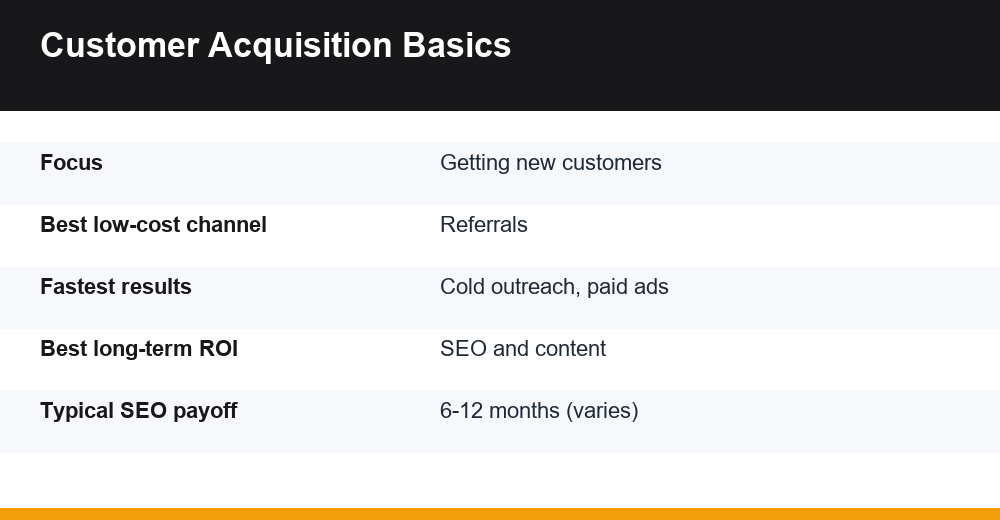
Referrals are consistently among the lowest-cost, highest-converting ways to grow, yet most owners simply hope for them. Make it deliberate. Right after you deliver a good result, ask your satisfied customer whether they know one other person facing the same problem. A specific, one-person ask lands far better than a vague ‘send people my way’, and the timing matters as much as the words.
2. Mine your existing network
Your first prospects are often already in your phone. Former colleagues, suppliers, past clients and people from industry groups are all worth a personal, low-key message. You are not delivering a hard pitch; you are letting people know what you now do and asking who they might introduce you to. Ten thoughtful messages this week will teach you more than a month of planning in the abstract.
3. Collect reviews and social proof
Reviews reassure buyers when you are not there to make the case yourself. Ask every satisfied customer for a short review on the platform your buyers actually check, then feature the best lines on your site and profiles. Strong social proof lowers the risk a stranger feels before buying, which quietly lifts the performance of every other channel you run.
- Ask for a referral within a day of delivering results
- Message ten warm contacts personally this week
- Request a review from every happy customer, every time
Get Found: Content, SEO and Social Media
Warm outreach eventually runs dry. To keep a steady stream of new prospects, you need channels that let strangers discover you, ideally at the exact moment they are already looking for a solution like yours. The three below work together, since good content feeds your search rankings and your social feed alike.
4. Publish genuinely helpful content
Content marketing means answering the questions your buyers ask before they ever contact you. A handful of truly useful articles, guides or videos can build trust at scale and feed every other channel. It is slow to start and demands real effort, but it compounds; one strong piece can bring in leads quietly for years after you publish it.
5. Rank in search with SEO
Search engine optimization puts your content in front of people typing your solution into a search engine. Target the specific phrases your customers actually use, answer their question completely, and earn links and mentions over time. SEO rarely rewards you in weeks, but for many businesses it becomes the most cost-effective channel they own, delivering visitors long after the work is done.
6. Show up on social media
You do not need to be everywhere; choose the one or two platforms where your buyers already spend time. Share useful ideas, show your process, and talk with people instead of broadcasting at them. Tying that activity to a strong personal profile helps enormously, and our personal branding guide covers how to build an audience that trusts you before they buy.
Reach New Audiences: Communities, Partners and Outreach
Some of your best customers are already grouped together in places you can reach directly. These channels take more effort than a single social post, but they let you borrow existing trust and skip the slow climb of building an audience from scratch.
7. Be genuinely useful in communities
Niche forums, subreddits, Slack groups and Discord servers are full of people describing the exact problems you solve. Join a few, answer questions honestly for weeks before you ever mention your business, and let your expertise do the talking. Communities punish spam quickly and reward genuine help just as fast, so treat them as relationships, not billboards.
8. Build strategic partnerships
Find businesses that serve your customers without competing with you, such as a bookkeeper and an accountant, or a photographer and a venue. Cross-refer clients, co-host a webinar, or bundle your offers together. One good partnership can send steady referrals for years, which makes this one of the highest-leverage moves on the entire list once you find the right fit.
9. Try honest cold outreach
Cold email and direct messages still work when they are targeted and human. Research a short list of ideal prospects, open with something specific about their situation, and make one clear, low-pressure offer. Skip the mass blasts entirely; a hundred thoughtful, personalized messages will beat ten thousand generic ones, and they will not damage your reputation in the process.
Local Visibility, Email and Paid Ads
Rounding out the twelve are three channels that suit different budgets and business types. Use whichever ones match where your customers genuinely look for a business like yours, rather than trying to force all three at once.
10. Own your local presence
If you serve a town or region, a complete Google Business Profile is one of the highest-return free tools available to you. Fill in every field, add real photos, and keep reviews fresh so you surface when nearby people search. Local directories, sponsorships and community events reinforce the same signal and help you stand out in a defined area.
11. Grow an email list
Email is one of the few audiences you truly own, free from any platform’s shifting algorithm. Offer a genuinely useful resource, such as a checklist, template or short guide, in exchange for an address, then stay in touch with helpful notes rather than constant selling. A warm list turns one-time visitors into repeat buyers and easy referrals.
12. Use paid ads to move faster
Paid advertising is the fastest way to test demand, and also the easiest way to waste money. Start with a small budget, one clearly defined audience and one measurable goal. If the numbers work at a small scale, spend more; if they do not, stop and redirect the money into the channels that are already proving themselves.
Channel Comparison: Effort, Cost and Time
Every channel trades money for time in a different way. Use the table below to match tactics to your budget and how quickly you need results. Treat these as general guidance only; your actual outcomes will vary by industry, market and how well you execute.
| Channel | Cost | Effort | Time to results |
|---|---|---|---|
| Referrals | Very low | Low | Days to weeks |
| Existing network | Very low | Low | Days |
| Reviews and proof | Very low | Low | Ongoing |
| Content marketing | Low | High | 3-6 months |
| SEO | Low | High | 6-12 months |
| Social media | Low | Medium | Weeks to months |
| Online communities | Very low | Medium | Weeks |
| Partnerships | Low | Medium | Weeks to months |
| Cold outreach | Low | High | Days to weeks |
| Local / GBP | Free | Low | Weeks |
| Email marketing | Low | Medium | Weeks to months |
| Paid ads | High | Medium | Days |
Notice the pattern running through it. The cheapest channels usually demand patience or personal effort, while the fastest ones cost real money. There is no free-and-instant option, whatever the ads in your feed promise, so plan your mix around what you have most of right now: time or cash.
Where to Start: Building Your Plan
Learning how to get customers is not about running all twelve tactics at once; trying to is the quickest route to burning out and quitting. Pick two or three channels that fit your stage, your budget and your natural strengths, then commit to them for at least ninety days before you judge whether they work.
A simple rule keeps you balanced: choose one warm channel for quick wins, one owned channel you fully control, and, if you have the budget, one paid channel to test demand faster. That combination gives you momentum now and a foundation that keeps paying off later. This balance is really what learning how to get customers comes down to.
- Weeks 1-2: ask for referrals and message your warm contacts
- Weeks 3-4: set up your Google Business Profile and gather reviews
- Month 2: publish your first helpful content and join one community
- Month 3: test a small paid campaign or start careful cold outreach
Track where every new customer came from, even in a basic spreadsheet, so you learn which channels genuinely pay off and which just feel busy. Free, neutral resources such as the U.S. Small Business Administration can help you build a broader marketing and financial plan around these tactics. Rules and support vary by location, so if you are outside the US, check the equivalent official agency in your own country.
Above all, consistency beats cleverness. The owners who win are rarely the ones with the flashiest campaign; they are the ones who showed up in two or three channels every single week until the results finally began to compound.
Frequently Asked Questions
What is the fastest way to get customers?
When founders ask how to get customers quickly, the honest answer is warm referrals, targeted cold outreach and small paid ads, because they reach ready buyers directly. Referrals cost the least, while paid ads cost the most but scale fastest. Slower channels like SEO pay off later, so it helps to run both types at once.
How can you get customers with no money?
Focus on time-rich, cash-poor channels: ask for referrals, message your existing network, gather reviews, be genuinely helpful in online communities and set up a free Google Business Profile. These cost nothing but effort and consistency, and they are often the highest-converting channels available to a brand-new business.
How long does it take to get new customers?
It depends entirely on the channel. Referrals and cold outreach can produce results in days, while content and SEO often take three to twelve months to gain real traction. That gap is exactly why most marketers suggest pairing one fast channel with one slow-but-compounding channel from the very start.
How many marketing channels should a small business use?
Two or three at a time is plenty for most small businesses. Spreading yourself thin across every platform usually means doing all of them badly. Choose the channels that match your customers and your strengths, commit to them for about ninety days, then focus on whatever clearly works.