An elevator pitch is a short, spoken summary — usually 30 to 60 seconds — that explains who you are, what you do, and why it matters, in about the time it takes to ride an elevator. Done well, it earns you a real conversation with investors, recruiters, and customers; done poorly, it loses them. This guide covers the structure, the ideal length, delivery, and the mistakes to avoid — and hands you a fill-in template you can adapt in minutes.
Table of Contents
What Is an Elevator Pitch, Really?
The name comes from a simple scene: you step into an elevator beside someone who could change your career, and you have only a few floors to make an impression. The idea has circulated in business communication for decades — you can read more about the format’s origins — but the goal has never changed: earn the next conversation, not close a deal in 30 seconds.
It is not a sales monologue or your résumé read aloud. It is a clear, memorable answer to the question every listener silently asks: why should I care? You can use the same core at a conference, in a job interview, or in a cold message — the underlying task does not change.
It works on the page, too. The same structure sharpens a LinkedIn headline, the first line of a cold email, or your reply to ‘so, what do you do?’ at a dinner. Written or spoken, the discipline is the same: say less, but make every word count. Learn it once and you will reach for it constantly.
The most common misconception is that the pitch is about you. It is not. The strongest versions spend most of their words on the listener’s world — their problem, their goal — and only a few on your name and title. Lead with them, not with your CV.
That shift in focus is what separates a memorable introduction from background noise. When people hear their own problem described clearly, they lean in; when they hear a list of your achievements, they wait politely for you to finish. Keep the spotlight on their world, and the rest of the pitch becomes far easier to write.
The Four-Part Structure: Problem, Solution, Value, Ask
Most memorable pitches follow the same four beats. Think of them as a short story that moves from tension to resolution to a clear next step — and keeps the listener at the center throughout.
- Problem. Name the specific pain your listener or their customers feel. Concrete beats abstract: ‘small clinics lose hours each week to missed appointments’ lands harder than ‘inefficiency in healthcare.’
- Solution. Explain what you do in plain language — one sentence, no jargon. If a sharp 12-year-old could not follow it, simplify until they could.
- Value. Say why it matters. Quantify the benefit where you honestly can — time saved, money earned, risk reduced — but never invent a number to sound impressive.
- Ask. Close with one low-friction next step: a meeting, a demo, an introduction, or a card. Without an ask, the conversation simply stops.
Here is the whole arc in one breath: ‘Freelance designers lose clients to slow, messy feedback. We give them a single link where clients comment right on the work, so approvals happen in hours, not weeks. I would love to send you a quick example.’ Problem, solution, value, ask — nothing wasted.
Notice the order. You lead with the listener’s world, not your biography. Opening with ‘I am the founder of a venture-backed startup…’ spends your most valuable seconds on the least interesting part of the story.
The value beat is where honesty matters most. A specific, true result — ‘we cut no-shows by about a third at one clinic’ — persuades more than any superlative, and it holds up when someone asks a follow-up question. If you do not have a number yet, describe the outcome plainly rather than reaching for words like ‘game-changing.’ Real detail beats inflated language every time.
How Long Should Your Pitch Be?
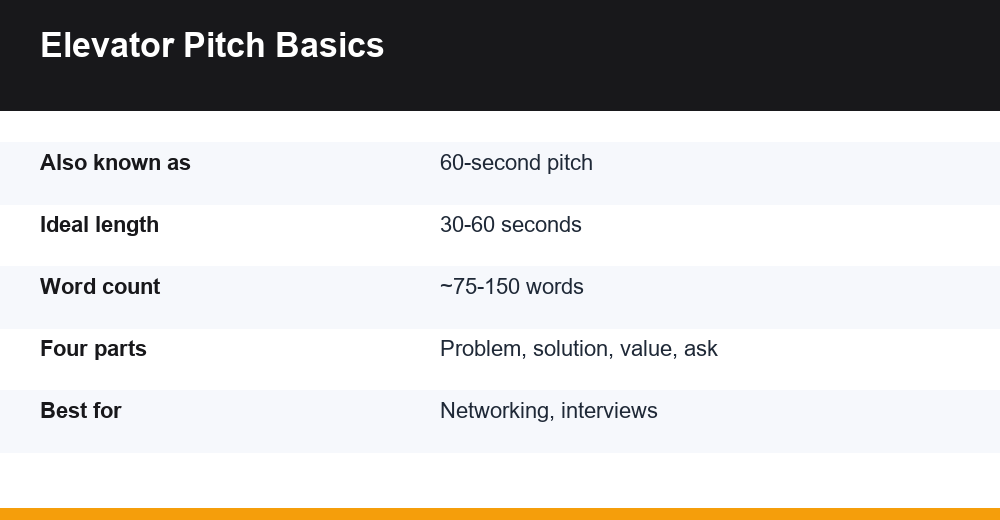
There is no single correct length — it depends on the room. A hallway hello should be shorter than a scheduled investor meeting. A safe default is 30 to 60 seconds, with a tighter version ready for when time and attention are scarce.
At a natural speaking pace — for most people, very roughly 130 words a minute — the common formats map out something like this:
| Version | Time | Approx. words | Best for |
|---|---|---|---|
| One-liner | ~10 sec | 20-25 words | Quick intros, hallways |
| Short | ~30 sec | 60-75 words | Networking, elevators |
| Standard | ~60 sec | 120-150 words | Interviews, events |
| Extended | ~2 min | 250-280 words | Investor & sales meetings |
Build the standard version first, then trim it down or pad it up from there. Having a 10-second, 30-second, and 60-second elevator pitch ready means you are never caught off guard. The extended version matters most when you are raising money — our startup funding guide shows how a pitch fits into the wider fundraising process.
Whatever length you choose, do not pad it. A crisp 25-second version beats a bloated 90-second one every time. Extra seconds are only worth using when each one earns its place with something the listener actually needs to hear.
A Fill-in-the-Blank Template
Here is a reusable frame. Fill in each blank, then read the result aloud and cut anything that sounds stiff or salesy.
I help [target audience] [achieve a specific outcome] by [what you do]. Unlike [the usual alternative], we [key difference]. For example, [a real result or proof point]. I would love to [specific, easy ask].
Filled in for a founder, it might sound like this:
‘I help independent dental clinics cut missed appointments by sending smart, automated reminders. Unlike generic scheduling apps, we flag the patients most likely to skip and nudge them first. At one clinic, that freed up several booked hours a week. Could I show you a quick two-minute demo?’
That hits all four beats of an elevator pitch in under a minute and ends with a clear, easy ask. Swap in your own details and you have a working draft you can refine.
The same frame works well beyond founders. Here it is for a job seeker:
‘I help early-stage teams turn messy data into decisions they can act on. Unlike analysts who hand over a report and disappear, I build dashboards the team actually uses. In my last role, that cut weekly reporting time roughly in half. I am looking for a data role where I can do more of that — could we talk?’
It flexes across other roles as well:
- Job seekers: replace the customer outcome with the value you would bring an employer.
- Freelancers: lead with the type of client you serve best and the result you deliver.
- Nonprofits: make the ask a donation, a volunteer sign-up, or a partnership.
Tailoring Your Pitch to the Audience
One script rarely fits every room. The four beats stay the same, but the emphasis shifts depending on who is listening and what they want from the exchange.
- Investors care about market size, traction, and returns. Lead with the scale of the problem and your strongest proof.
- Recruiters and hiring managers want the value you would add to their team — not your full life story.
- Potential customers care about their problem and your solution; skip the funding history and the org chart.
- Peers and partners respond to shared goals and to how working together helps both sides.
Read the setting, too. A crowded happy hour rewards a punchy one-liner; a seated coffee meeting gives you room for the standard version and a thoughtful follow-up question.
Your pitch is also part of how people remember you, so keep it consistent with the rest of your reputation. If you are building a public profile, line it up with the messaging in your personal branding guide so your introduction, bio, and online presence all tell one coherent story.
Tailoring does not mean writing four unrelated scripts. Keep one honest core — the same problem, solution, and value — and adjust only the emphasis and the ask for each audience. That way you stay consistent no matter who you meet, and you are never scrambling to remember which version you told to whom.
Delivery: Making It Sound Natural
A strong script falls flat if it sounds rushed or robotic. How you deliver the pitch matters as much as the words, and it is the part most people skip entirely.
- Slow down. Nerves speed you up. Deliberate pauses signal confidence and give the listener time to absorb what you said.
- Practice out loud, not just in your head. Record yourself and listen for filler words, run-on sentences, and tangents.
- Match your energy to the setting — warmer and looser at a party, crisper and tighter in an interview.
- Watch for cues. If they lean in, add a detail; if their eyes drift, wrap up and make your ask.
Memorize the beats, not the exact words. You want to sound like you are talking, not reciting a script. A useful test: say it aloud several times until it feels like something you would actually tell a friend.
Body language carries real weight, too. Make steady eye contact, keep an open posture, and end with a genuine smile — small signals that help the whole thing land. If you tend to fidget, plant your feet and let your hands rest; stillness reads as calm, and calm reads as credible.
Nerves are normal, and a little adrenaline can even sharpen you. The fix is not to remove the jitters but to rehearse until the structure is automatic. When you no longer have to remember what comes next, you free up attention for the person in front of you — and that presence is what makes a pitch feel like a conversation rather than a performance.
How to Test and Refine Your Pitch
Your first draft is rarely your best. Treat the pitch like a product: put it in front of people, gather feedback, and improve it over time rather than chasing perfection on paper.
- Time it. If you run past 60 seconds, cut adjectives and side details before anything else.
- Test it on an outsider. If someone outside your field can repeat back what you do, it is clear enough.
- Track reactions. The questions people ask afterward reveal what landed and what confused them.
- Refresh it. Update your proof point and your ask as your work and goals change.
A pitch is a living tool, not a finished monument. Revisit it every few months, and always tune it before a big conference, interview, or fundraising round.
Pay special attention to the questions you hear again and again. If three different people ask what your product actually does, your solution beat is not clear yet. If they ask about price or results, that is a good sign — they are interested, so fold a crisp answer into the pitch itself and the next listener never has to ask. After a few rounds of this, your pitch stops sounding like a draft and starts sounding like you.
Common Mistakes to Avoid
Most weak pitches fail for predictable reasons. Watch for these:
- Leading with yourself. Your title and company history are the least compelling opener. Start with the listener’s problem instead.
- Drowning it in jargon. If your pitch needs a glossary, it is too complex for 30 seconds.
- Skipping the ask. Ending with ‘so, yeah, that is what I do’ wastes the opening you just built.
- Trying to say everything. A rambling elevator pitch that covers your entire career buries the one point that actually mattered.
- Sounding scripted. Word-for-word memorization reads as fake; internalize the beats instead.
- Inventing proof. Empty superlatives (‘the best,’ ‘revolutionary’) and made-up numbers erode trust quickly.
Fix these and you are already ahead of most people in the room. None of them require talent — only attention and a little practice. The aim is a short, honest, memorable answer that leaves the listener wanting the next conversation, not a polished performance.
Frequently Asked Questions
How long should an elevator pitch be?
Aim for 30 to 60 seconds, or roughly 60 to 150 words at a natural pace. It also helps to prepare a 10-second one-liner, so you can adapt to how much time and attention you actually have in the moment.
Should I memorize my pitch word for word?
No. Memorize the four beats — problem, solution, value, and ask — rather than exact wording. Rigid scripts sound stiff and tend to fall apart when you are nervous. Knowing the structure lets you stay natural and adjust to each listener.
How do I open my pitch?
Start with the listener’s problem, not your job title. A specific pain point — ‘teams waste hours chasing approvals’ — earns attention immediately. Save your name and company for after you have shown them why they should care.
Can I use the same pitch for every audience?
Keep the four-part structure constant, but shift the emphasis. Investors want market size and traction; recruiters want the value you would add; customers want their problem solved. Tailor the specifics to each audience while keeping your core message consistent.