Personal branding is the reputation you build on purpose: what people expect from you before you speak in a meeting, a pitch, or a comment thread. For founders and professionals, that reputation can open doors a company name cannot yet open. It earns trust sooner, helps attract talent and investors, and makes it easier for a stranger to become a customer. This guide explains how to build one deliberately, without hype or promises of overnight results.
Table of Contents
What Personal Branding Actually Means
Your personal brand is not your logo, your headshot, or a clever tagline. It is the sum of impressions people form from your work, your words, and the way you show up over time. You already have one, whether you intend to or not. The real question is whether you shape it deliberately or leave it to chance and to other people’s assumptions.
The idea is not new. It entered mainstream business writing in the late 1990s, when writers argued that professionals should manage their careers the way companies manage products. What has changed since is reach. A single well-aimed post can now put your thinking in front of thousands of the exact people you hope to work with, at very low cost.
For a founder this matters more than most. Early-stage companies have little brand equity of their own, so people judge the person behind the business. Investors back operators they trust. Customers buy from someone who appears to understand their problem. A credible professional reputation helps offset a company’s short track record.
None of this requires becoming an influencer or living online. Most respected operators post modestly and let the quality of their thinking do the work. The goal of personal branding is not fame; it is to be known and trusted by the specific people who can hire you, fund you, or buy from you.
Define Your Niche and Core Message
The most common mistake is trying to be known for everything. Breadth feels safe, but it makes you forgettable. Authority comes from narrowing your focus: choosing a specific problem, for a specific group, and becoming a reliable voice on it. You can broaden later, once people already associate your name with something concrete.
One useful approach is to find the overlap between two or three things you genuinely know – operations and healthcare, say, or design and B2B software. That intersection is less crowded than any single topic, and it is where your point of view becomes harder to copy. Choose a subject you can discuss for years without losing interest.
Test your niche with a simple question: could you write fifty posts about it without repeating yourself or running out of things you actually believe? If not, it is either too narrow or not truly yours. If yes, you have found something you can sustain.
Turn your niche into one clear sentence
Once you know your focus, compress it into a sentence you can say out loud without wincing. Who do you help, what changes for them, and why you? For structure, borrow the discipline of a well-built elevator pitch – the same clarity that works in a room works on a profile bio or a homepage.
Then define three to five content pillars: the recurring themes you return to. Pillars keep you focused and make you predictable in a useful way, because people learn what they can expect from you.
- Hard-won lessons from building or running your business
- Practical how-tos that solve a narrow problem for your audience
- Your honest take on how your industry actually works
- Behind-the-scenes decisions, trade-offs, and mistakes
- Clear breakdowns of the trends your buyers are trying to understand
Do not treat these pillars as fixed forever. Review them after a few months and drop any you have run out of things to say about. A living set of themes keeps your message focused while leaving room to follow what your audience responds to most. The point is to stay recognizable, not to trap yourself in topics you no longer care about.
Choose the Right Platforms
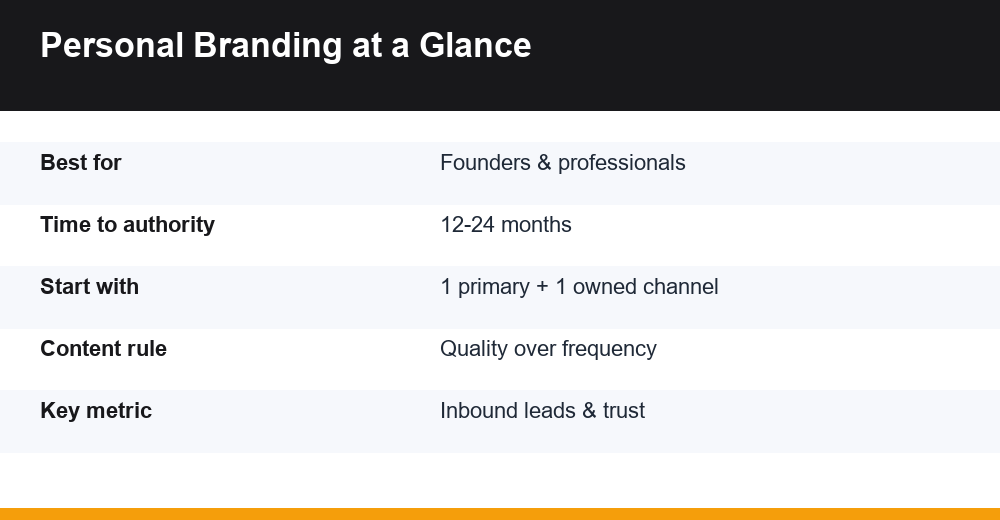
Do not start by asking which platform is best. Ask where the people you want to reach already spend their attention, and which format you can sustain without dreading it. The usual answer is one primary channel where your audience gathers, plus one asset you own – an email newsletter or a blog – that no algorithm can take away.
Every channel rewards a different behavior, so match the platform to how you like to create. If you think in sentences, writing platforms fit. If you are comfortable on camera, video builds trust faster. Forcing yourself onto a format you dislike is the quickest way to quit within a month or two.
| Channel | Best for | Format | Effort |
|---|---|---|---|
| B2B founders, execs, hiring | Short posts, articles | Medium | |
| X / Twitter | Tech, media, real-time takes | Posts, threads | Medium |
| YouTube | Deep trust and teaching | Long-form video | High |
| Instagram / TikTok | Consumer, visual brands | Short video, images | High |
| Newsletter | An owned audience, depth | Email essays | Medium |
| Podcast | Relationships, long-form | Audio interviews | High |
Notice the effort column. Video can build trust quickly but costs the most time, so be honest about what you can maintain for a year. It is better to run two channels with regular activity than to claim six and abandon most of them. Regular activity matters more than wide coverage.
Whatever you choose, plan to reuse your best material. A single strong idea can become a short post, a longer article, a talk, and a section in your newsletter without feeling repetitive. Repurposing keeps you visible on more than one channel without doubling the work, and it gives a good idea several chances to reach the right person at the right time.
Create Content That Builds Trust
Good content does two things at once: it shows you know your field, and it makes you feel like a real, relatable person. Lean too far into authority and you sound like a textbook; lean too far into personality and you become noise. The balance is what earns both respect and warmth.
- Authority: frameworks, case studies, and clear breakdowns of how you solved a real problem
- Stories: a decision you got wrong, what it cost, and what you changed
- Opinion: a well-reasoned stance on where your industry is heading
- Teaching: step-by-step answers to the questions your buyers actually ask
- Proof: results, before-and-after comparisons, and lessons from client work
Favor depth over volume. One well-researched piece that answers a genuine question will outlast a month of thin, promotional updates. A sustainable rhythm for most people is two to four posts a week on your main channel, plus one deeper piece – an article, video, or newsletter – every week or two.
A helpful planning rule is to keep most of what you publish genuinely useful and only a small share openly promotional. When nearly everything you post teaches, explains, or entertains, the occasional ask lands better, because you have earned attention rather than demanded it.
Pay attention to how each piece opens. Most readers decide within a line or two whether to keep going, so lead with the specific problem or result rather than a slow introduction. A clear first line does more for your reach than any posting schedule, because it earns the attention the rest of your point needs to land.
Write the way you talk. Skip jargon, lead with the point instead of a long windup, and give something useful away for free. Generosity is what helps a personal brand spread: people share what helps them, not what flatters you.
Consistency, Networking and Credibility
Consistency is what turns effort into reputation. Authority is built through repetition – the same clear ideas, published steadily over months, until your name and your topic become linked in people’s minds. Showing up unevenly resets that progress. A simple content calendar, prepared in advance, protects you during busy weeks, when publishing is the first thing most people drop.
Broadcasting is only half the work. Reputations grow through relationships, not reach alone. Reply thoughtfully to others, support peers in public, and hold real conversations in comments and messages. Attention only matters once it becomes trust and, eventually, revenue – so pair your visibility with a deliberate plan for how to get customers rather than assuming followers will convert on their own.
Signals that make you credible
- Third-party proof: press mentions, guest posts, and podcast appearances
- Testimonials and specific results from people you have helped
- A consistent story across your bio, website, and every profile
- Published work – a talk, a guide, or a real body of useful posts
Credibility is cumulative. Each signal is small, but stacked together they make a stranger comfortable enough to reach out, refer you, or say yes when it matters.
None of this means being loud. A steady, modest presence usually beats an occasional burst of activity, because trust grows when people see you turn up again and again. Decide on a pace you can hold through a busy quarter, then protect it. The habit itself, more than any single post, is what adds up over time.
Measuring Whether It Works
Vanity metrics feel good and mean little. Follower counts and likes tell you almost nothing about business impact. Effective personal branding is measured by outcomes – the opportunities, conversations, and revenue your reputation creates – not by applause. Choose a few numbers tied to your goals and review them quarterly, not hourly.
It also helps to write down why you are doing this before you start. Are you raising a round, hiring, generating leads, or building a future option? The goal decides which metrics matter and stops you drifting toward whatever happens to attract the most likes.
- Inbound leads and messages from people who found you, not referrals
- Branded search: people searching your name or your company
- Speaking, podcast, or partnership invitations you receive
- The quality of inbound talent and how easily deals close
- Email subscribers and reply rates on what you publish
Set expectations honestly. Building recognized authority often takes twelve to twenty-four months of steady effort, and the early stretch feels quiet. Track the trend rather than any single week. If inbound interest and branded search climb slowly, it is working, even before the numbers look impressive.
Keep the review simple. A short note each quarter – what came in, from where, and what it was worth – tells you more than a dashboard you never open. Over a year, that record shows whether your personal branding is producing the conversations you set out to create, or whether your focus needs to shift.
Common Mistakes to Avoid
Most personal branding efforts stall for a few predictable reasons. Knowing them in advance can save you months of wasted effort.
- Mistaking visibility for authority – posting more without a clear stance
- Exaggerating or inventing credentials, which is a serious reputational risk
- Chasing every topic instead of owning one
- Telling a different story on each profile
- Waiting to feel ready; silence usually costs more than an imperfect start
- Copying someone else’s voice instead of sounding like yourself
Done well, a personal brand is one of the more durable assets you can build – it follows you across jobs, companies, and markets. Start narrow, publish something useful this week, and keep showing up. Progress is slow at first, then steadier as your reputation compounds.
Your First 90 Days
You do not need a grand strategy to begin – you need a small, repeatable routine. Here is a realistic starting sequence that avoids overwhelm and gives you something to learn from quickly.
- Weeks 1-2: Clarify your niche, write your one-line message, and update your bios so they tell one consistent story.
- Weeks 3-4: Pick one primary platform, list your three to five pillars, and draft ten post ideas from them.
- Weeks 5-8: Publish two to three times a week and reply to others daily. Do not judge results yet.
- Weeks 9-12: Ship one deeper piece, ask two clients for a testimonial, and review which topics earned real engagement.
At the end of ninety days you will not be famous, and that is fine. You will have a clear message, a publishing habit, and early data about what resonates – the foundation everything else builds on.
Frequently Asked Questions
How long does it take to build a personal brand?
Expect roughly twelve to twenty-four months of consistent effort before your reputation reliably drives inbound opportunities. The early weeks feel quiet. Momentum builds once your point of view is clear and people begin to associate your name with a specific problem you solve well.
Which platform should I start with?
Start where your buyers already spend time, not where you feel most comfortable. For many B2B founders that is LinkedIn, paired with a newsletter you own. Master one primary channel before adding a second, or you will spread thin effort across too many accounts.
Do I need to be active on every social network?
No. Two channels done well beat five done poorly. A single strong platform plus one owned asset, such as a blog or newsletter, is enough. Repurpose the same core ideas across them instead of creating separate content for each one.
How is personal branding different from self-promotion?
Self-promotion pushes your accomplishments; a genuine reputation is built by being useful first. Share lessons, answer real questions, and show your reasoning. Recognition follows the value you provide, which is why trust, not visibility alone, should be the goal.