These cold email tips are written for founders and small sales teams who send a few dozen thoughtful messages a week, not ten thousand automated ones. Most guides that rank for this topic come from companies selling outreach software, so they treat volume as the answer. This one covers what actually earns replies: a tight four-part structure, a sensible follow-up rhythm, inbox-placement basics and the legal rules you cannot skip.
Table of Contents
The 9 cold email tips at a glance
Before the detail, here is the short version. Each point gets its own section below, and together they form a repeatable process rather than a bag of tricks.
- Pick fewer, better prospects. A list of 40 well-researched contacts beats 4,000 scraped ones.
- Write a plain, specific subject line of a few words that matches the body.
- Open with an observation about them, not an introduction of you.
- State one concrete benefit in a single sentence.
- Make one small ask that is easy to say yes to.
- Keep the first email short enough to read on a phone without scrolling.
- Follow up two to four times, adding something new each time.
- Protect your domain with authentication, warm-up and low daily volume.
- Follow the law: honest headers, a real postal address and a working opt-out.
None of these cold email tips is clever on its own. The results come from doing all nine consistently, then measuring which ones move your reply rate.
How to write a cold email that gets a reply
A cold email that gets answered usually has four parts and nothing else: subject, opener, value and ask. Anything that does not serve one of those four jobs is a candidate for deletion. That includes long company histories, lists of features and paragraphs about how excited you are to connect.
The opener: prove this is not a mass email
The first line appears in the inbox preview, so it does as much work as the subject. Reference something specific and recent: a hiring post, a product launch, a podcast episode, a problem their customers mention in reviews. One sentence is enough. Avoid flattery that could apply to anyone, such as “I love what you are doing.”
The value: one outcome, stated plainly
Next, connect that observation to a result you can help with. Describe an outcome, not a product. “We cut month-end close from nine days to four for two accounting firms your size” is stronger than “our AI-powered platform streamlines workflows.” If you struggle to say it in one sentence, work through an elevator pitch framework first; a cold email is essentially a written pitch with even less time.
The ask: small, specific, easy
End with a single question. Asking a stranger for a 45-minute demo is a big request. Asking whether a problem is on their radar this quarter, or whether a two-page case study would be useful, is not. These interest-based asks lower the cost of replying, and a reply is what starts the conversation.
| Part | Job | Good example | Weak example |
|---|---|---|---|
| Subject | Earn the open | question about Q1 hiring | Revolutionize your business! |
| Opener | Show relevance | Saw you opened a Denver office in March | Hope this email finds you well |
| Value | Name an outcome | Cut onboarding time by half for 3 similar agencies | We are a leading provider of solutions |
| Ask | Start a dialogue | Worth a short call next week? | Let me know your availability for a 60-min demo |
Sign off with your name, role and company, plus your business postal address and an opt-out line. That last part is not only courtesy; for commercial email in the US it is a legal requirement, covered later in this guide.
Cold email tips for subject lines that get opened
What makes a good subject line for a cold email?
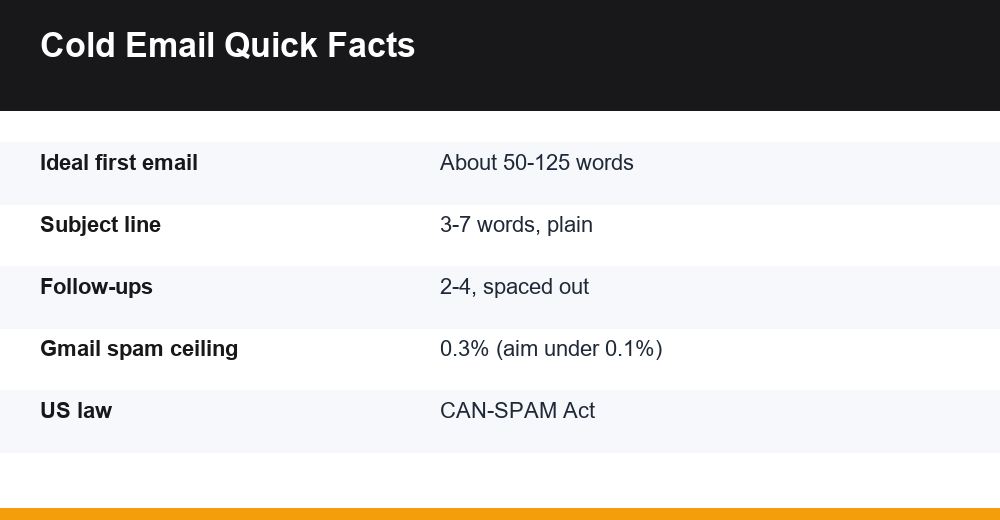
A good subject line reads like something a colleague would send. Short, lowercase or sentence case, no exclamation marks, no emoji, no “quick question” bait. Most practitioner guidance lands on three to seven words, which also keeps the line readable on mobile, where much email is first seen.
The most important rule is honesty. The subject must reflect what is inside. A misleading line might lift opens once, but it damages trust, invites spam complaints and, in the US, breaches the CAN-SPAM Act’s ban on deceptive subject lines.
Subject line patterns worth testing
- Their company plus a topic: “Acme onboarding”
- A mutual connection: “Priya suggested I reach out”
- A relevant question: “still hiring for the Austin role?”
- A specific trigger: “your new pricing page”
- A plain outcome: “shorter month-end close”
Only use the mutual-connection pattern when the referral is real and the person agreed to be named. Avoid words that read like advertising, such as “free,” “guaranteed” or “limited time.” They rarely sink a message on their own, but they set the wrong expectation and tend to attract the spam button from irritated recipients.
How long should a cold email be?
Short. Most outreach practitioners recommend roughly 50 to 125 words for a first email, with the lower end suited to busy executives. A practical test: the whole message should fit on a phone screen without scrolling.
Length is not a goal in itself, though. A 40-word email that says nothing specific will lose to a 110-word email that shows real research. Cut adjectives, filler phrases and your company background before you cut the sentence that proves relevance.
A simple editing pass
- Delete the first sentence if it is about you.
- Replace every general claim with a number, a name or an example.
- Remove any second call to action.
- Read it aloud; rewrite anything you would not say to someone in person.
- Check it on your phone before sending.
Follow-ups can be even shorter, often two or three sentences, because the context is already in the thread below them.
Research and targeting before you hit send
The highest-leverage of all cold email tips happens before any writing: choosing who receives the message. A strong email sent to the wrong person gets ignored, while an average email sent to someone with an urgent, matching problem often gets a reply.
Start with a clear ideal customer profile: industry, size, role, and the trigger events that make your offer timely. If you have not defined this yet, our guide on how to get your first customers walks through identifying the segment most likely to buy.
What to look for in ten minutes of research
- Recent news: funding, expansion, leadership changes, new products
- Job postings that reveal priorities or gaps
- The person’s own posts, talks or articles
- Customer reviews that mention a pain you solve
- Tools in their stack that you integrate with or replace
Write down one fact per prospect that you will use in the opener. If you cannot find one, consider whether that contact belongs on your list at all. Fewer, better-matched sends also help deliverability, because relevant emails draw fewer complaints.
Verify addresses before sending. Bounces signal a poorly maintained list to mailbox providers, and repeated hard bounces hurt your sender reputation faster than almost anything else.
How many follow-ups should you send?
Many replies do not come from the first message. Figures published by outreach vendors vary widely and are not independent, but they consistently show that a share of responses arrive only after a follow-up. For a small team, two to four follow-ups after the initial email is a sensible range; beyond that, irritation and spam complaints climb.
The rule that matters more than the number: every follow-up must add something. A useful link, a short case result, a different angle on the problem, or a simple question. “Just bumping this up” adds nothing and trains the recipient to ignore you.
| Step | Timing | Content idea | Length |
|---|---|---|---|
| Email 1 | Day 1 | Observation, outcome, one ask | 50-125 words |
| Follow-up 1 | Day 3-4 | Short reminder plus a relevant result | 2-3 sentences |
| Follow-up 2 | Day 8-10 | New angle or helpful resource | 2-4 sentences |
| Follow-up 3 | Day 15-18 | Ask if someone else owns this | 1-2 sentences |
| Final note | Day 25-30 | Polite close, door left open | 1-2 sentences |
Timings are a starting point, not a rule; adjust them to your sales cycle. Stop the sequence immediately when someone replies, unsubscribes or asks not to be contacted. If a prospect says “not now,” note the date and reach out later with a fresh reason.
The closing email
A respectful final message often gets a response because it removes pressure: “I will not keep following up. If improving onboarding becomes a priority later, I am happy to help.” It also gives people a polite way to say no, which is still useful information.
Deliverability safeguards for small senders
A perfect email does nothing if it lands in spam. Since February 2024, Google and Yahoo have enforced stricter requirements for bulk senders. Google defines a bulk sender as one sending close to 5,000 messages a day to personal Gmail accounts. A small team will usually sit far below that, but filters judge everyone on similar signals, so the same habits protect you.
The technical basics
- SPF and DKIM set up for the domain you send from
- A DMARC record for your sending domain (a policy of p=none is the minimum Google asks of bulk senders)
- A separate sending domain or subdomain, so outreach problems do not damage your main business email
- Gradual warm-up: start with a handful of sends per day and increase slowly
- Valid, verified addresses to keep bounces low
Behavioural signals that matter
Google asks senders to keep the spam rate reported in Postmaster Tools below 0.1% and never to reach 0.3%. With cold outreach, a few annoyed recipients can push you over that line quickly. Relevance, low volume and an easy opt-out are your best protection.
| Safeguard | Why it matters | Small-team target |
|---|---|---|
| Daily volume | Spikes look like spam | Tens per inbox, not hundreds |
| Bounce rate | Signals a bad list | Keep it very low; verify first |
| Spam complaints | Directly hurts reputation | Under 0.1% where measurable |
| Plain text | Fewer filter triggers | Minimal images, few links |
| Opt-out | Legal and reputational | Clear line in every email |
Limit links to one or none in a first email, and skip tracking pixels if you can live without open data, since image blocking and privacy features make open rates unreliable anyway. Replies are the metric that counts.
Is cold emailing legal?
In the United States, yes, provided you follow the CAN-SPAM Act. It does not require prior consent, and it covers business-to-business email as well as consumer email. The rules are set out in the FTC’s CAN-SPAM compliance guide for business, and the core requirements are:
- Do not use false or misleading header information (From, To, Reply-To, routing).
- Do not use deceptive subject lines.
- Identify the message as an advertisement where it is one.
- Include a valid physical postal address.
- Tell recipients how to opt out, and honor opt-outs within 10 business days.
- Keep the opt-out mechanism working for at least 30 days after sending.
- Monitor what anyone sending on your behalf does; you remain responsible.
Penalties are serious. Each separate email that violates the law can be fined, and the maximum, which the FTC adjusts for inflation each year, was set at $53,088 per email in January 2025.
Emailing prospects in the EU and UK
Europe is stricter. The GDPR (and the UK GDPR after Brexit) requires a lawful basis for processing a prospect’s personal data, and many B2B senders rely on legitimate interest, backed by a documented balancing test. On top of that, national rules based on the ePrivacy Directive, and PECR in the UK, decide whether unsolicited marketing email to business contacts needs prior consent. These differ by country, so check the rules in each target market and take local advice before you start.
Whatever the jurisdiction, a few habits keep you on safe ground: contact people in their professional role, explain where you found their details if asked, offer an easy opt-out, and delete data for people who decline.
Measuring results and improving over time
Track a small set of numbers per campaign: emails sent, bounces, replies, positive replies and meetings booked. Positive reply rate is the most honest measure, because it ignores “please remove me” responses that inflate raw reply counts.
Test one variable at a time, such as the subject line or the ask, across at least a few dozen sends before drawing conclusions. With small volumes, results will be noisy, so look for consistent patterns rather than single wins. Revisit these cold email tips every quarter and drop whatever your own numbers say is not working.
Finally, remember that cold outreach and permission-based newsletters are different channels. Once a prospect replies and agrees to hear more, move them into a proper opt-in list; our guide to email marketing for small businesses covers how to build that next stage. Used together, cold outreach and a well-run newsletter turn strangers into conversations and conversations into customers.
Frequently Asked Questions
How do you write a cold email that gets a reply?
Keep it to four parts: a plain subject line, an opener that mentions something specific about the recipient, one sentence describing an outcome you can deliver, and a single low-effort question. Cut anything about your company history. Send it to a well-researched prospect with a real, timely reason to care, and follow up with something new.
What is a good subject line for a cold email?
A good cold email subject line is short, plain and honest, usually three to seven words in sentence or lower case. Reference the prospect’s company, a real trigger event or a genuine mutual connection. Skip exclamation marks, emoji and hype words, and never mislead: in the US, deceptive subject lines breach the CAN-SPAM Act.
How many follow-ups should you send after a cold email?
For most small teams, two to four follow-ups spread over three or four weeks is a reasonable range. Each message should add value, such as a result, a resource or a new angle, rather than simply bumping the thread. Stop at once if the person replies, opts out or asks you not to contact them again.
Is cold emailing legal?
In the US it is legal if you follow the CAN-SPAM Act: honest headers and subject lines, a physical postal address, a clear opt-out and opt-outs honored within 10 business days. In the EU and UK, GDPR and national ePrivacy rules such as PECR apply, and some countries require prior consent, so check local rules first.